Archive for 2025

Grey is the colour, Racing is the game

Posted on:

Grey is the colour, Racing is the Game


**  1  **

The Grey Gene 


WITH the exception of a tiny minority, who trace to a grey son of the Brownlow Turk, every grey thoroughbred we see today derives his greyness, generation by generation without a single break, from the Alcock Arabian (gr.c. 1704), who was also known as Pelham’s Grey Arabian.
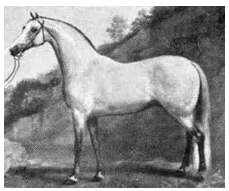
The colour of the Alcock Arabian was, as it is with all other grey thoroughbreds, not a true colour. The greyness is a deficiency that causes the coat to ‘silver’ with age, until a foal with a ‘gun metal’ colouring slowly turns white in appearance.

The greyness in fact, has only a masking effect which, when transmitted, dominates the basic colours of bay and chestnut. It is therefore inherited together with the basic colour genes, not instead of them.

No grey horse has ever been born without one of its parents being grey, the deficiency being transmitted only from the parents to the foal.

It follows that bays or chestnuts mated together have never produced a grey, even though their parents might all have been greys. It must also be noted that two grey parents will not necessarily produce a grey foal, unless one of them has inherited the greyness from both of its parents.


Having set out the rules of nature, the percentage of grey racehorses has generally hovered around 3%.

This figure is backed up by taking an extract from all the Classic races and Champion Sires. Even so, in the decades before The Tetrarch, it was predicted in time there would be no grey racehorses.

As with other forms of predictability, this low percentage indicates that success is generally unpredictable.  For example, in more than two centuries only four winners of the Derby and four winners of the Oaks have been grey.  The latest Derby winner being Airborne in 1946 and the latest Oaks winner, Sleeping Partner in 1969.

This set against the One Thousand Guineas, first run in 1814 with 13 grey winners, the first, Tagalie not appearing until 1912. And the St Leger with 11, yet none between 1798 and 1920.

There can be reasons for this. In some cases where an exceptional grey horse, such as The Tetrarch, will go on influencing pedigrees for generations.


**  2  **

Alcock Arabian (gr.c. 1704)

Returning to the Alcock Arabian, although said to have been imported via Constantinople by Sir Robert Sutton, evidence now exists that the Alcock Arabian may have been sired by the Curwen Bay Barb out of Sir John Parson’s Old Wen grey mare, a sister to Clumsey.

In 1722, the Alcock Arabian was purchased by the 2nd Duke of Ancaster, and progressed to be Champion Sire in 1728 .

His most Notable Progeny was  CRAB gr.c. 1722 (below) ex sister to SOREHEELS by BASTO.
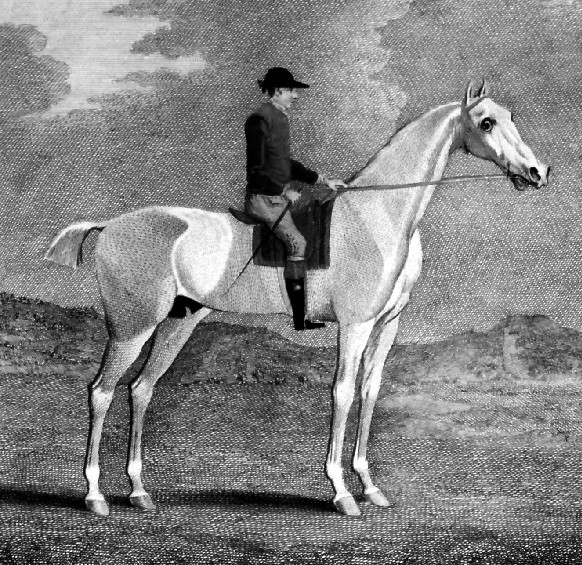
CRAB was bred by Charles Pelham of Lincolnshire and later purchased by Mr Cotton.

He was “a horse of size and strength”. He ran only as a six and seven-year-old and won five races, including a King’s Plate at Newmarket.
After retiring to Thomas Panton’s stud, Crab became the Champion Sire for three consecutive years; 1748, 1749 and 1750.

Among his best progeny was Spectator (b.c. 1749), who won the 1756 Jockey Club Plate, beating Brilliant and Matchem, and later became the broodmare sire of the first two Derby winners – Diomed in 1780 and Young Eclipse in 1781 – and the grandsire of the 1785 Derby winner Aimwell.

Crab died on Christmas day 1750, aged 28 years.


**  3  **

The Tetrarch (gr.c. 1911)


The unpredictability of the grey gene referred to earlier, is no more evident than with the emergence of The Tetrarch.

Bred by Mr Edward Kennedy at the Straffan Stud in County Kildare, The Tetrarch was born in 1911, sired by the grey French bred stayer Roi Herode. Mated to Vahren, a 14-year-old mare that had won three small races, it was noted that she was a shy breeder – a trait to be inherited by The Tetrarch.
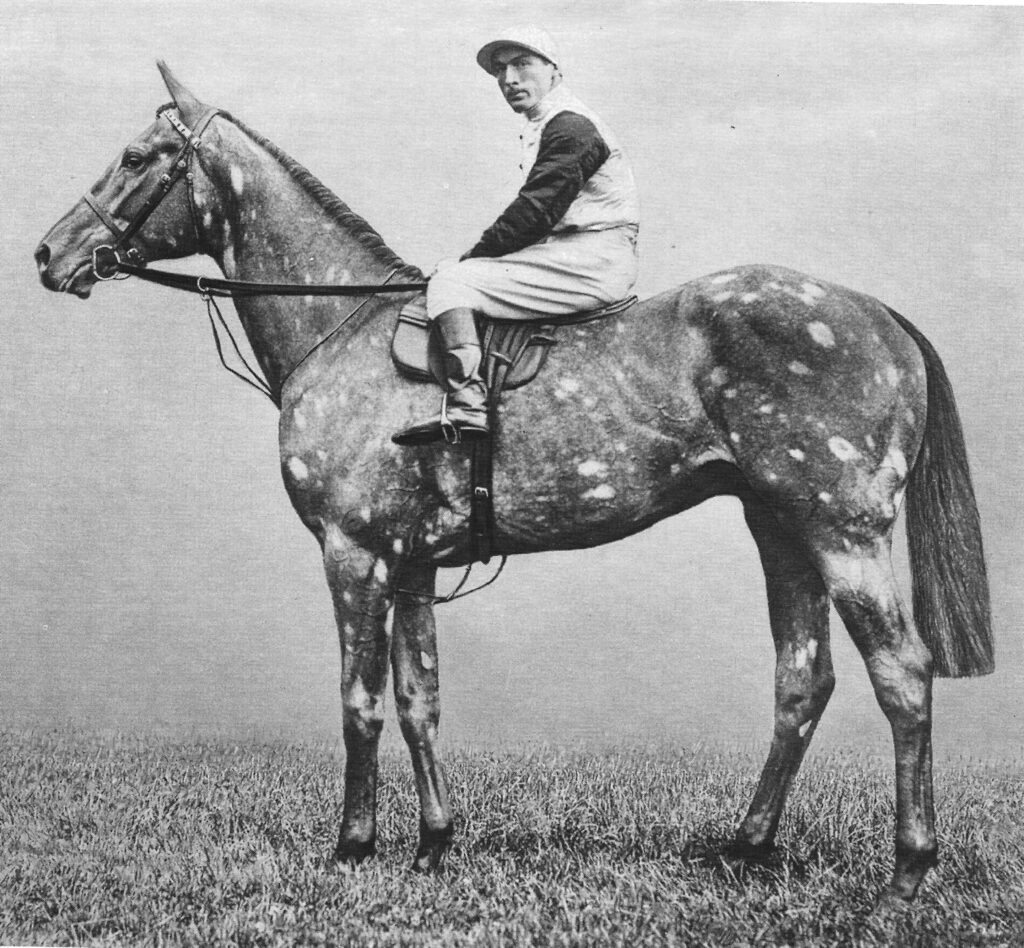
THE TETRARCH was born a chestnut with black splodges, however, by the time trainer Atty Persse had bought him for 1,300 guineas at Doncaster’s Yearling Sales, the chestnut pigment had turned to gun-metal grey and the random egg-shaped splodges to white.

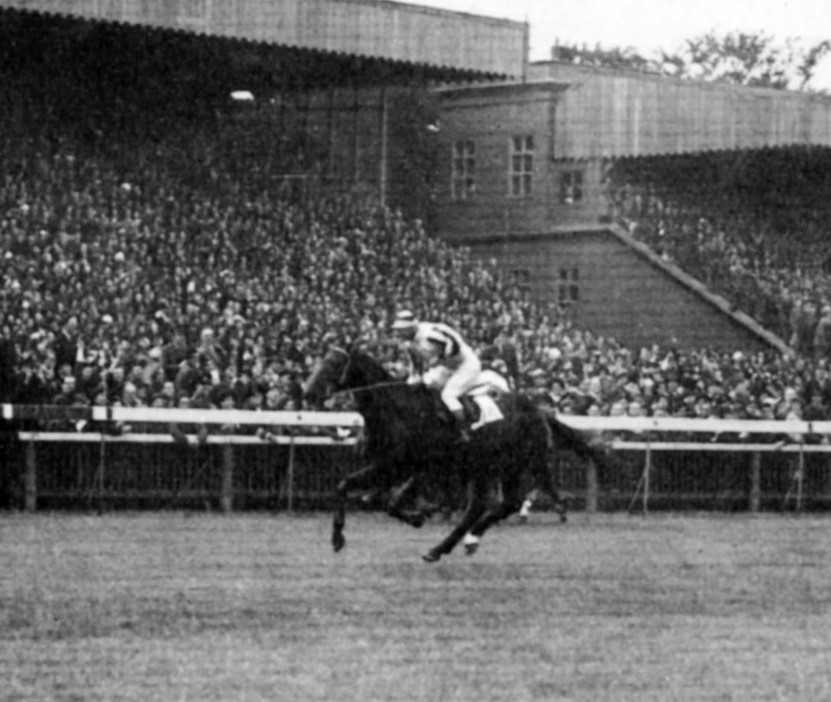
STEVE DONOGHUE (seen aboard) said of The Tetrarch, “He was without doubt the fastest horse that I ever rode, and probably, the fastest horse that ever ran on the Turf.”

Having passed on The Tetrarch to his cousin Dermot McCalmont at cost price, Persse set about training the colt on his Stockbridge gallops in Hampshire. The results were spectacular, and so must have been the stable security, for when The Tetrarch won his maiden at the Newmarket Craven by four lengths in a canter, he did so at generous odds of 5-1.
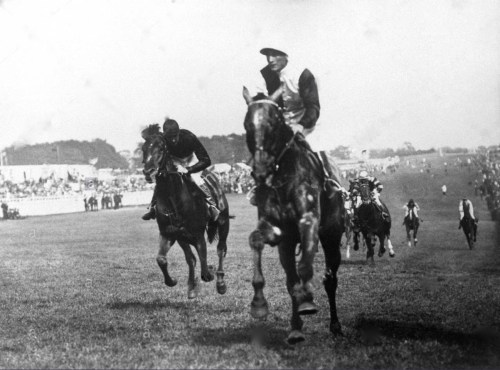
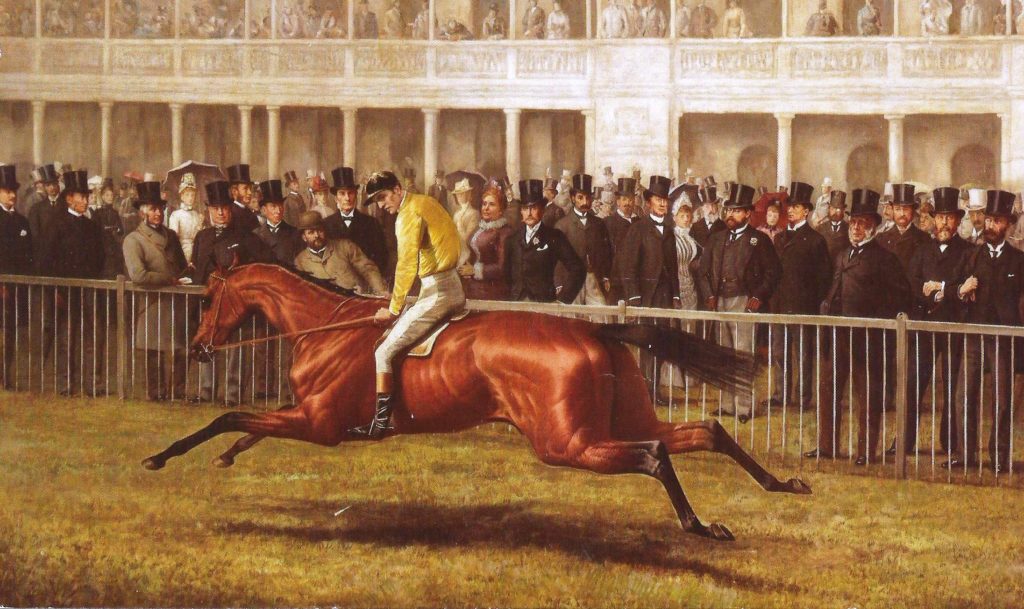
The Tetrarch (above) winning the Woodcote Stakes at Epsom and setting a new six furlong course record of 1 minute 7.6 seconds, beating Parhelion by three lengths.

Then at Ascot, in the Coventry Stakes, he annihilated six rivals to win by ten lengths.

To the sporting press, who had dubbed him as “The Rocking Horse”, he now became “The Spotted Wonder”.

Crowds flocked to Sandown to see his next race – the National Breeders’ Produce Stakes. But anticipating the start, he caught the tapes in his mouth, reared up and came down on his knees.

At half-way, his task looked impossible, but Donoghue got him balanced and won the race by a neck. For historians, however, it was his next race – the six-furlong Rous Memorial Stakes at Goodwood – that stands out. Conceding 13lb to the future One Thousand Guineas and Oaks winner Princess Dorrie, he won “in runaway style”, beating her by six lengths.

Further convincing victories followed in the Champion Breeders’ Foal Stakes at Derby, by four lengths, and in the Champagne Stakes at Doncaster, beating Stornaway (winner of the Prince of Wales’s Plate and Gimcrack Stakes at York), by three lengths. Soon after this, he rapped his off-fore fetlock in a home gallop and after treatment, was put away for the winter.

Rated at 9st 10lb in the Free Handicap, The Tetrarch was made winter favourite for both the Two Thousand Guineas and Derby.

Early in March, it was admitted that his injury was greater than thought at first, and eventually he was withdrawn from the Guineas. Finally, after rapping his off-fore again in early May, he was taken out of the Derby.

For the record, The Tetrarch ran only at 2 years and won all his 7 races incl. Woodcote Stakes, Coventry Stakes, National Breeders’ Produce Stakes, Sandown, Rous Memorial Stakes, Goodwood, and the Champagne Stakes, Doncaster.

The question raised was, could a horse with such speed have stayed the Derby distance? His trainer Atty Persse said, “There was no three-year-old in 1914, who would have been capable of extending him over any distance.”

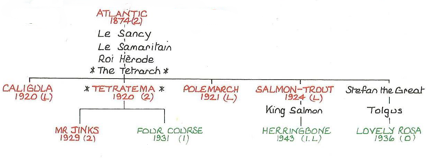
At his owners Ballylinch Stud in Co. Kilkenny, The Tetrarch showed little interest in mating and sired only 130 foals in about 20 years. However, his 80 winners included the 1920 Two Thousand Guineas winner Tetratema; three St Leger winners: Caligula, Polemarch and Salmon-Trout,  ‘The Flying Filly’ Mumtaz Mahal, (Champion 2-y-o filly in 1923) and grandam of Mahmoud (1936 Derby).

The Tetrarch was Champion Sire in 1919, and between 1918 and 1927 he figured in the top dozen sires’ eight times.

The enigma of The Tetrarch was the extremes of his progeny, from the speed of Tetratema and Mumtaz Mahal to his three St Leger winners. For breeders, however, the mere presence of his grey gene in the pedigree was one of improvement.

Later in life his strange spots completely disappeared as he became entirely white. He was infertile for the last ten years of his life, and died on 8 August, 1935. Aged 24, he was buried at the Ballylinch Stud,  County Kilkenny.

In the excellent book, “A Century of Champions” by John Randall and Tony Morris, The Tetrarch was rated the “Best Two-Year-Old of the Century”, ahead of Tudor Minstrel and Tetratema.


**  4  **

Tetratema (gr.c. 1917)

Following The Tetrarch, his son Tetratema was a worthy successor.
 

TETRATEMA, the best and fastest son of The Tetrarch, inherited all that was to be admired in “The Spotted Wonder”, but, with soundness and an on-going ability at stud.
His dam, Scotch Gift (b.f. 1907) by Symington, had been a useful two-year-old, winning four races. Later she bred seven winners, including a full brother to Tetratema – The Satrap – a winner of the July Stakes and the Richmond Stakes.

A grey colt born in 1917, Tetratema, was bred by Major Dermot McCalmont, trained at Stockbridge by Atty Persse and ridden by Brownie Carslake. Unbeaten in five starts as a juvenile, he won the first three of these – the National Breeders’ Produce Stakes, the Molecomb Stakes and Doncaster’s Champagne Stakes – by a distance of four lengths. And by now noted by every tout in the country, he took the Imperial Produce Plate at Kempton, conceding weight to two rivals, at odds of 7-100. Finally that year, he won the Middle Park Plate, beating Southern and three others by six lengths. At the end of the year, he was rated 12lb clear at the top of the Juvenile Free Handicap and turfites questioned whether he was a better colt than his illustrious sire.

The following year, after a surprise half-length defeat in the Greenham Stakes by Silvern (a full brother to Fifinella), he justified public support by winning the Two Thousand Guineas as the 2-1 favourite, leading from start to finish to beat Allenby and 15 other rivals.

Nevertheless, in spite of his sprint-bred pedigree, Tetratema started favourite for the Derby. However, soon after entering the straight, he was done for, finishing down the field behind Spion Kop, who benefiting from the early pace set a new course record.

That year, Tetratema went on to win a further three races from four starts: the five-furlong Fern Hill Stakes at Ascot, the six-furlong King George at Goodwood, beating the famous Diadem, then closing with an easy match victory over Britomart (rec. 21lb) in the Kennet Stakes (5f.) at Newmarket. His defeat came in the Eclipse Stakes when finishing unplaced to Buchan over a distance beyond his ability.
With lessons learned, Tetratema’s connections confined him to sprints for his final season and, running in four races, he won them all – the King’s Stand Stakes, the July Cup, another King George at Goodwood and finally the Snailwell Stakes at Newmarket.

Over his three seasons, he won 13 races and was never beaten in 12 starts over five and six furlongs.

At Stud he was Champion Sire in 1929, when Mr Jinks won the Two Thousand Guineas and Royal Minstrel won the Eclipse. These were his best two sons and both were greys. He also finished second in the Sires list three times: 1929, 1934 and 1936.

Tetratema died on 16 July, 1939 aged 22 years, and was buried at the Ballylinch Stud.


**  5  **

Le Sancy (gr.c. 1884)
Returning to the male line  to The Tetrarch, Le Sancy, owned and bred by Baron Arthur de Schickler in France, was by the 2,000 Guineas winner Atlantic (ch.c. 1871), out of Gem of Gems (gr.f. 1873).

Le Sancy won 27 races from 43 starts incl: Grand Prix de Deauville, (twice), Prix Daru, Prix des Sablonnes and the Grand Prix de Dieppe (twice). In 1911 he was the French leading broodmare sire.

Continuing the links in the chain, Le Sancy sired Le Samritain (gr.c. 1895), winner of 9 races from 28 starts incl: Grande Prix de Deauville, Prix Daru and Grand Prix Saint Leger de France and at stud sired Roi Herode.
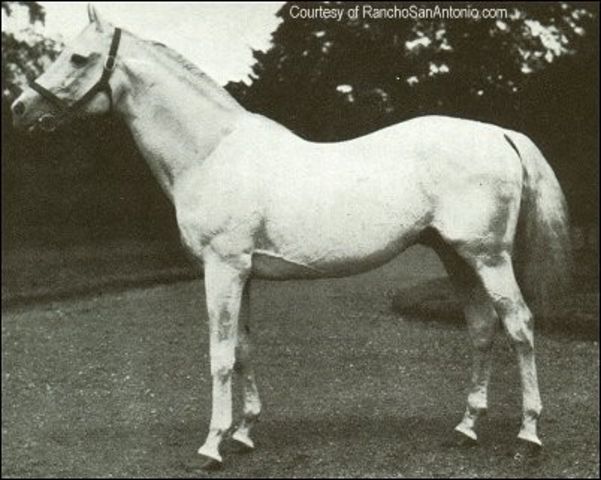
 

ROI HERODE (gr.c. 1904), sire of The Tetrarch, was bred in France by Maurice Caillaut.

He won only 3 races from 24 starts: Prix de la Neva, Grand Prix de la Ville de Vichy, Prix de la Table, and was second in Doncaster Cup.

But, in an attempt to revive the HEROD male line he was bought by Edward Kennedy for £2,000.


**  6  **

Tagalie (gr.f. 1909)

In 1912, TAGALIE was only the second grey to win the Derby and the fifth filly to do so.
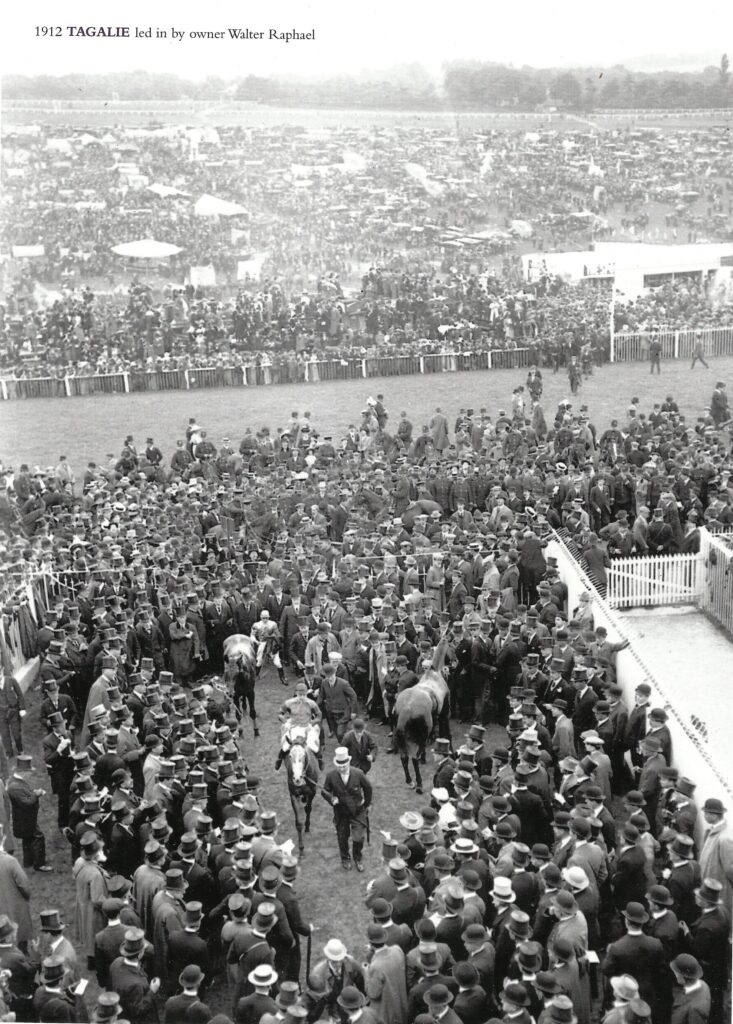
 

Mr Walter Raphael leads in his Derby winner Tagalie

Tagalie’s sire Cyllene, had three previous Derby winners Cicero (1905), Minoru (1909) and Lemberg (1910).

Her dam, Tagale, was bred in France and won two races before breeding seven winners from nine foals.

Walter Raphael (1862-1938), the owner/breeder of Tagalie, was a rich London financier, whose Louviers was beaten a short head by Minoru in the 1909 Derby.

Raphael had a private stable at Somerville Lodge, Newmarket, where he employed the trainer Dawson Waugh.

Tagalie made a winning debut in the Boscawen (Post) Stakes at Newmarket. Two weeks later she finished third to Belleisle in the Cheveley Park Stakes, before disappointing in a Maiden at Sandown.

On her three-year-old debut, however, Tagalie won the One Thousand Guineas at odds of 20-1, with the favourite Belleisle third.

Although her second in the Newmarket Stakes kept her in the Derby picture, the Two Thousand Guineas form dominated the betting, with the American-bred winner Sweeper 2-1 favourite and second placed Jaeger on 8-1. Tagalie was a popular each way bet at 100-8.

Tagalie was ridden by the American lightweight Johnny Reiff, who had won the 1907 Derby on Orby. Reiff gave a brilliant display of ‘waiting in front’ as Tagalie won by four lengths from Jaeger, with Tracery a further two lengths away third.

Two days later Tagalie returned for the Oaks as 1-2 favourite but, with George Stern now in the saddle, she was held back until Tattenham Corner and was soon beaten in the straight, finishing sixth to the 33-1 outsider Mirska. Further defeats followed when she ran unplaced behind Prince Palatine in the Eclipse Stakes and Tracery in the St Leger.

Retired to stud, Tagalie produced four winners of 12 races and died after foaling in 1920.


**  7  **

Mahmoud (gr.c. 1933)


The grey gene now continues from The Tetrarch to Mahmoud via his daughter Mumtaz Mahal and grand-daughter Mah Mahal
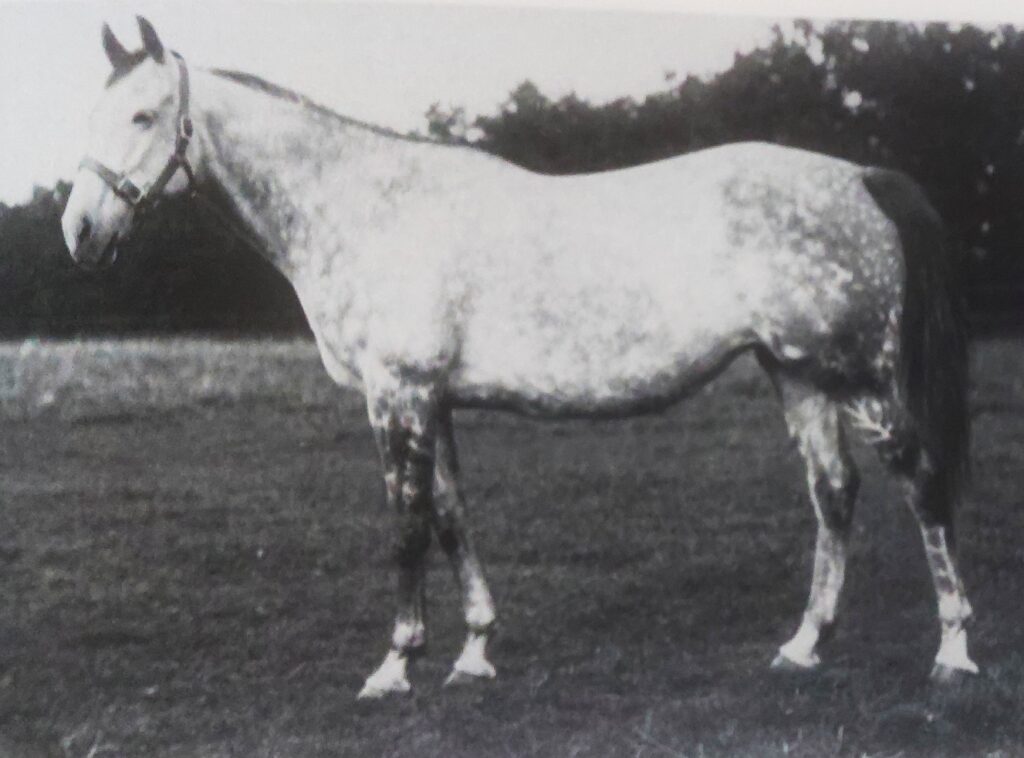
 

Mumtaz Mahal (gr.f. 1921)

MAHMOUD was a light grey colt of 15 hands 21⁄4 with a distinctive Arab-like head, a strong back and muscular quarters.Bred in France by the Aga Khan III and born in 1933, he was by the 1930 Derby winner Blenheim and the first foal of his dam Mah Mahal (by Gainsborough).

Trained by Frank Butters at Newmarket he won 4 races: Exeter Stakes, Newmarket, Richmond Stakes, Goodwood,  Champagne Stakes, Doncaster, Derby Stakes. Second in Two Thousand Guineas Stakes, third in St Leger Stakes. Champion Sire in North America 1946.
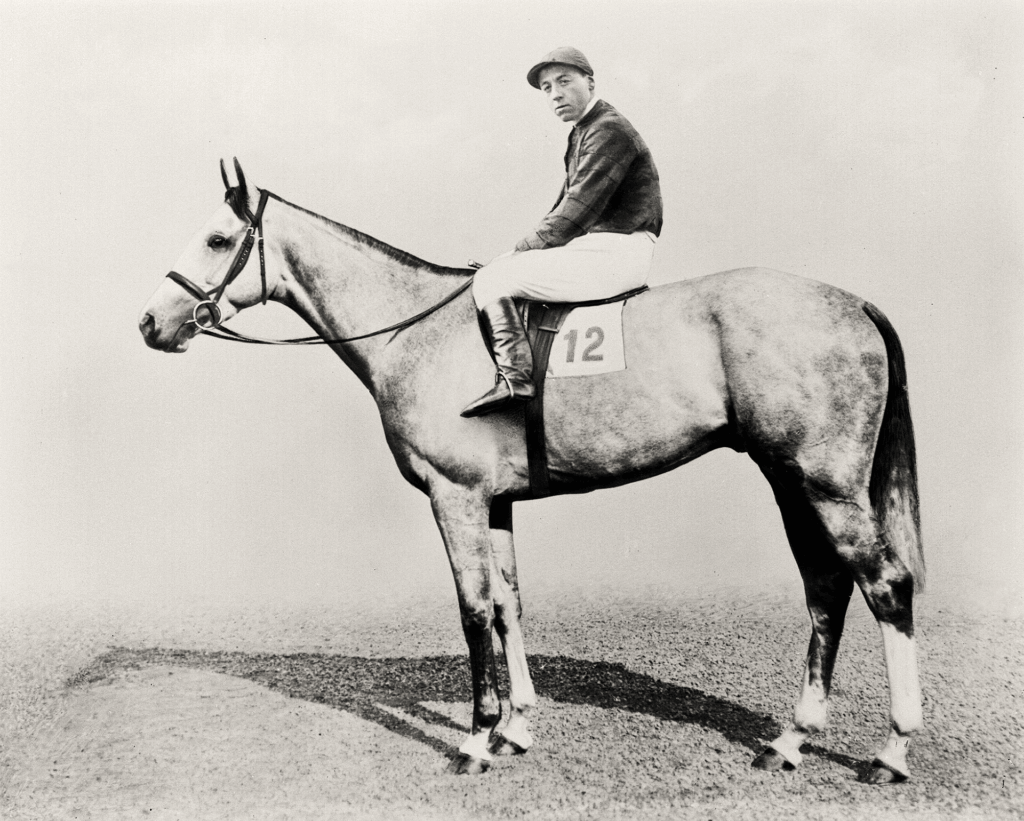
MAHMOUD with Charlie Smirke

It had been an exceptionally dry May and the official going on Derby day was firm, although in reality it was bone hard.

Pay Up, having beaten Mahmoud by a short-head in the 2,000 Guineas, was now the 5-1 Derby favourite, while Gordon Richards’ choice of three Aga Khan runners, was the Chester Vase winner Taj Akbar (6-1) above Mahmoud (100-8) and top juvenile Bala Hissar (100-6). Frank Butters’ fourth runner, Noble King, gave punters an each way chance at 9-1.

From a field of 22  although Thankerton led round Tattenham Corner, Mahmoud quickly made up ground entering the straight and bounded off the fast surface like a cricket ball on concrete, passing Thankerton two furlongs out. Taj Akbar ran on for second place but could not get to Mahmoud, who won by three lengths in the new record time of 2 min 33.80 sec., unsurpassed for the next 60 years.  Thankerton finished a brave third, a further three-quarters of a length away.

Feeling the effects of Epsom and conceding 7lb, Mahmoud was beaten five lengths by Rhodes Scholar in the St James’s Palace Stakes at  Ascot.

Later, his preparation for his finale, the St Leger, was interrupted by an attack of heel-bug and he did well to finish third to Boswell.

Retiring to Egerton Stud at a fee of 300 guineas, Mahmoud was bought at the close of the 1940 season for $84,000 by Mr C.V. Cornelius Vanderbilt Whitney, a major player on the American turf, the movies and aviation. Sent to his stud in Kentucky, Mahmoud proved a great success becoming Champion Sire in North America in 1946. Among his prolific winners were:

OIL CAPITOL gr.c. 1947 ex NEVER AGAIN by PHAROS. He won 19 races incl. Flamingo Stakes,Widener Handicap, U.S.A.

COHOES b.c. 1954 ex BELLE OF TROY by BLUE LARKSPUR. He won 13 races incl. Brooklyn Handicap,Whitney Stakes, U.S.A.

THE AXE gr.c. 1958 ex BLACKBALL by SHUTOUT He won 15 races incl. Imperial Stakes, Kempton, Newmarket Stakes, San Luis Rey Handicap, Man o’War Stakes, and the Canadian Championship Stakes.


**  8  **

Addenda

Of the 11 grey winners of the St Leger, none produced a Classic winner.

Although Airborne, who also won the 1946 Derby, sired Silken Glider to win the 1957 Irish Oaks and finish second in the Oaks at Epsom.


The seventh and and only grey Champion Sire of G.B. & Ireland, since Tatratema, was Dark Angel (gr.c. 2005), who traces back in unbroken line 11 generations to The Tetrarch.


Of the eight grey Kentucky Derby winners, six trace back to Mahmoud and the other two to The Tetrarch by  a different rout. 

Mahmoud died on 18 September, 1962 and is buried in the equine cemetary on Gainsway Farm, near Lrxington, Kentucky.

If there is to be a resergence of the grey gene in our Classic winners you can be sure that either Mahmoud or The Tetrarch will figure in their pedigrees.


For those who like to leave with a smile, the grey gene of the famous chaser, Desert Orchid, goes back 300 years without a break, to our start with the Alcock Arabian.


Thus concludes our journey with the grey gene through the Thoroughbred racehorse


(2820 words)


For more Racing History see Michael’s Books for Sale.
 

Bay Middleton – Derby Winner & Champion Sire

Posted on:

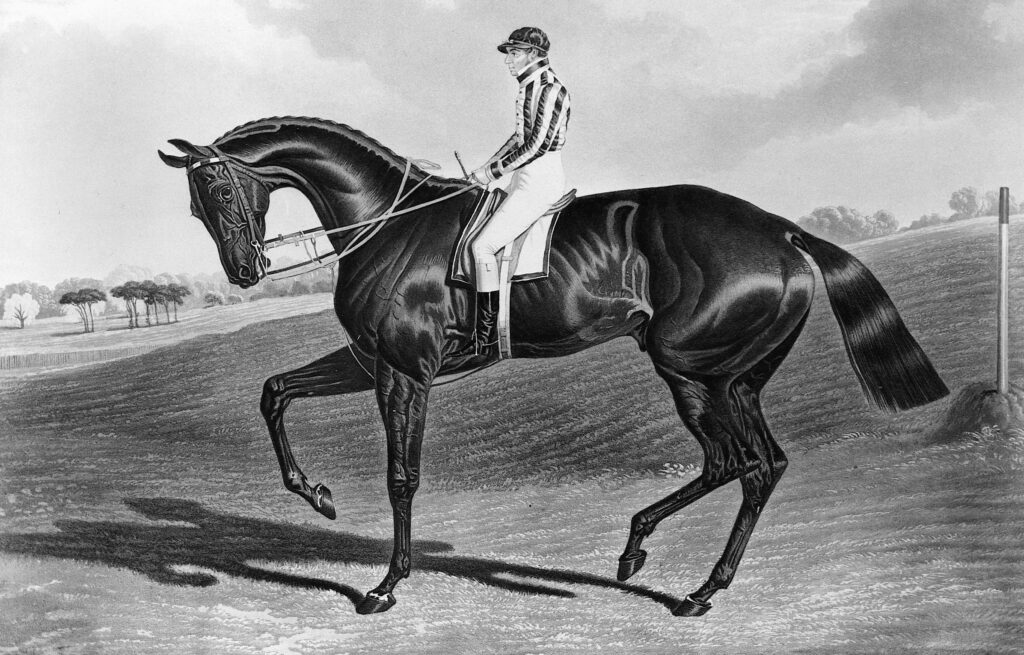
Bay Middleton – Derby winner & Champion Sire


Bay Middleton with Jem Robinson aboard


BRED BY 5th Earl of Jersey. CHAMPION SIRE 1844, 1849.

WON 7 races incl. Riddlesworth Stakes,Two Thousand Guineas Stakes, Derby Stakes, Buckhurst Stakes, Grand Duke Michael Stakes (never beaten).

A bay colt born in 1833, Bay Middleton’s excellence lay in his pedigree.

His sire was William Crockford’s Sultan, a Champion Sire six times and the sire of eight Classic winners; his dam was Cobweb, winner of the One Thousand Guineas and Oaks and breeder of three Classic winners. With such references, Bay Middleton was a hot property and was backed at 8-1 for the Derby before he even set a foot on the gallops.

Bay Middleton’s first race was at the Craven Meeting in 1836, where he won the Riddlesworth Stakes, then on the last day of the same meeting, he walked over for the Bruton Street Stakes.

Two weeks later, Bay Middleton won the Two Thousand Guineas as 4-6 favourite from the future St Leger winner Elis and four others.


On Derby day, rumours abounded about Bay Middleton’s doubtful leg and bad temper, but despite the latter made worse by countless deliberate false starts – he held fast in the market going off the 7-4 favourite. And, after shaking off the late challenge of Gladiator, he won easily by two lengths.

Although the judge placed only two, Venison was third and Slane fourth, both  future Champion Sires.

Such was the pace of the race and the class of the winner that many of the field tailed in nearly two furlongs behind.

At Ascot, Bay Middleton won the Buckhurst Stakes at odds of 1-20 from Lord Exeter’s Derby runner Muezzin and followed this up by beating Elis again in the Grand Duke Michael Stakes at Newmarket in October.

His final race was a match at the Houghton Meeting, in which he conceded 13lb to Muezzin over the Ditch Mile and landed odds of 1-8.


Bay Middleton, unbeaten in his seven races, was promptly retired to the Turf Tavern, Doncaster, at a fee of 30 guineas. He sired four Classic winners, including Derby heroes The Flying Dutchman (1849) and Andover (1854) and was Champion Sire in 1844 and 1849. Altogether, he sired the winners of 487 races, and died at Danebury in 1857.


HIS NOTABLE PROGENY


ALL ROUND MY HAT br.f. 1841 ex CHAPEAU D’ESPAGNE by DOCTOR SYNTAX.

WON Nassau Stakes, Goodwood.

ELLEN MIDDLETON br.f. 1846 ex MYRRHA by MALEK.

WON Yorkshire Oaks. Dam of WILD DAYRELL br.c. 1852 by ION, won Derby Stakes.

THE FLYING DUTCHMAN br.c. 1846 ex BARBELLE by SANDBECK

WON 14 races (from 15 starts) incl. July Stakes, Champagne Stakes, Doncaster, Derby Stakes, St Leger Stakes, Ascot Gold Cup, Match for £1,000 against VOLTIGEUR over 2 miles, York.

SUNFLOWER b.f. 1847 ex IO by TAURUS.

Dam of SUNBEAM b.f. 1855 by CHANTICLEER, won St Leger Stakes, Coronation Cup.

APHRODITE br.f. 1848 ex VENUS by SIR HERCULES.

WON Champagne Stakes, Doncaster, One Thousand Guineas Stakes, Park Hill Stakes. Second in St Leger Stakes. Dam of SIDEROLITE b.c. 1866 by ASTEROID, won Ascot Gold Vase, Goodwood Cup.

ANDOVER b.c. 1851 ex daughter (1844) of DEFENCE.

WON Molecomb Stakes, Brighton Club Plate, Derby Stakes, Stockbridge Triennial Stakes, Champagne Stakes, Brighton, Don Stakes, Doncaster.

THE HERMIT br.c. 1851 ex JENNY LIND by TOUCHSTONE.

WON Two Thousand Guineas Stakes, Ascot Gold Vase, Stewards Plate, Stockbridge, Queen’s Plate, York. Third in Derby Stakes.

ANTON b.c. 1854 ex daughter (1844) of DEFENCE.

WON St James’s Palace Stakes. Second in Two Thousand Guineas Stakes.

______________________________________________________________________________________________


For more Racing History see Michael’s Books for Sale.
The Romance of Wild Dayrell

Posted on:

The Romance of

Wild Dayrell


WILD DAYRELL was bred by Francis Popham at Littlecote House, Littlecote Park in Wiltshire, and named after the notorious, 16th century owner of the place – a man described as a ‘wildshaver’ who, by good fortune escaped the gallows, only to be killed by a fall from his horse. Soon after, the estate came into the possession of the Popham family, who it was said, witnessed the ghost of Dayrell on more than one occasion.

Popham, a hunting man, cautiously began to breed thoroughbreds and after agreeing to £50 for Ellen Middleton, a daughter of the 1836 Derby winner, Bay Middleton, he mated her to Ion, the runner-up in both the 1838 Derby and St Leger.


The arrival of Ellen Middleton’s first foal  – caused  great excitement within the household. Edward Moorhouse relates “The Druid’s” account:


“When the colt appeared between midnight and one o’clock in the morning the butler was rung up and rushed on the scene with his nightcap on his head and a bottle of wine in  his hand; and, as it was necessary to remove the little stranger into a warmer box, he got a wheelbarrow and insisted on  “’wheeling the winner of the Derby once in my life.’Further. when Rickaby (the stud-groom), got to his cottage at five  oclock  that  April morning, he told his wife that there must be  something remarkable for good or evil about the colt, because he had  just seen the  strange sight of a  wild duck and wild  drake sitting on a quickset hedge close to the high road!”


The colt that the omen applied to was named, “for good or evil”, Wild Dayrell and was sold without sentiment to the Duke of Richmond’s son, Lord Henry Lennox, for 100 guineas, with a 500-guinea contingency if he won the Derby.


Packed off to Goodwood to be trained by John Kent, Wild Dayrell was slow to mature and at the Duke of Richmond’s dispersal sale he was sent with others to Tattersall’s. One account relates there was no bid for him and that Mr Popham bought him back privately for 180 guineas, allowing his neighbour, Lord Craven a share.


With stud groom John Rickaby appointed trainer, a primitive training gallop was laid out at Littlecote Park and together with a three-year-old filly and a five-year-old gelding, Wild Dayrell continued his career until May 1854, when all three were sent over to Lord Craven’s Ashdown Park, in the care of John Rickaby.


A big, strong horse, Wild Dayrell eventually came to hand and made a winning debut in late September, starting favourite in a three-horse-race over the Newmarket’s Two-Year-Course (five furlongs, 140 yards). That was to be his only run as a two-year-old and he never ran again before the Derby.


In order to give Wild Dayrell a serious preparation for the Derby many horses were bought or borrowed to trial him, but none were up to the task. A recent Chester winner, Jack Shepherd, was therefore bought for £1,600. Ten days before the race, giving Jack Sheppard a year and 8lb and another four-year-old 2 stone, he cruised past them with ease, prompting Charlton, the rider of Jack Sheppard, to exclaim: “I thought King Tom’s trial a good one last year, but I never rode against such a horse as this before.”


Wild Dayrell was not, however, ‘clear of the wood’ yet. When news of the trial leaked out, the colt’s chances sparked a rush of bets for the Derby, although strangely, his price never shortened.


In a fiendish attempt to stop him reaching Epsom, nobblers removed the linchpins from the wheels of his horsebox but Popham and his trainer Rickaby were forewarned and substituted a bullock for the Derby favourite – the horse box came crashing down and the bullock broke a leg.. Then, in one last desperate attempt, bookmakers’ ‘agents’ offered Popham £5,000 cash not to run Wild Dayrell.

After all the trials, schemes, plots and hedging of bets, Derby Day arrived and so did Wild Dayrell. Those who had tried to stop him were now forced to back him, so sending his price down from 3-1 to even-money. Meanwhile, the Two Thousand Guineas winner, Lord of the Isles, remained steady at 7-4, while Kingstown, third in the Guineas, drifted alarmingly from 9-2 to 12-1.


This year, however, the attendance was down and the normal razzamatazz of Derby Day, somewhat subdued. England was in the throes of the Crimean war and effects of the revealing aftermath of the ‘Charge of the Light Brigade’.


On a dull and cold day, the field of 12 first made their way from the Paddock to Tattenham Corner, where they waited for the course to be cleared, before running  ‘The Preliminary Canter’ past the grandstands and on to the starting post.


Off and running, Lord of the Isles, having pulled very hard for the first two furlongs, was allowed by Tom Aldcroft to make the running to the top of the hill. There, joined by Kingstown, the pair raced down to Tattenham Corner, with Wild Dayrell moving in just behind them..The three principals then raced together to the furlong pole, where Robert Sherwood let Wild Dayrell have his head, and as Lord of the Isles and Kingstown had little more to give, he swept past to win by two lengths. Kingstown held on to be second by a head with Lord of the Isles third, Flatterer fourth and Courtenay fifth.


The crowd resolutely cheered home Wild Dayrell and most of the bookmakers lost money. ‘Leviathan’ Davis took £50,000 but paid out £70,000. Francis Popham, who said he was not a betting man, won a brilliant wager of £l0,000 to £150, which he shared with his friends. He later made it known, that nothing ever again would induce him to own another Derby horse.


Wild Dayrell ran twice more. He won the Ebor St Leger at York, beating the Ascot Gold Vase winner Oulston, but broke down in the Doncaster Cup won by Rataplan. He went to stud at Chilton Folliat, near Hungerford, at a fee of 30 guineas. A magnificent brown horse standing 16.1 hands, he looked even bigger, with “immense arms, gaskins, knees and hocks”.

He proved popular with breeders, siring many good winners including, Buccaneer (Royal Hunt Cup), who went on to be Champion Sire in 1868, when his filly Formosa won four Classics. He also sired Hurricane, who took the One Thousand Guineas and later produced the Two Thousand Guineas winner Atlantic.


Wild Dayrell died in his stall at Littlecote in November 1879, aged 27 years.


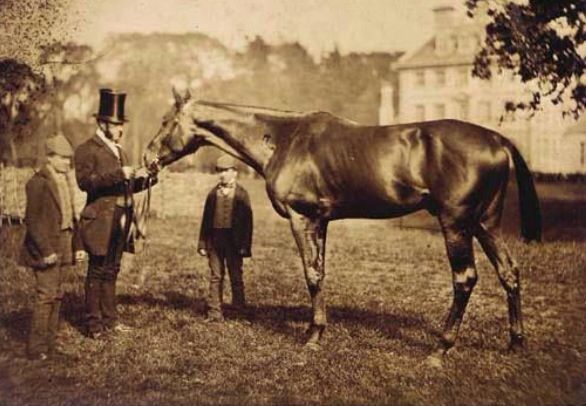
The picture, thought to be taken by Robert Howlett in 1855, is the oldest known photograph of a Thoroughbred racehorse.


Wild Dayrell’s Derby jockey, Robert Sherwood (1835-1894), when 18 years old, won both the Prix du Jockey-Club and the Prix de Diane on M. Lupin’s Jouvence. However, two years after his Derby victory, he steadily gained in weight until, in 1863, he went to Hong Kong to manage the racing stables of some British merchants. A few years after returning to England, he trained from Exeter House, Newmarket, where he sent out Jack Hammond’s St Gatien to dead-heat with Harvester in the 1884 Derby. Sherwood also won the 1889 Oaks with L’Abbesse de Jouarre for Lord Randolph Churchill.


For more Racing History see Michael’s Books for Sale.
Harry Wragg and the Brylcreem Boy

Posted on:

Harry Wragg and the Brylcreem Boy


This popular story, from Ripping Gambling Yarns was the very first of my short stories and goes back to an age before betting shops.


 I knocked twice on the dark stained door at the end of the passage.

A small hatch slid open.

“Oxo,” I said boldly, standing on tiptoe.

Alice let me in.

I entered the smoke-filled room where the usual crowd huddled around the ticker-tape machine, its stuttering chatter competing with the ringing telephones.

This is the back room of Charlie Young’s Hairdressing Salon and, as a chirpy, skinny ten-year-old, my excessive enthusiasm for racing and betting has led me to be accepted by all the regulars.


Today is both the last day of the 1946 Flat Season and the last day in the riding career of Harry Wragg, so consequently, my last chance to back him.

Harry was the thinking man’s jockey, known nationally as ‘The Head Waiter’ because of his effective waiting tactics. He had been champion jockey in 1941, and ridden the winners of 13 Classic races, including three Derby winners – Felstead (in 1928), Blenheim (1930) and Watling Street (1942). He also had two younger brothers, Sam and Arthur who were both successful jockeys in their own right.

Time running out, I quickly scribbled my first bet, 2/- win Tiffin Bell, (Harry’s first mount), and slid it across to Charlie’s lanky blonde wife Alice, who promptly secured it among 50 or so others in a giant bulldog clip.

“Two lumps today, Alice,” I piped, reaching for the obligatory cup of tea.  But before I had put the cup to my lips, Uncle Albert shouted across “Result Manchester – 1.15 – first Tiffin Bell – 5-2.”

“Blimey, I’m off to a good start,” I squeaked.


During the next 30 minutes, a pipe and two Capstan full strength passed through the security system and quickly contributed to the diminishing visibility.

Continuing my loyalty to H. Wragg, I invested 2/- to win on Aprolon in the next, and made myself useful by taking a tray of tea and biscuits out to Charlie in the shop.

Charlie, a dead ringer for Alfred Hitchcock, often used his ventriloquist talents whilst cutting hair.

“How’s it going young squirt?” he enquired, throwing his voice to the corner of the salon.

“I backed Tiffin Bell, won 5-2,” I boasted.

“Then you can afford a hair cut he replied,” still in the high squeaky voice.

“Sit in the end chair.”

Ten minutes later I re-entered the betting room sporting a well-slicked head.

“Aprolon won at 7-4 Michael,” Alice said, coughing manfully, adding “it must be your lucky day.”

“And Harry’s,” I said.

“What are you doing in the big one?” she enquired.

“Well, I’ve got to stick to Wragg now, but c-c-can I have a sub on my winnings?  I did have a shilling left over, but I had my hair cut.”

“Ask Taffy to settle up on one of your slips.”

“Bloody hell boyo,” said Taffy, “its like looking for a needle in a haystack.  Tell you what, I’ll lend you two bob until Monday.”

“Super,” I replied, and instantly returned the coin to his hand.

“Put it on Las Vegas in the N-November Handicap,” I stammered.

Two fifteen approached and the request for prices from the ticker-tape had the ring of an auction. Five to one Dornot – Rae Johnson; 100-8 Star of Autumn – Charlie Smirke; 20-1 Las Vegas – Harry Wragg.


Arriving just in time for the big race, I recognised the voices of Uncle Arthur (Craven A), and Uncle Henry (Rothmans), through the blue haze.  At this time, it was thought expedient by a health fanatic, to take the drastic step of opening a window an inch or two, as visibility had fallen to one pace, and it was difficult to hear the odds over the coughing.

Standing on a chair, Taffy shouted out “Under orders Manchester,” shortly followed by “Off Manchester 2-20.”

A stillness now came over the assembly, and strangely, the absence of a running commentary in no way diminished the excitement, as each man prepared himself for the instant finality of the result.

The silence was finally broken by the sound of the ticker-tape. Taffy crouched over it assisting its passage like a midwife at a birth.

“Here it comes,” Taffy warned … “Manchester – 2.15 – first, Las Vegas 20-1, second, Delville Wood 33-1, third, Star of Autumn….”


At this point Charlie, burst in shouting “Quiet everybody, quiet, I’ve just seen two coppers hanging about outside – there’s going to be a raid – everyone upstairs, quick as you can.”

Charlie then went into his raid-drill, “Alice get rid of the ash-trays, Taffy give me the cash and the books, and put the ticker-tape under the stairs, NOW!”


A crocodile of disgruntled men climbed the stairs to temporarily pay their respects to Alice’s bewildered mother, Violet.  Meanwhile, Charlie beckoned to me, “You come with me boy.”

“They’re at the back door Charlie,” Alice cried out.

“Hold them up for as long as you can,” he replied, then staring close into the faces of two bemused customers, said, “You’ve seen nothing, OK – and your haircuts are on the house.”

“Michael, put the plank across the arms of that chair, and sit up on it.”  I obeyed instinctively.  Charlie then put the books, cash and betting slips into a pillowcase, pushed it under the plank and threw a large white cape around me to cover everything.


“Afternoon Mr Young.” The stentorian voice preceded the presence of two uniformed police officers.


“You’ve been very busy this afternoon.”

“Yes, usual Saturday afternoon you know.” Charlie replied, looking a little pale.

“Alice looks as if she has been washing up cups for an army,” the sergeant added sarcastically.

“Customers like a cup of tea with their haircut you know.”

“Yes of course, we must try that approach down at the station,” he retorted.

“Given up the betting, have you Charlie?” he persisted.

“Yes, a mug’s game really you know officer.”

“You’d be a mug if you got caught Charlie – a heavy fine could close your business down.”

“Yes officer, but all that’s in the past now.” said Charlie, riding his luck.

The sergeant’s gaze turned to the customers.

“Been waiting long, gents?” he probed, but their nervous mutterings revealed nothing.

Looking in the facing mirror, I watched the copper slowly circle my chair.

Until, “This boy’s nearly done.  Perhaps as a favour you could cut my hair next.”

I could feel my heart beating – my winnings were in that pillowcase.

Suddenly, I blurted out,

“Ch-Charlie’s got to wash it first, officer, I’ve only just got here.”

Charlie’s blanched face sprang to life.

“Yes, course I have. His Mum hates all that Brylcreem plastered all over it.”


Terrifyiingly, I felt myself propelled forward to the basin for a vigorous hair washing.  This, having been done under the sergeant’s steady gaze, Charlie was then obliged to begin my second haircut of the afternoon.  As the sergeant’s puzzled frown deepened, Charlie explained helpfully, “His mum likes it short!”

“Oh well, must be getting along, I suppose.” The sergeant slowly moved towards the door before pausing.

“There’s just one thing you might like to help with Charlie,” he said thoughtfully.

“Of course officer, anything,” said Charlie obsequiously.

“I’ve got ten tickets left for the Police Dance next Saturday, would you like to take them off my hands?  Be good for you and Alice to get out occasionally.”

Charlie gritted his teeth and paid up.


Leaving by the front door the two policemen were joined by Uncles Arthur and Henry tiptoeing down the stairs from the now profoundly bewildered Violet.

“What are you two up to – leaving the scene of the crime?” questioned the sergeant.

“No officer,” said Arthur, “we’ve just been estimating for a wallpapering job.”

“A cover up job, more likely,”


As the story of this raid went around Woking, so I became the boy hero, albeit with the shortest haircut in Surrey.


Owen Tudor – a Sire of Champions

Posted on:

Although never a Champion Sire,

Owen Tudor was the sire of Champions.

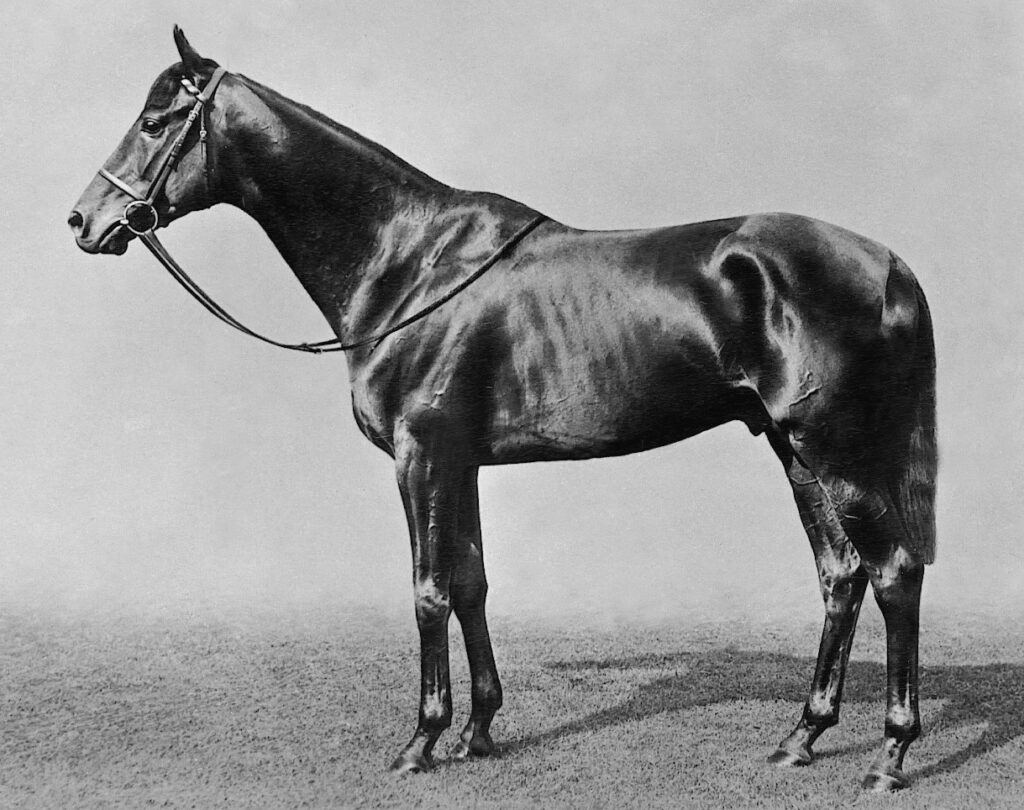
“A short-coupled colt of rare quality,” he was bred by Mrs Catherine (later Lady) MacDonald-Buchanan, the daughter of Lord Woolavington.

A brown colt of 16.1 hands by Hyperion out of the Poule d’Essai des Pouliches winner, Mary Tudor II, he was sent to Fred Darling at Beckhampton in Wiltshire, for training.

Ridden by Gordon Richards on his debut, he won the 10-runner, five furlong, Salisbury Stakes by four lengths from Excursionist. Much was expected from him when odds-on in the Criterion Stakes. However, he surprisingly failed to stay the extra furlong and finished fifth to Starwort. Returning to Newmarket for the six-furlong Boscawen Stakes, he challenged close home to be beaten a head by City of Flint.

The following year, he won the one-mile Column Stakes by three lengths, before disappointing in the Two Thousand Guineas when favourite and only fifth to Lambert Simnel.

His pre-Derby race was the Salisbury Trial Stakes, and starting at 4-7 he was beaten two lengths by Fairy Prince. Owen Tudor’s Derby chance now seemed remote and with Gordon Richards recovering from a broken leg, the ride was given to Billy Nevett, the top northern jockey, who at the time was serving as a private in the Royal Army Ordnance Corps.


When Derby Day arrived the first three in the Two Thousand Guineas, Lambert Simnel, Morogoro and Sun Castle, occupied the same positions in the Derby betting at 4-1, 11-2 and 6-1 respectively. Although looking impressive in the paddock, at 25-1 Owen Tudor was the least fancied of Fred Darling’s five runners, having been beaten when odds-on in the Salisbury Trial Stakes.

On a warm day at Newmarket, 20 runners went to post on good ground. Selim Hassan set the pace to Plantation Corner, but soon after, gave way to Starwort and Annatom. Into the dip, Starwort led Morogoro with Firoze Din and Owen Tudor on either side.

At the foot of the hill, Morogoro (blinkers), looked the winner, but meeting the rising ground, Owen Tudor (hidden) stormed past him to win by one and a half lengths, with Firoze Din a further two lengths away third. 


Owen Tudor seen shortly after the Derby.


Owen Tudor ran a further three times that year, finishing fourth to Sun Castle in the St Simon Stakes, ninth to Sun Castle in the St Leger and finally winning the Newmarket St Leger from Chateau Larose. As a four-year-old, Owen Tudor won two of his three starts, opening with an eight lengths victory in the mile-and-a-half Salisbury Trial Plate. Seven weeks later, over the same course and two extra furlongs, he faded badly, finishing sixth of seven to Mazarin. However, in his final race, the Ascot Gold Cup, all was forgiven, Owen Tudor winning in fine style with Mazarin only fourth. This was the first time a Derby winner had won the Gold Cup since Gainsborough, Owen Tudor’s grandsire,  in 1918. On both occasions the double was achieved at Newmarket.   


Owen Tudor retired to his owner-breeder’s New England Stud at Newmarket, at a fee of 250 guineas. Although never Champion Sire he got a number of top-quality colts, including the sensational TUDOR MINSTREL br.c. 1944 ex SANSONNETT by SANSOVINO, won Two Thousand Guineas Stakes, St James’s Palace Stakes; ABERNANT gr.c. 1946 ex RUSTOM MAHAL by RUSTOM PASHA, won Middle Park Stakes, King’s Stand Stakes, July Cup (twice), King George Stakes (twice), Nunthorpe Stakes (twice). Second in Two Thousand Guineas Stakes; RIGHT ROYAL br.c. 1958 ex BASTIA by TORNADO or VICTRIX, won Poule d’Essai des Poulains, Prix Lupin, Prix du Jockey-Club, King George VI and Queen Elizabeth Stakes.

Aged 28 years, Owen Tudor was put down in March 1966.                                                                                                                   

OWEN TUDOR, won 6 races: Salisbury Stakes, Column Stakes, Newmarket, New Derby Stakes, Newmarket St Leger,Trial Plate, Salisbury, Newmarket Gold Cup (Ascot Gold Cup substitute).

His sire, HYPERION, won 8½ races: New Stakes, Prince of Wales’s Stakes (d-ht), Goodwood, Dewhurst Stakes, Chester Vase, Derby Stakes, Prince of Wales’s Stakes, Ascot, St Leger Stakes, March Stakes, Burwell Stakes. Champion Sire 1940, 1941, 1942, 1945, 1946, 1954. Sire of 7 Classic winners incl. SUN CHARIOT br.f. 1939 ex CLARENCE by DILIGENCE, won New One Thousand Guineas Stakes, New Oaks Stakes, New St Leger Stakes and bred 7 winners of 18 races; SUN STREAM ch.f. 1942 ex DRIFT by SWYNFORD, won One Thousand Guineas Stakes, Oaks Stakes and bred 4 winners of 8 races; AUREOLE ch.c. 1950 ex ANGELOLA by DONATELLO, won King George VI and Queen Elizabeth Stakes, second in Derby Stakes and Champion Sire 1960 & 1961.

His dam, MARY TUDOR II, won. 6 races incl. Poule d’Essai des Pouliches. From 7 foals in G.B. she bred 6 winners incl. TUDOR MAID, won 4 races and bred ROYAL FOREST b.c. 1946 by BOIS ROUSSEL, won Coventry Stakes, Dewhurst Stakes and Champion Sire in Brazil; EDWARD TUDOR ch.c. 1943 by HYPERION, won 5 races incl. Chester Vase. MARY TUDOR II died in 1954.


For more Racing History see Michael’s Books for Sale.


Remembering ‘The Tinman’: Fred Archer 1857-1886

Posted on:

Remembering “The Tinman”

Fred Archer 1857-1886

Known as ‘The Tinman’, due to his fondness for cash, Frederick James Archer was the greatest jockey of his generation.

And, such was his popular acclaim, that London cab drivers would hail each other with “Archers up,” to show all was well.


Fred was born at St Georges Cottage, Cheltenham on 11th January, 1857. His father, William Archer, was a successful N.H. jockey, and the year after Fred was born he won the Grand National on Little Charlie.

At  the age of 11, Fred signed apprentice indentures to Mathew Dawson at Heath House, in Newmarket.  It was there he learned his trade, and weighing only 4st. 1lb, he partnered all the stable’s lightweights in handicaps.

Eventually, when he grew tall, he would rap his legs around the horse, squeezing him for the final drive. Powerful in a finish, he was rarely beaten and used the whip unsparingly.


Between 1874 and his death he notched 21 British Classics, including four in the Oaks: Spinaway (1875), Jannette (1878), Lonely (1885), and Wheel of Fortune (1879), who he swore was the best filly he ever rode. He also rode five winners of the Derby: Silvio (1877), Bend Or (1880), Iroquois (1881), Melton (1885) and Ormonde (1886), the greatest horse of the 19th century.


Also, since Fred Archer holds the Royal Ascot record with 12 wins from 24 rides it is worth unearthing his brilliant achievement in 1878.

Ascot was then a four-day meeting. On the Tuesday, he rode one winner from seven rides – Garswood 4-9 fav in a Post Sweepstake.

On Wednesday, he rode five winners from six mounts: Lady Lumley 5-4 fav  in the Fern Hill Stakes; Julius Caesar 10-1, top weight (5y-8st-6lb) in the Royal Hunt Cup; Redwing 8-1 in the Coronation Stakes; Muley Edris 9-4 in the Triennial Stakes and Sonsie Queen 9-2 in the Ascot Biennial Stakes.

On the Thursday, he rode three winners from six mounts: Lord Clive 1-3 fav in the New Biennial Stakes; Trappist 2-5 fav in the All-aged Stakes and Petrarch 5-4 fav in the Rous Memorial Stakes.

On Friday, the final day, he rode another three winners from five mounts: Out of Bounds 5-6 fav in the Maiden Plate; Trappist 7-1, top weight (6y-9st-10lb) in the Wokingham Stakes and Jannette 4-7 fav in a Triennial Stakes.

In contrast to today, Trappist‘s 9st 10lb in the Wokingham, gave 20lb to the next highest and 59lb to the bottom weights on 5st 7lb, in a field of 24. The distances were 3/4 length and a bad third.


Fred Archer on Ormonde at Epsom 1886


During this time his weight rose from 6 st 2 lb to 9 st 1 lb, so causing him to endure lengthy periods of wasting with a vicious purgative known as “Archer’s Mixture”.

While still mourning the death of his wife, Helen Rose and wasting to make 8 st 7 lb on St. Mirin in the Cambridgeshire, he was beaten a head carrying 1lb overweight.

Tragically, on Monday, 8 November, 1886, while suffering from a typhoid fever, he shot himself in a fit of depression. He was 29 years of age.

Archer was Champion jockey for 13 consecutive years to 1886 and rode a total 2,748 winners, including 246 in 1885. His lifetime ratio of winners to mounts exceeded 34%, although in 1881 and 1884 it exceeded 41%

His obituary stated:

Backers have lost the best friend they ever had”.


For more Racing History see Michael’s Books for Sale.


2025 Betfred Derby – Lambourn

Posted on:

247                                 LAMBOURN                                 2025

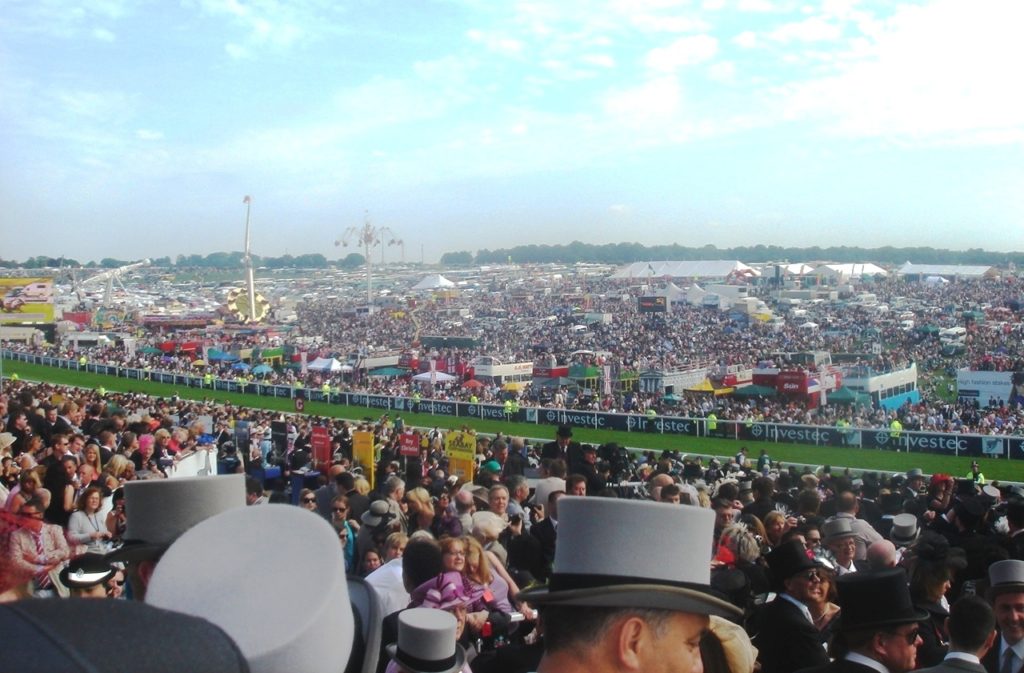
Run on Saturday, 7 June, 2025 as the Betfred Derby over the Derby Course of one mile and a half and 6 yards, Epsom Downs. For three-year-olds; entire colts 9st 2lb, fillies 8st 13lb. 93 entries. Value to winner £909,628.40

1st     LAMBOURN                    Wayne Lordan                         13-2

2nd    LAZY GRIFF                   Christophe Soumillon              50-1      3¾ lengths

3rd    TENNESSE STUD            Dylan Browne McMonagle    28-1       1 length

 Also ran: 4th  New Ground (Alexis Pouchin) 50-1; Stanhope Gardens (Hector Crouch) 12-1; Tornado Alert (Oisin Murphy) 40-1; Green Storm (Billy Loughnane) 50-1; Nightime Dancer (Jamie Spencer) 100-1; Delacroix (Ryan Moore) 2-1 Fav; Midak (Mickael Barzalona) 9-1; Sea Scout (Harry Davies) 125-1; Nightwalker (Tom Marquand) 40-1 (tailed off); Rogue Impact (Luke Morris) 200-1 (tailed off); The Lion In Winter (Colin Keane) 7-1 (tailed off); Al Wasl Storm (David Probert) 20-1 (tailed off); Tuscan Hills (David Egan) 40-1 (tailed off); Pride Of Arras (Rossa Ryan) 4-1(tailed off); Damysus (James Doyle) 16-1 (tailed off  last 52¼ lengths behind the winner).

Non Runner: Ruling Court (unsuitable ground).

 Commentary: With a choice of Aidan O’Brien’s three, Ryan Moore chose Delacroix, who as a juvenile was beaten a nose in the Doncaster Futurity. Later, following up with victories in the Ballysax Stakes and the Leopardstown Derby Trial Stakes, he went off the 2-1 Derby favourite. At 7-1, also from the O’Brien yard: The Lion In Winter, the long-time Derby favourite beset with training problems and a poor showing in the Dante Stakes. Finally Lambourn, winner of the Chester Vase, beating Lazy Griff, then backed into third favourite for the Derby at 13-2. Pride Of Arras, winner of the Dante Stakes was well supported into 4-1.

Eighteen runners went to post and the commentators “The’re Off”, was met with a great cheer.

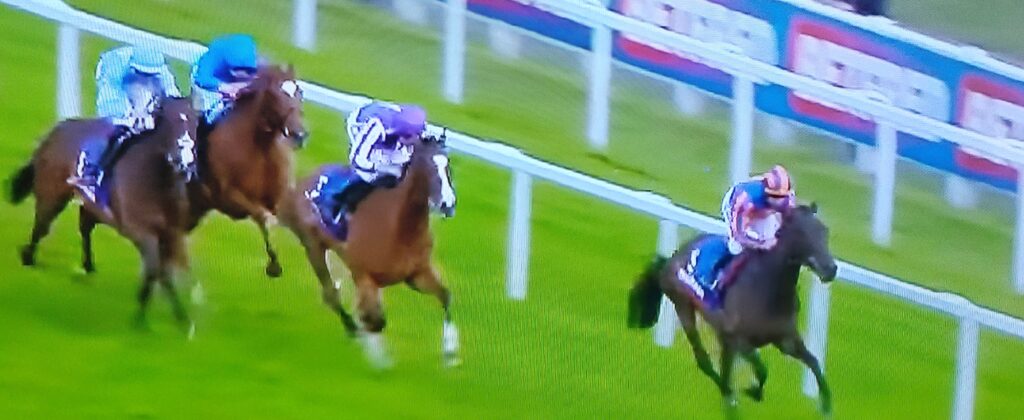
Soon after leaving the stalls, Lambourn was pushed through to lead from Lazy Griff, Midak and Damysus. The order remained unchanged down to Tattenham Corner, where Lambourn led Sea Scout, with a break of four lengths back to Midak, Lazy Griff and Tuscan Hills.

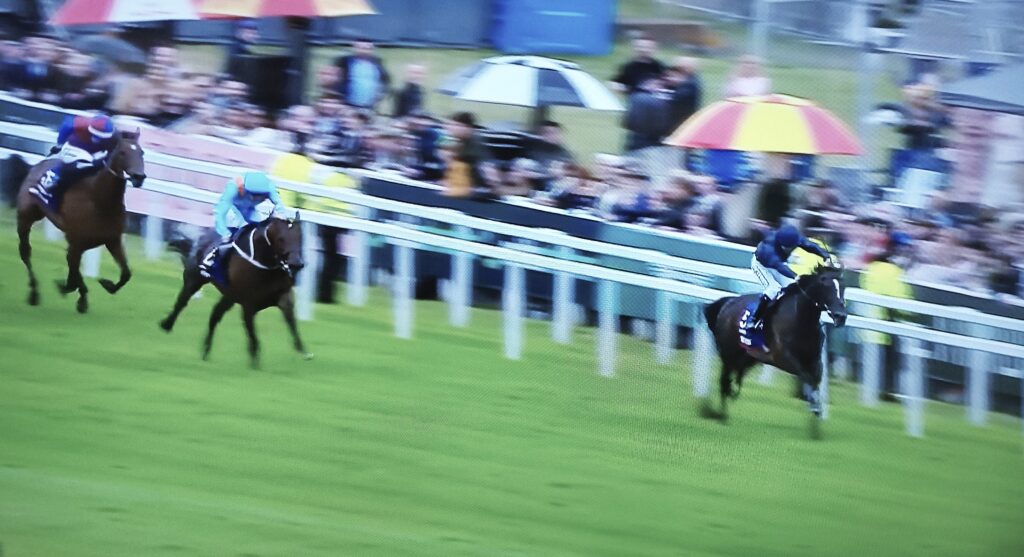
From three furlongs out, Lambourn, now three clear, continued to blaze away in the manor of Slip Anchor and was not for catching. With Sea Scout and Lazy Griff in vain pursuit, Lambourn extended his lead the further they went.

Lazy Griff once second, stuck to his task, but could make no impression on the winner. Tennessee Stud made late headway to finish third, whilst New Ground took fourth in the final strides,

Delacroix, never got into the race after being hampered and was taken back. Pride Of Arras made no impression from his wide draw and was never able to settle. The Lion In Winter, also drawn wide, pulled hard and weakened early in the straight.                                        18 ran    Time 2min 38.50 sec

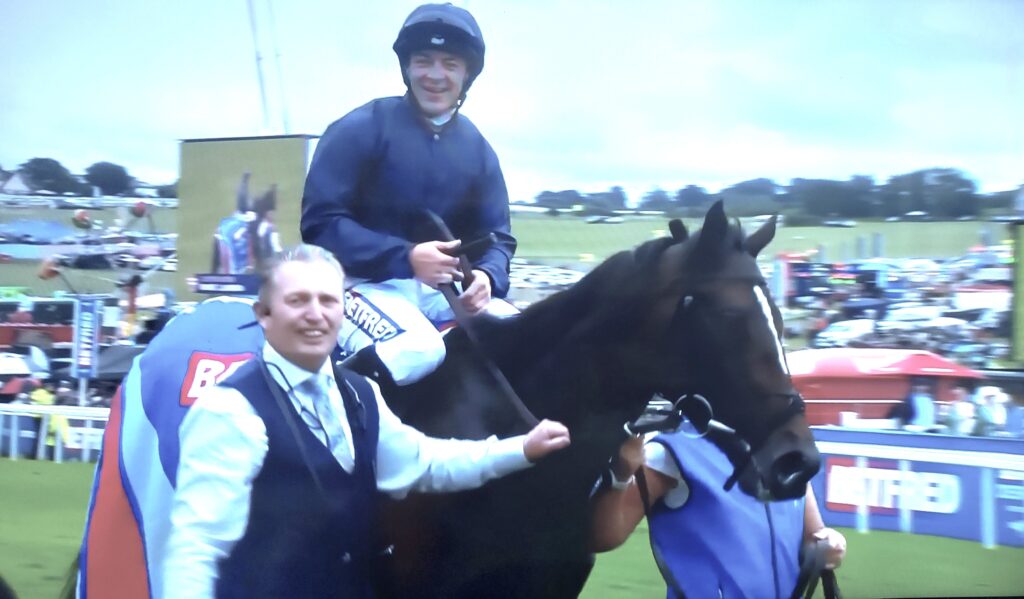
This was Aidan O’Brien’s record eleventh Derby winner and Mrs John (Sue) Magnier and Michael Tabor’s 12th in partnership.


Wayne Lordan and Lambourn – The conquering heroes.

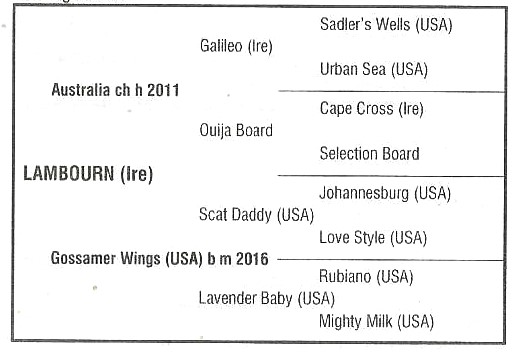
The winner was BRED by Coolmore, OWNED by Mrs John Magnier, Michael Tabor & Derrick Smith and TRAINED by A.P. O’Brien at Cashel, Co. Tipperary.

The winner, LAMBOURN, has won 4 races from 6 starts incl. Boodles Chester Vase, Betfred Derby, Epsom; second to Delacroix in the P. W. McGrath Memorial Ballysax Stakes, Leopardstown.

The sire, AUSTRALIA (ch.c. 2011), won 5 races from 8 starts incl. ICON Breeders’ Cup Juvenile Turf Trial Stakes, Leopardstown, Investec Derby, Epsom, Dubai Duty Free Irish Derby, Juddmonte International Stakes, York. Third in QIPCO Two Thousand Guineas Stakes.

The dam, GOSSAMER WINGS (b.f. 2016) by SCAT DADDY ex LAVENDER BABY, won 1race from 14 starts. She also bred ENTHRALLING -.f. 2021 by GALILEO, placed 3 times from 7 starts.

______________________________________________________________________________________________________


The new Derby poem by Michael Church

Posted on:

The new Derby poem by Michael Church

Starting a new Derby tradition, Michael’s revised Derby poem is to be played on course and broadcast on TV as the Derby runners are circling, waiting to enter the stalls.

The poem to be read by a different famous personality each year to continue the tradition.

Click below to hear Richard Hoiles’s reading of Derby Day.


Derby Day

Today is Derby Day!

The Thoroughbred’s in bloom,

A nation’s hopes ride strong and proud

This late spring afternoon.


The plans, the trials, the joy, the tears

Have happened all before;

The race has run for two four six years

And shall for many more.


Whether in the Queen’s Stand high,

Or out across the Downs,

Or strolling through the fairground,

The magic still resounds.


It’s speed and heart, it’s fine and flight,

A test of nerve and grace-

Where history gallops into view,

And heroes find their place


The silks shine bright, the crowd holds breath,

The tension fills the air –

You place your bet…they’re moving in…

The Derby’s nearly there.


MICHAEL CHURCH

Official Derby Historian


2025 Betfred Oaks – Minnie Hauk

Posted on:

248                                MINNIE HAUK                             2025 

RUN on Friday, 6 June 2025, as the Betfred Oaks, over the Derby Course of one mile and a half and 6 yards, Epsom Downs. For three-year-old fillies, 9st 2lb. Value to winner £335, 033.36

1st   MINNIE HAUK                        Ryan Moore               9-2

2nd  WHIRL                                      Wayne Lordan          15-2                 Neck

3rd  DESERT FLOWER                  William Buick          11-10 Fav           4 lengths

Also ran:

4th Wemightakedlongway (Dylan Browne McMonagle) 16-1; Giselle (Colin Keane) 13-2; Revoir (Hector Crouch) 22-1 (tailed off); El Wateen (Jim Crowley) 14-1 (tailed off); Qilin Queen (Tom Marquand) 20-1 (tailed off); Go Go Boots (Oisin Murphy) 33-1 (tailed off, last).

 Commentary: Desert Flower, having won the May Hill at Doncaster and the Fillies Mile at Newmarket as a juvenile, cemented her Classic claims by winning the 1,000 Guineas. And although starting the Oaks as the 11-10 favourite, a few pedigree buffs doubted her ability to stay the distance. Minnie Hawk (by Frankel out of a Dansili mare), from the Aiden O’Brien yard, having won the Cheshire Oaks, had no such doubts and started 9-2 second favourite. While her stable companion Whirl, winner of the Musidora at York went off at  15-2.  To protect the ground inside the repositioned running rail for the following days Derby, an estimated 14 yards were added.

Off and running, Whirl was pushed to the front, chased up by Minnie Hauk, Wemightakedlongway and Desert Flower.  Continuing to the highest part of the course, Whirl extended her lead over Minnie Hauk to 3 lengths, with Wemightakedlongway and Desert Flower a little over a length behind.

The order maintained until 2 furlongs out from where Minnie Hauk joined Whirl to fight out an exciting finish, Moore and Lordan giving their best, until Minnie Hauk prevailed in the last few strides. Further behind, Desert Flower rallied to take third, a length ahead of Wemightakedlongway.


    9 ran. Time 2min 38.91 sec


BRED by B.V. Sangster.

OWNED by Derrick Smith, Mrs John Magnier & Michael Tabor. 

TRAINED by A.P. O’Brien at Cashel, Co Tipperary.

This was Mrs John Magnier’s 10th Oaks winner in partnership and Aidan O’Brien’s 11th Oaks winner.

______________________________________________________________________________________________________________________________

The winner, MINNIE HAUK (b.f. 2022), has won 3 races from 4 starts incl, Cheshire Oaks, Chester and the Betfred Oaks, Epsom.

The sire, FRANKEL (b.c. 2008) ex KIND by DANEHILL, (unbeaten), won 14 races incl. Two Thousand Guineas Stakes, St James’s Palace Stakes, Sussex Stakes, (twice), Queen Anne Stakes, International Stakes, Champion Stakes. Sire of 7 British Classic winners, incl. 3 Oaks winners since retiring to Judmonte’s Banstead Manor Stud in 2013: ANAPURNA , 2019 Oaks; LOGICIAN, 2019 St Leger, ADAYAR, 2021 Derby, HURRICANE LANE, 2021 St Leger, CHALDEAN 2023 , 2000 Guineas, SOUL SISTER, 2023 Oaks and MINNIE HAUK 2025 Oaks.

The dam, MULTILINGUAL (b.f. 2012) by DANSILI, a half-sister to KINGMAN, she also bred TILSIT, won 3 races from 8 starts incl. Gp 2 Summer Mile Stakes, Ascot.

_____________________________________________________________________________________________________________________________________


Derby Day Commentaries – Dante

Posted on:

Derby Day Commentaries – Dante

The 1945 Derby Day Commentary

1st DANTE Billy Nevett 100-30 Fav

2nd MIDAS Eph Smith 6-1      2 lengths

3rd COURT MARTIAL Cliff Richards 100-9     a head

Dante wins the 1945 Derby from Midas (hidden).

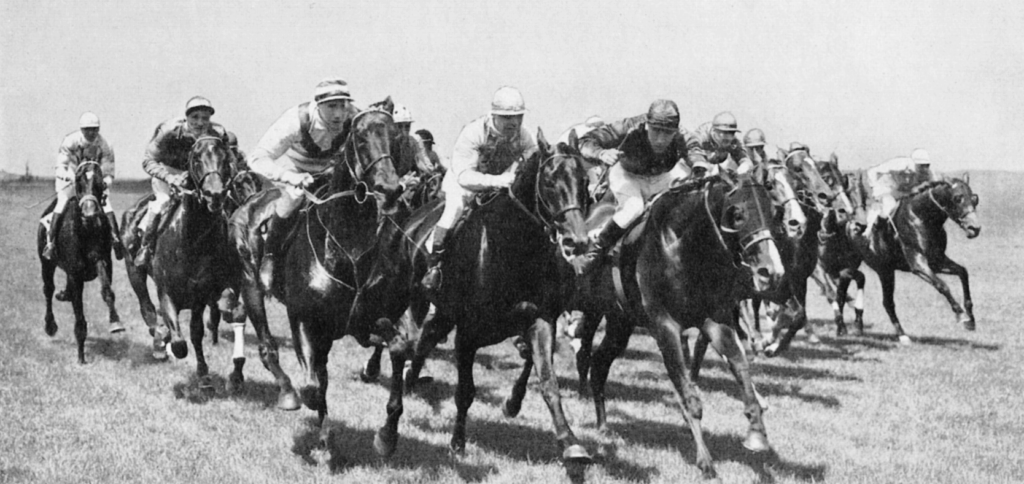
Commentary: The war in Europe had been over for a month and thousands came to see the final Derby run over the July Course at Newmarket. Dante, a close second to Court Martial in the Guineas was favourite at 100-30. Next in the betting were two colts by Hyperion – Lady Derby’s High Peak, on 5-1 and Lord Rosebery’s Newmarket Stakes winner, Midas, on 6-1. Stamina doubts raised against Court Martial kept him at 100-9. After a good start, Rio Largo led the field to Plantation Corner, where Sun Storm went on from High Peak, Rising Light and Midas. In the dip, Midas took up the running, pursued by Dante and Court Martial, but before reaching the hill, Dante shot through to lead, going on to win by two lengths. The time of 2 min 26.60 sec, equalled Watling Street’s best time for the 10 Derby’s run at Newmarket. In a great battle for the places, Midas finished second, a head in front of the fast-finishing Court Martial, with Chamossaire, a neck away fourth.

27 ran • Time: 2 min. 26.60 sec.

BRED & OWNED by Sir Eric Ohlson. TRAINED by Mathew Peacock at Middleham, Yorkshire.

Although odds on for the St Leger, after conflicting rumours Dante never ran again. Retiring to Theakston Stud, Bedale, he sired Darius (b.c.1951), won Two Thousand Guineas Stakes, St James’s Palace Stakes, Eclipse Stakes.


For more racing history see Michael’s Books for Sale. 
To see Michael’s interviews go to the foot of About Michael