The Romance of
Wild Dayrell
WILD DAYRELL was bred by Francis Popham at Littlecote House, Littlecote Park in Wiltshire, and named after the notorious, 16th century owner of the place – a man described as a ‘wildshaver’ who, by good fortune escaped the gallows, only to be killed by a fall from his horse. Soon after, the estate came into the possession of the Popham family, who it was said, witnessed the ghost of Dayrell on more than one occasion.
Popham, a hunting man, cautiously began to breed thoroughbreds and after agreeing to £50 for Ellen Middleton, a daughter of the 1836 Derby winner, Bay Middleton, he mated her to Ion, the runner-up in both the 1838 Derby and St Leger.
The arrival of Ellen Middleton’s first foal – caused great excitement within the household. Edward Moorhouse relates “The Druid’s” account:
“When the colt appeared between midnight and one o’clock in the morning the butler was rung up and rushed on the scene with his nightcap on his head and a bottle of wine in his hand; and, as it was necessary to remove the little stranger into a warmer box, he got a wheelbarrow and insisted on “’wheeling the winner of the Derby once in my life.’” Further. when Rickaby (the stud-groom), got to his cottage at five o‘clock that April morning, he told his wife that there must be something remarkable for good or evil about the colt, because he had just seen the strange sight of a wild duck and a wild drake sitting on a quickset hedge close to the high road!”
The colt that the omen applied to was named, “for good or evil”, Wild Dayrell and was sold without sentiment to the Duke of Richmond’s son, Lord Henry Lennox, for 100 guineas, with a 500-guinea contingency if he won the Derby.
Packed off to Goodwood to be trained by John Kent, Wild Dayrell was slow to mature and at the Duke of Richmond’s dispersal sale he was sent with others to Tattersall’s. One account relates there was no bid for him and that Mr Popham bought him back privately for 180 guineas, allowing his neighbour, Lord Craven a share.
With stud groom John Rickaby appointed trainer, a primitive training gallop was laid out at Littlecote Park and together with a three-year-old filly and a five-year-old gelding, Wild Dayrell continued his career until May 1854, when all three were sent over to Lord Craven’s Ashdown Park, in the care of John Rickaby.
A big, strong horse, Wild Dayrell eventually came to hand and made a winning debut in late September, starting favourite in a three-horse-race over the Newmarket’s Two-Year-Course (five furlongs, 140 yards). That was to be his only run as a two-year-old and he never ran again before the Derby.
In order to give Wild Dayrell a serious preparation for the Derby many horses were bought or borrowed to trial him, but none were up to the task. A recent Chester winner, Jack Shepherd, was therefore bought for £1,600. Ten days before the race, giving Jack Sheppard a year and 8lb and another four-year-old 2 stone, he cruised past them with ease, prompting Charlton, the rider of Jack Sheppard, to exclaim: “I thought King Tom’s trial a good one last year, but I never rode against such a horse as this before.”
Wild Dayrell was not, however, ‘clear of the wood’ yet. When news of the trial leaked out, the colt’s chances sparked a rush of bets for the Derby, although strangely, his price never shortened.
In a fiendish attempt to stop him reaching Epsom, nobblers removed the linchpins from the wheels of his horsebox but Popham and his trainer Rickaby were forewarned and substituted a bullock for the Derby favourite – the horse box came crashing down and the bullock broke a leg.. Then, in one last desperate attempt, bookmakers’ ‘agents’ offered Popham £5,000 cash not to run Wild Dayrell.
After all the trials, schemes, plots and hedging of bets, Derby Day arrived and so did Wild Dayrell. Those who had tried to stop him were now forced to back him, so sending his price down from 3-1 to even-money. Meanwhile, the Two Thousand Guineas winner, Lord of the Isles, remained steady at 7-4, while Kingstown, third in the Guineas, drifted alarmingly from 9-2 to 12-1.
This year, however, the attendance was down and the normal razzamatazz of Derby Day, somewhat subdued. England was in the throes of the Crimean war and effects of the revealing aftermath of the ‘Charge of the Light Brigade’.
On a dull and cold day, the field of 12 first made their way from the Paddock to Tattenham Corner, where they waited for the course to be cleared, before running ‘The Preliminary Canter’ past the grandstands and on to the starting post.
Off and running, Lord of the Isles, having pulled very hard for the first two furlongs, was allowed by Tom Aldcroft to make the running to the top of the hill. There, joined by Kingstown, the pair raced down to Tattenham Corner, with Wild Dayrell moving in just behind them..The three principals then raced together to the furlong pole, where Robert Sherwood let Wild Dayrell have his head, and as Lord of the Isles and Kingstown had little more to give, he swept past to win by two lengths. Kingstown held on to be second by a head with Lord of the Isles third, Flatterer fourth and Courtenay fifth.
The crowd resolutely cheered home Wild Dayrell and most of the bookmakers lost money. ‘Leviathan’ Davis took £50,000 but paid out £70,000. Francis Popham, who said he was not a betting man, won a brilliant wager of £l0,000 to £150, which he shared with his friends. He later made it known, that nothing ever again would induce him to own another Derby horse.
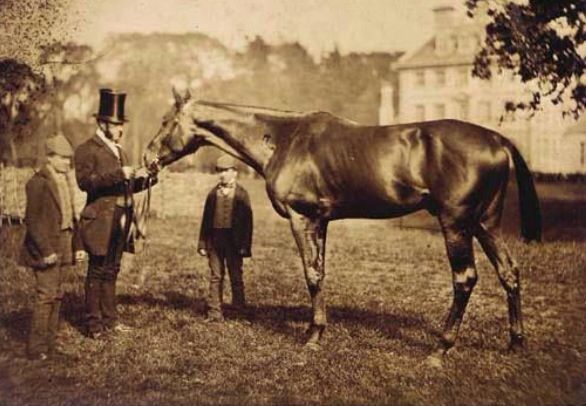
Wild Dayrell ran twice more. He won the Ebor St Leger at York, beating the Ascot Gold Vase winner Oulston, but broke down in the Doncaster Cup won by Rataplan. He went to stud at Chilton Folliat, near Hungerford, at a fee of 30 guineas. A magnificent brown horse standing 16.1 hands, he looked even bigger, with “immense arms, gaskins, knees and hocks”.
He proved popular with breeders, siring many good winners including, Buccaneer (Royal Hunt Cup), who went on to be Champion Sire in 1868, when his filly Formosa won four Classics. He also sired Hurricane, who took the One Thousand Guineas and later produced the Two Thousand Guineas winner Atlantic.
Wild Dayrell died in his stall at Littlecote in November 1879, aged 27 years.
The picture, thought to be taken by Robert Howlett in 1855, is the oldest known photograph of a Thoroughbred racehorse.
Wild Dayrell’s Derby jockey, Robert Sherwood (1835-1894), when 18 years old, won both the Prix du Jockey-Club and the Prix de Diane on M. Lupin’s Jouvence. However, two years after his Derby victory, he steadily gained in weight until, in 1863, he went to Hong Kong to manage the racing stables of some British merchants. A few years after returning to England, he trained from Exeter House, Newmarket, where he sent out Jack Hammond’s St Gatien to dead-heat with Harvester in the 1884 Derby. Sherwood also won the 1889 Oaks with L’Abbesse de Jouarre for Lord Randolph Churchill.
For more Racing History see Michael’s Books for Sale.