Archive for April, 2022

NIJINSKY – The last Triple Crown winner ?
Posted on:


NIJINSKY – The last Triple Crown winner ?


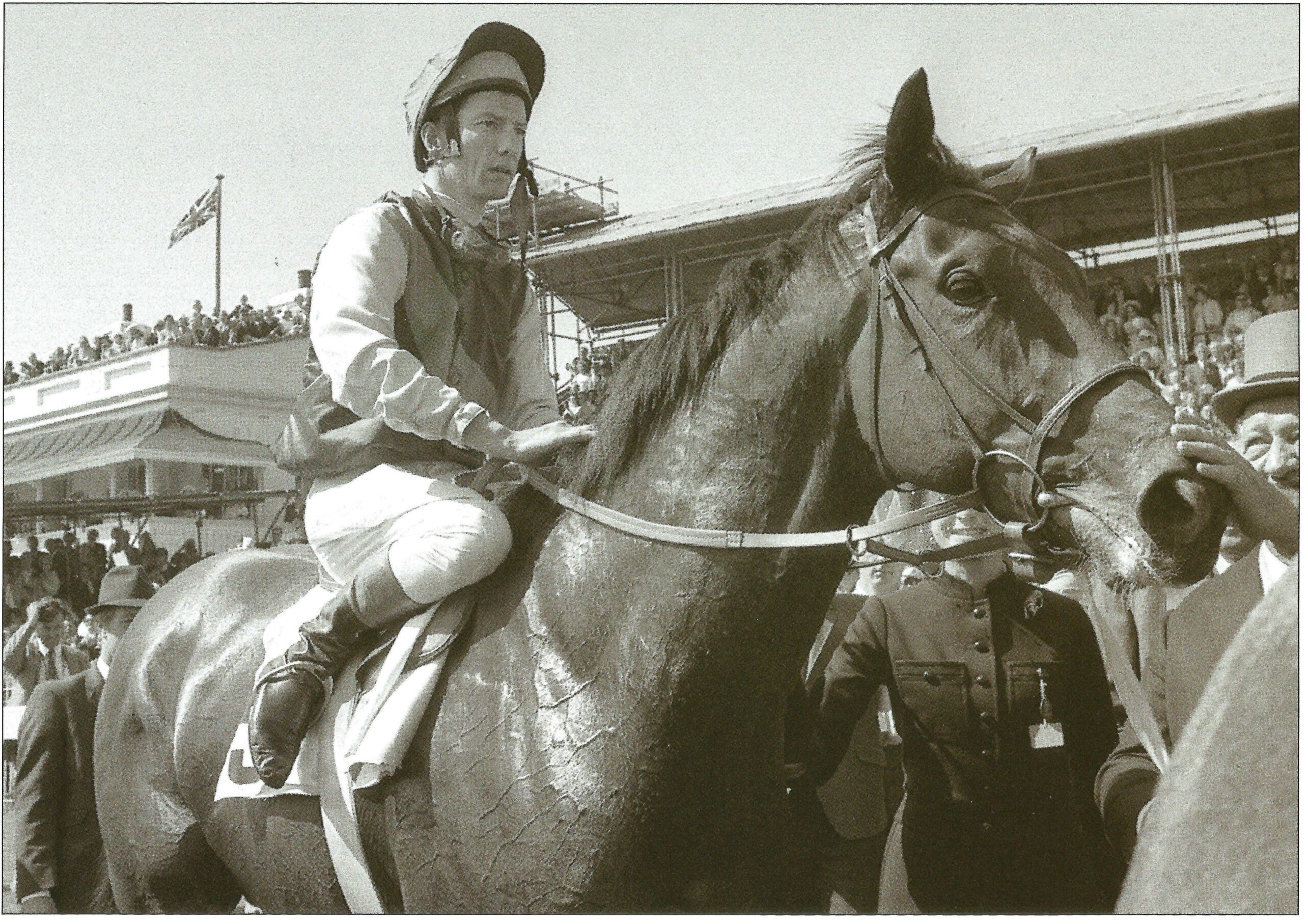
WHEN Nijinsky landed the Triple Crown in 1970, many judges suspected he might be the last horse to achieve this magnificent treble. Poignantly, his brilliant racecourse career mingled triumphs with moments of great sorrow for his thousands of fans.

Nijinsky, born on 21 February, 1967, was bred by Edward P.Taylor in Ontario, Canada. Sired by the great Northern Dancer out of Flaming Page, a Canadian Classic winner of nervous temperament, Nijinsky was bought by Charles Engelhard at the Woodbine Sale in Toronto for Can$84,000 (a Canadian yearling record) and sent to be trained by Vincent O’Brien in Ireland.

A powerful, bright bay colt with three white feet and a large heart-shaped star on his forehead, Nijinsky stood 15.3½   hands high as a yearling and grew to 16.3 hands as a two-year-old.

After a winning debut in the Erne Stakes at The Curragh, Nijinsky returned there to take the Railway Stakes, the Anglesey Stakes and the Beresford Stakes. He was partnered each time by Liam Ward, who rode him in all his races in Ireland, while Lester Piggott had the mount in England and France. Nijinsky’s final race of the season was the Dewhurst Stakes, and his convincing three lengths victory ensured him top spot in the English and Irish Free Handicaps.

The following April, Nijinsky reappeared in the Gladness Stakes at The Curragh, beating the Irish St Leger second Deep Run by four lengths. He followed up in the Two Thousand Guineas, effortlessly accounting for Yellow God.

Doubts about Nijinsky’s stamina for the Derby allowed him to start 11-8 favourite, the only time he went off at odds against in his 13-race career. The pick of Nijinsky’s rivals were Gyr, winner of the Prix Daru and Prix Hocquart; Stintino, winner of the Prix Lupin; and Approval, winner of the Observer Gold Cup and Dante Stakes.

In the descent to Tattenham Corner,Meadowville and Long Till led Gyr and Great Wall with Nijinsky going easily behind the leaders.With a furlong and a half to go, Gyr took up the running, pressed by Great Wall, Stintino and Nijinsky. A furlong out Nijinsky burst through between the leaders and came away to win by two and a half lengths from Gyr, with Stintino a further three lengths away third. It was an emphatic victory and one that answered every question. Nijinsky’s time for the race was 2 min 34.68 sec, the fastest since Mahmoud in 1936.

Nijinsky went on to win the Irish Sweeps Derby by three lengths from Meadowville and the King George VI and Queen Elizabeth Stakes by two lengths, from the plucky Blakeney. He then won the St Leger from Meadowville (see below), with consummate ease, so completing a historic Triple Crown.
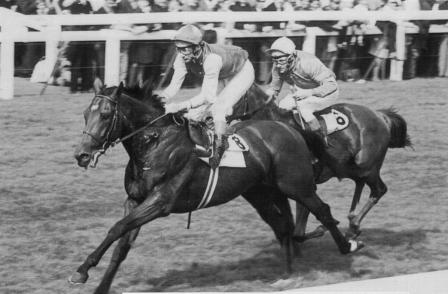
Sadly, he never won again. The attack of ringworm he suffered before the St Leger may have taken its toll, but at the time his head defeat by Sassafras in the Prix de l’Arc de Triomphe was put down to his extreme nervousness and fretting throughout the preliminaries, while his loss to Lorenzaccio in the Champion Stakes was clearly a case of going to the well once too often.

At stud Nijinsky did superbly, getting three Derby winners – Golden Fleece (1982), Shahrastani (1986) and Lammtarra (1995) – plus the 1986 Kentucky Derby winner Ferdinand. He was Champion Sire in 1986 and sired the Champion Sire of 1988 and 1991 in Caerleon. After a long struggle against laminitis, Nijinsky was put down on 15 April, 1992 and buried at Claiborne Farm in Kentucky.

Charles W. Engelhard, Jnr. (1917-1971) was a multimillionaire minerals industrialist from New Jersey. His colours of ‘green, yellow sleeves, scarlet sash, green cap’ made famous by Nijinsky, were also carried by Indiana (1964 St Leger) and the brothers Ribocco and Ribero, who in 1967 and 1968 respectively, won both the Irish Sweeps Derby and the St Leger.

When asked how he wished to be remembered, Engelhard, one of the richest men in the world, said simply, “As the man who owned Nijinsky”.

He died at his home in Boca Grande, Florida on 2 March, 1971 after a heart attack.

________________________________________________________________

For more Racing History see Michael’s Books for Sale.   

To see Michael’s interviews go to the foot of About Michael
The Kidnapping of Shergar

Posted on:


At around 8.40, on Tuesday, 8 February, 1983, a time before electronic security gates and CCTV cameras, an armed gang of six or more men broke into the Aga Khan’s Ballymany Stud, near Newbridge, County Kildare. Three of them, masked and armed, forced their way into the house, bludgeoning down Bernard Fitzgerald at the front door and holding the family at gunpoint in the kitchen.

“We have come for Shergar.  We want £2 million for him.”

Shergar’s groom, Jim Fitzgerald, father of Bernard, was then ordered to help load the stallion into their horsebox, while two further gunmen were detailed to guard the groom’s family. Shergar was then towed away and never seen again.

Meantime, Jim Fitzgerald was put into a car, driven around for three hours and on receiving the password for negotiations, was pushed out on to a quiet road a few miles from home. Strangely, it was eight hours before the Garda were informed of Shergar’s kidnapping, Fitzgerald later telling Chief Superintendent James Murray of the Newbridge Police that the gangsters always referred to each other as Cresswell!

That evening, the story was broadcast by Alistair Burnet on ITV’s News at Ten, explaining the repercussions within the Thoroughbred Industry. Shergar, whose value was assessed at £10 million, had previously been syndicated into 40 shares; 34 sold to investors at £250,000 each, with the remaining six shares held by the Aga Khan. In return, shareholders would hope to receive a foal each year.

The £2 million ransom demand, was on realisation of the multiple ownership, subsequently reduced to £40,000. However, the kidnappers received no payment and Shergar was never found. On 16 June, it was reported that the insurers, Lloyds of London, having received no further contact from the kidnappers, had agreed to pay £7 million to the owners’ syndicate, on the presumption that Shergar was dead.


For the record, Shergar, was a rich bay colt of 15 hands 3, with a white blaze and four white socks. Bred by his owner the Aga Khan, he was by Great Nephew (the sire of the 1975 Derby winner, Grundy), out of Sharmeen by Val de Loir.

Sent to trainer Michael Stoute at Newmarket, Shergar ran twice as a juvenile, winning the Kris Plate at Newbury on his debut and following up with a 2½ length second to Beldale Flutter in Doncaster’s Group 1 Futurity Stakes, after which 33-1 could be obtained about his chance in the Derby.

Reappearing in the spring, Shergar impressively won the Sandown Classic Trial by 10 lengths and the Chester Vase by 12 lengths. Meanwhile, a week before the Derby, his main rival, Beldale Flutter, was involved in a freak training accident on Newmarket Heath, falling heavily on a road, sustaining serious injuries to his knee and ribs, so causing his withdrawal from the Derby and sending Shergar’s odds tumbling to 10-11.

With the opposition now considerably weaker, Lester Piggott’s mount Shotgun (second to Beldale Flutter in the Mecca-Dante Stakes), became second favourite at 7-1. Others for small money were Kalaglow, winner of the Heath Stakes, and Glint of Gold, successful in the Warren Stakes at Epsom and the Derby Italiano.


On a hot, sunny Derby Day, with the police in shirt sleeves, 18 runners went to post on good-to-soft ground.

At the top of the hill Riberetto led from Silver Season with Shergar two lengths away third.

Entering the straight, Shergar joined the leaders and cruised into an unassailable lead.

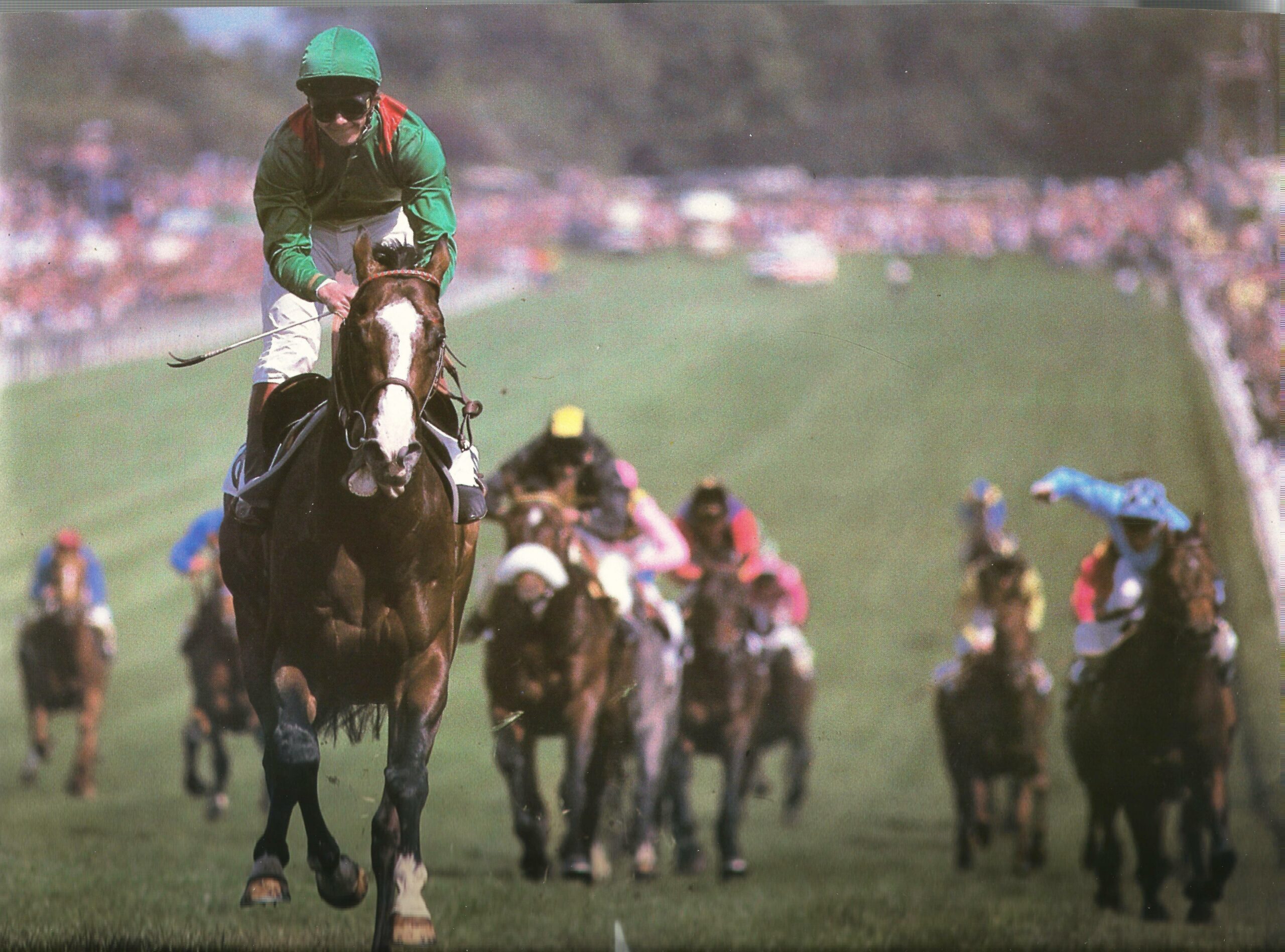
At the two-furlong marker he was four lengths clear, a furlong later, the distance had doubled, until eventually eased down in the hands of 19-year-old Walter Swinburn, he won by 10 lengths – the greatest winning distance in the history of the race.

The placings were all but irrelevant, but for the record Glint of Gold finished second, two lengths ahead of Scintillating Air.

Strangely, the time, 2 min 44.21 sec., was the slowest since Airborne in 1946, which, may have been due to the ground, the quality of Shergar’ s opponents, the ease of his victory, or all three.


Shergar went on to win the Irish Derby by four lengths from Cut Above, and the King  George VI and Queen Elizabeth Diamond Stakes by four lengths from Madam Gay. In the St Leger, however, he made no impression in the final quarter-mile and finished a disappointing fourth behind Cut Above and Glint of Gold.

Shergar did not run in the Prix de l’ Arc de Triomphe as planned and retired to stud forthwith. His first and only crop included Authaal, winner of the Irish St Leger, and Maysoon, placed in both the One Thousand Guineas and Oaks.


Further evidence in the Shergar kidnapping mystery came to light in a piece published by Racing Post on 20 May, 1998. It stated:

“Sean OCallaghan, a senior member of the Provisional IRA who later turned informer, backs up the findings of the security report commissioned by Shergar‘s owner the Aga Khan. O Callaghan reveals the kidnap plot was hatched in prison by a former bookies clerk and republican veteran, who was head of a special operations team set up to raise money for Sinn Fein and buy weapons for the  IRA.

In published extracts from O’Callaghan’s book “The Informer”, he stated:

“Shergar was loaded into a horsebox and driven off towards north County Leitrim …The horse threw itself into a frenzy in the horsebox, damaging a leg and proving impossible  for the team to control. He was killed within days, even though the IRA kept up the pretence he was alive.


Sadly, the kidnapping of Shergar is what most people are now left with, however, I would like to redress the balance with the memory of his record 10 length victory at Epsom. Long may it last.


For more Racing History see Michael’s Books for Sale. 

  To see Michael’s interviews go to the foot of About Michael