Archive for September, 2025

The Romance of Wild Dayrell

Posted on:

The Romance of

Wild Dayrell


WILD DAYRELL was bred by Francis Popham at Littlecote House, Littlecote Park in Wiltshire, and named after the notorious, 16th century owner of the place – a man described as a ‘wildshaver’ who, by good fortune escaped the gallows, only to be killed by a fall from his horse. Soon after, the estate came into the possession of the Popham family, who it was said, witnessed the ghost of Dayrell on more than one occasion.

Popham, a hunting man, cautiously began to breed thoroughbreds and after agreeing to £50 for Ellen Middleton, a daughter of the 1836 Derby winner, Bay Middleton, he mated her to Ion, the runner-up in both the 1838 Derby and St Leger.


The arrival of Ellen Middleton’s first foal  – caused  great excitement within the household. Edward Moorhouse relates “The Druid’s” account:


“When the colt appeared between midnight and one o’clock in the morning the butler was rung up and rushed on the scene with his nightcap on his head and a bottle of wine in  his hand; and, as it was necessary to remove the little stranger into a warmer box, he got a wheelbarrow and insisted on  “’wheeling the winner of the Derby once in my life.’Further. when Rickaby (the stud-groom), got to his cottage at five  oclock  that  April morning, he told his wife that there must be  something remarkable for good or evil about the colt, because he had  just seen the  strange sight of a  wild duck and wild  drake sitting on a quickset hedge close to the high road!”


The colt that the omen applied to was named, “for good or evil”, Wild Dayrell and was sold without sentiment to the Duke of Richmond’s son, Lord Henry Lennox, for 100 guineas, with a 500-guinea contingency if he won the Derby.


Packed off to Goodwood to be trained by John Kent, Wild Dayrell was slow to mature and at the Duke of Richmond’s dispersal sale he was sent with others to Tattersall’s. One account relates there was no bid for him and that Mr Popham bought him back privately for 180 guineas, allowing his neighbour, Lord Craven a share.


With stud groom John Rickaby appointed trainer, a primitive training gallop was laid out at Littlecote Park and together with a three-year-old filly and a five-year-old gelding, Wild Dayrell continued his career until May 1854, when all three were sent over to Lord Craven’s Ashdown Park, in the care of John Rickaby.


A big, strong horse, Wild Dayrell eventually came to hand and made a winning debut in late September, starting favourite in a three-horse-race over the Newmarket’s Two-Year-Course (five furlongs, 140 yards). That was to be his only run as a two-year-old and he never ran again before the Derby.


In order to give Wild Dayrell a serious preparation for the Derby many horses were bought or borrowed to trial him, but none were up to the task. A recent Chester winner, Jack Shepherd, was therefore bought for £1,600. Ten days before the race, giving Jack Sheppard a year and 8lb and another four-year-old 2 stone, he cruised past them with ease, prompting Charlton, the rider of Jack Sheppard, to exclaim: “I thought King Tom’s trial a good one last year, but I never rode against such a horse as this before.”


Wild Dayrell was not, however, ‘clear of the wood’ yet. When news of the trial leaked out, the colt’s chances sparked a rush of bets for the Derby, although strangely, his price never shortened.


In a fiendish attempt to stop him reaching Epsom, nobblers removed the linchpins from the wheels of his horsebox but Popham and his trainer Rickaby were forewarned and substituted a bullock for the Derby favourite – the horse box came crashing down and the bullock broke a leg.. Then, in one last desperate attempt, bookmakers’ ‘agents’ offered Popham £5,000 cash not to run Wild Dayrell.

After all the trials, schemes, plots and hedging of bets, Derby Day arrived and so did Wild Dayrell. Those who had tried to stop him were now forced to back him, so sending his price down from 3-1 to even-money. Meanwhile, the Two Thousand Guineas winner, Lord of the Isles, remained steady at 7-4, while Kingstown, third in the Guineas, drifted alarmingly from 9-2 to 12-1.


This year, however, the attendance was down and the normal razzamatazz of Derby Day, somewhat subdued. England was in the throes of the Crimean war and effects of the revealing aftermath of the ‘Charge of the Light Brigade’.


On a dull and cold day, the field of 12 first made their way from the Paddock to Tattenham Corner, where they waited for the course to be cleared, before running  ‘The Preliminary Canter’ past the grandstands and on to the starting post.


Off and running, Lord of the Isles, having pulled very hard for the first two furlongs, was allowed by Tom Aldcroft to make the running to the top of the hill. There, joined by Kingstown, the pair raced down to Tattenham Corner, with Wild Dayrell moving in just behind them..The three principals then raced together to the furlong pole, where Robert Sherwood let Wild Dayrell have his head, and as Lord of the Isles and Kingstown had little more to give, he swept past to win by two lengths. Kingstown held on to be second by a head with Lord of the Isles third, Flatterer fourth and Courtenay fifth.


The crowd resolutely cheered home Wild Dayrell and most of the bookmakers lost money. ‘Leviathan’ Davis took £50,000 but paid out £70,000. Francis Popham, who said he was not a betting man, won a brilliant wager of £l0,000 to £150, which he shared with his friends. He later made it known, that nothing ever again would induce him to own another Derby horse.


Wild Dayrell ran twice more. He won the Ebor St Leger at York, beating the Ascot Gold Vase winner Oulston, but broke down in the Doncaster Cup won by Rataplan. He went to stud at Chilton Folliat, near Hungerford, at a fee of 30 guineas. A magnificent brown horse standing 16.1 hands, he looked even bigger, with “immense arms, gaskins, knees and hocks”.

He proved popular with breeders, siring many good winners including, Buccaneer (Royal Hunt Cup), who went on to be Champion Sire in 1868, when his filly Formosa won four Classics. He also sired Hurricane, who took the One Thousand Guineas and later produced the Two Thousand Guineas winner Atlantic.


Wild Dayrell died in his stall at Littlecote in November 1879, aged 27 years.


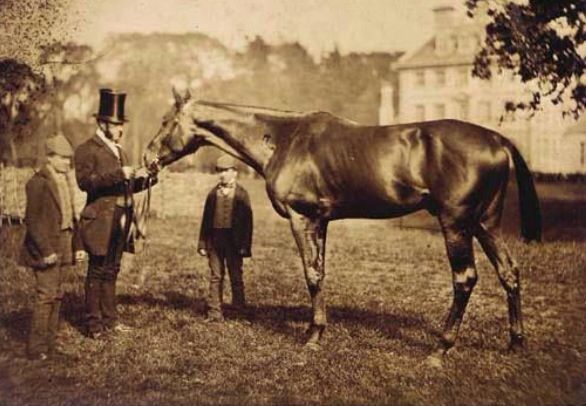
The picture, thought to be taken by Robert Howlett in 1855, is the oldest known photograph of a Thoroughbred racehorse.


Wild Dayrell’s Derby jockey, Robert Sherwood (1835-1894), when 18 years old, won both the Prix du Jockey-Club and the Prix de Diane on M. Lupin’s Jouvence. However, two years after his Derby victory, he steadily gained in weight until, in 1863, he went to Hong Kong to manage the racing stables of some British merchants. A few years after returning to England, he trained from Exeter House, Newmarket, where he sent out Jack Hammond’s St Gatien to dead-heat with Harvester in the 1884 Derby. Sherwood also won the 1889 Oaks with L’Abbesse de Jouarre for Lord Randolph Churchill.


For more Racing History see Michael’s Books for Sale.

Harry Wragg and the Brylcreem Boy

Posted on:

Harry Wragg and the Brylcreem Boy


This popular story, from Ripping Gambling Yarns was the very first of my short stories and goes back to an age before betting shops.


 I knocked twice on the dark stained door at the end of the passage.

A small hatch slid open.

“Oxo,” I said boldly, standing on tiptoe.

Alice let me in.

I entered the smoke-filled room where the usual crowd huddled around the ticker-tape machine, its stuttering chatter competing with the ringing telephones.

This is the back room of Charlie Young’s Hairdressing Salon and, as a chirpy, skinny ten-year-old, my excessive enthusiasm for racing and betting has led me to be accepted by all the regulars.


Today is both the last day of the 1946 Flat Season and the last day in the riding career of Harry Wragg, so consequently, my last chance to back him.

Harry was the thinking man’s jockey, known nationally as ‘The Head Waiter’ because of his effective waiting tactics. He had been champion jockey in 1941, and ridden the winners of 13 Classic races, including three Derby winners – Felstead (in 1928), Blenheim (1930) and Watling Street (1942). He also had two younger brothers, Sam and Arthur who were both successful jockeys in their own right.

Time running out, I quickly scribbled my first bet, 2/- win Tiffin Bell, (Harry’s first mount), and slid it across to Charlie’s lanky blonde wife Alice, who promptly secured it among 50 or so others in a giant bulldog clip.

“Two lumps today, Alice,” I piped, reaching for the obligatory cup of tea.  But before I had put the cup to my lips, Uncle Albert shouted across “Result Manchester – 1.15 – first Tiffin Bell – 5-2.”

“Blimey, I’m off to a good start,” I squeaked.


During the next 30 minutes, a pipe and two Capstan full strength passed through the security system and quickly contributed to the diminishing visibility.

Continuing my loyalty to H. Wragg, I invested 2/- to win on Aprolon in the next, and made myself useful by taking a tray of tea and biscuits out to Charlie in the shop.

Charlie, a dead ringer for Alfred Hitchcock, often used his ventriloquist talents whilst cutting hair.

“How’s it going young squirt?” he enquired, throwing his voice to the corner of the salon.

“I backed Tiffin Bell, won 5-2,” I boasted.

“Then you can afford a hair cut he replied,” still in the high squeaky voice.

“Sit in the end chair.”

Ten minutes later I re-entered the betting room sporting a well-slicked head.

“Aprolon won at 7-4 Michael,” Alice said, coughing manfully, adding “it must be your lucky day.”

“And Harry’s,” I said.

“What are you doing in the big one?” she enquired.

“Well, I’ve got to stick to Wragg now, but c-c-can I have a sub on my winnings?  I did have a shilling left over, but I had my hair cut.”

“Ask Taffy to settle up on one of your slips.”

“Bloody hell boyo,” said Taffy, “its like looking for a needle in a haystack.  Tell you what, I’ll lend you two bob until Monday.”

“Super,” I replied, and instantly returned the coin to his hand.

“Put it on Las Vegas in the N-November Handicap,” I stammered.

Two fifteen approached and the request for prices from the ticker-tape had the ring of an auction. Five to one Dornot – Rae Johnson; 100-8 Star of Autumn – Charlie Smirke; 20-1 Las Vegas – Harry Wragg.


Arriving just in time for the big race, I recognised the voices of Uncle Arthur (Craven A), and Uncle Henry (Rothmans), through the blue haze.  At this time, it was thought expedient by a health fanatic, to take the drastic step of opening a window an inch or two, as visibility had fallen to one pace, and it was difficult to hear the odds over the coughing.

Standing on a chair, Taffy shouted out “Under orders Manchester,” shortly followed by “Off Manchester 2-20.”

A stillness now came over the assembly, and strangely, the absence of a running commentary in no way diminished the excitement, as each man prepared himself for the instant finality of the result.

The silence was finally broken by the sound of the ticker-tape. Taffy crouched over it assisting its passage like a midwife at a birth.

“Here it comes,” Taffy warned … “Manchester – 2.15 – first, Las Vegas 20-1, second, Delville Wood 33-1, third, Star of Autumn….”


At this point Charlie, burst in shouting “Quiet everybody, quiet, I’ve just seen two coppers hanging about outside – there’s going to be a raid – everyone upstairs, quick as you can.”

Charlie then went into his raid-drill, “Alice get rid of the ash-trays, Taffy give me the cash and the books, and put the ticker-tape under the stairs, NOW!”


A crocodile of disgruntled men climbed the stairs to temporarily pay their respects to Alice’s bewildered mother, Violet.  Meanwhile, Charlie beckoned to me, “You come with me boy.”

“They’re at the back door Charlie,” Alice cried out.

“Hold them up for as long as you can,” he replied, then staring close into the faces of two bemused customers, said, “You’ve seen nothing, OK – and your haircuts are on the house.”

“Michael, put the plank across the arms of that chair, and sit up on it.”  I obeyed instinctively.  Charlie then put the books, cash and betting slips into a pillowcase, pushed it under the plank and threw a large white cape around me to cover everything.


“Afternoon Mr Young.” The stentorian voice preceded the presence of two uniformed police officers.


“You’ve been very busy this afternoon.”

“Yes, usual Saturday afternoon you know.” Charlie replied, looking a little pale.

“Alice looks as if she has been washing up cups for an army,” the sergeant added sarcastically.

“Customers like a cup of tea with their haircut you know.”

“Yes of course, we must try that approach down at the station,” he retorted.

“Given up the betting, have you Charlie?” he persisted.

“Yes, a mug’s game really you know officer.”

“You’d be a mug if you got caught Charlie – a heavy fine could close your business down.”

“Yes officer, but all that’s in the past now.” said Charlie, riding his luck.

The sergeant’s gaze turned to the customers.

“Been waiting long, gents?” he probed, but their nervous mutterings revealed nothing.

Looking in the facing mirror, I watched the copper slowly circle my chair.

Until, “This boy’s nearly done.  Perhaps as a favour you could cut my hair next.”

I could feel my heart beating – my winnings were in that pillowcase.

Suddenly, I blurted out,

“Ch-Charlie’s got to wash it first, officer, I’ve only just got here.”

Charlie’s blanched face sprang to life.

“Yes, course I have. His Mum hates all that Brylcreem plastered all over it.”


Terrifyiingly, I felt myself propelled forward to the basin for a vigorous hair washing.  This, having been done under the sergeant’s steady gaze, Charlie was then obliged to begin my second haircut of the afternoon.  As the sergeant’s puzzled frown deepened, Charlie explained helpfully, “His mum likes it short!”

“Oh well, must be getting along, I suppose.” The sergeant slowly moved towards the door before pausing.

“There’s just one thing you might like to help with Charlie,” he said thoughtfully.

“Of course officer, anything,” said Charlie obsequiously.

“I’ve got ten tickets left for the Police Dance next Saturday, would you like to take them off my hands?  Be good for you and Alice to get out occasionally.”

Charlie gritted his teeth and paid up.


Leaving by the front door the two policemen were joined by Uncles Arthur and Henry tiptoeing down the stairs from the now profoundly bewildered Violet.

“What are you two up to – leaving the scene of the crime?” questioned the sergeant.

“No officer,” said Arthur, “we’ve just been estimating for a wallpapering job.”

“A cover up job, more likely,”


As the story of this raid went around Woking, so I became the boy hero, albeit with the shortest haircut in Surrey.