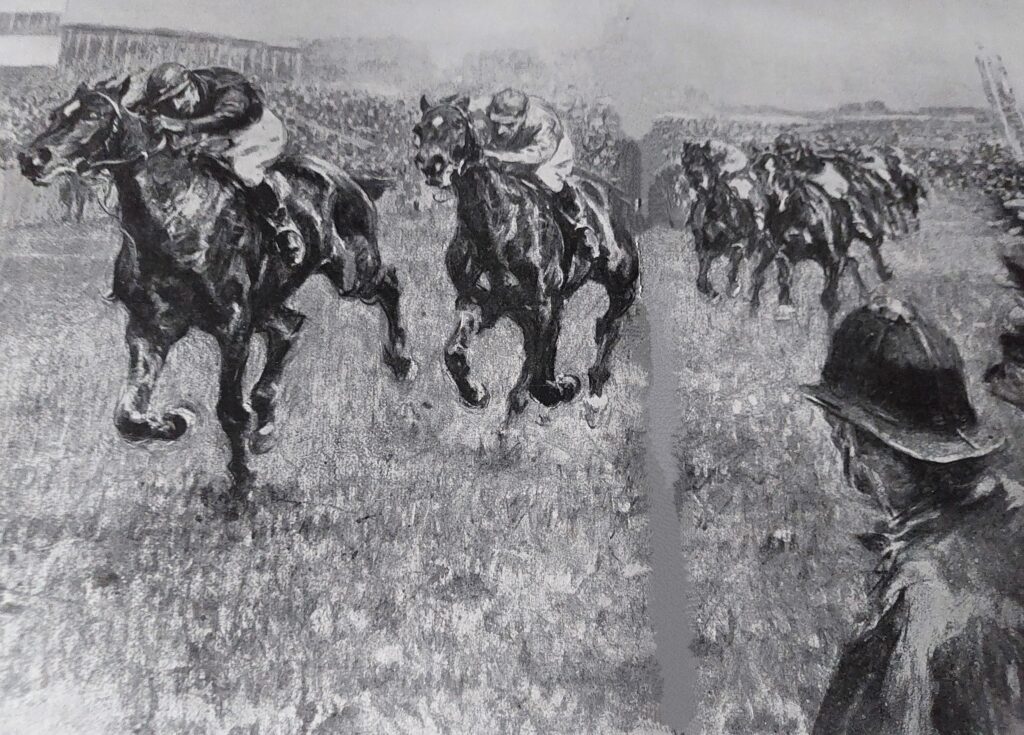
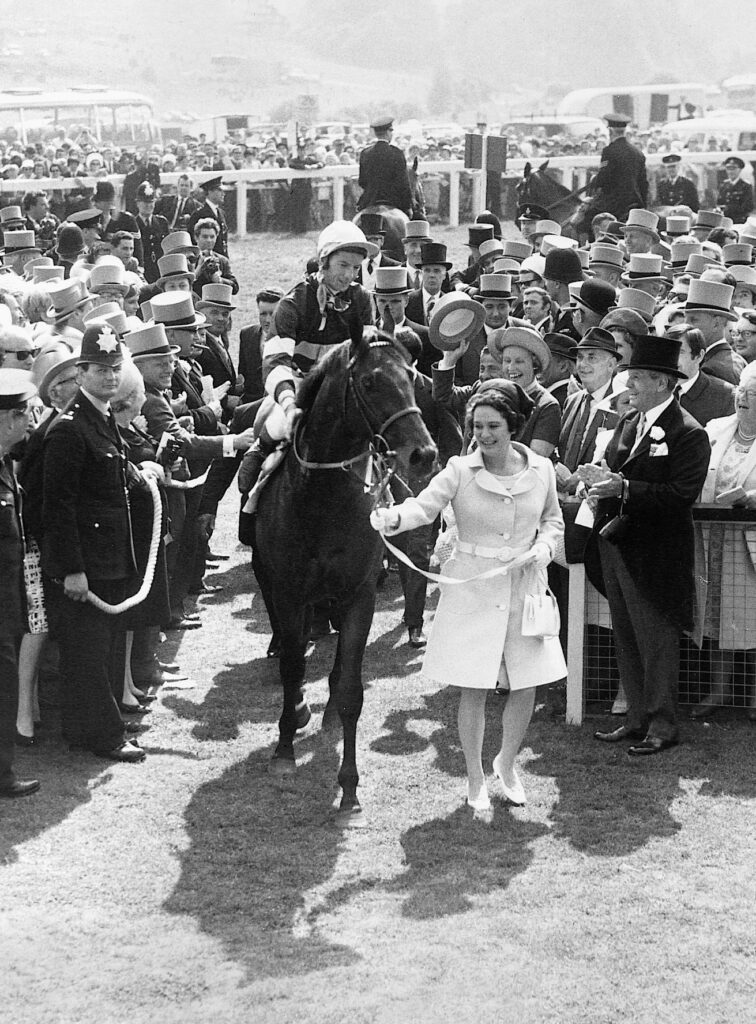
Michael takes a light hearted look back to his wartime memories
Taking Cover
“Come on Michael, we’ve got to get under the table.”
“But Mum, I haven’t finished eating my boiled egg.”
“Never mind, bring it with you.”
The air raid siren wailed out from the top of the Co-op building at the end of the road. And although in the spring of 1940, alarms like this were not frequent in Woking, in the following months they grew to become a regular occurrence.
On more than one occasion my mother would run outside and hold me up to see a stray German plane and a British fighter engaged in what was known as a dogfight. One such dogfight took place high over Woking Railway Station, drawing a large crowd below. A railway porter told my mother, that ours was a Hurricane and theirs a Messerschmitt, and a great cheer went up, when after many minutes of combat the Nazi pilot was seen off.
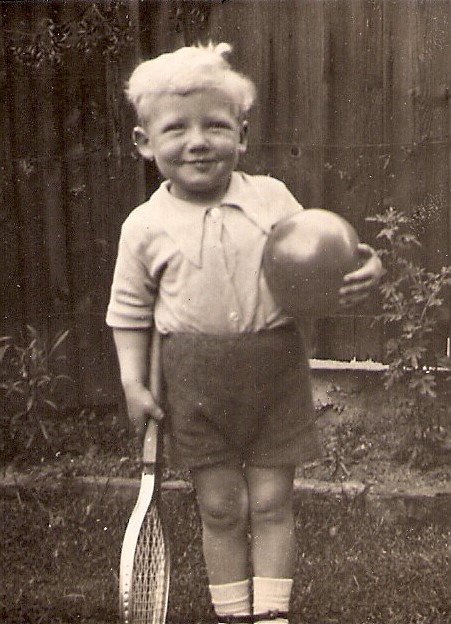
That summer, late one night, a returning German bomber passed low over our bungalow accompanied by a loud whistling noise and a crunching thud.
I can remember the crushing feeling of my father throwing himself on top of me, followed by a lot of shouting. Eventually, when everyone had calmed down, Dad and Mr Powney, from next door, bravely went out into the back garden with a torch to look for the unexploded bomb.
Strangely, nothing could be found, so Mr Powney, a fireman, quickly cycled off to the Fire station to report the incident. Later, when bells and sirens filled the air, a fire engine appeared on the other side of the canal, directly opposite our back garden, where they found the unexploded bomb had taken the corner off a nearby house
As a result of this close shave, my father, who was expecting his call-up papers any day, decided to move the family to Wales. My Nan, who lived with us, knew of her brother-in-law in Llandrindod Wells, and thinking he would help us and the war would be over by Christmas, we packed a few things into a couple of suitcases and walked to the top of the road to catch the bus.
It seems I was a little difficult, and not content in just taking my teddy bear, insisted on carrying a small metal case filled with tin soldiers. In the 200-yard walk to the bus stop the inevitable happened; the case proved too heavy for me to carry and, my Nan, who had vehemently protested against me bringing it, ended up by carrying it herself. A story she repeatedly told, whenever I got my case out to play soldiers.
After an arduous two-day bus journey, we finally located the Llandrindod Post Office. To our despair, they had no knowledge of Nan’s brother- in-law, neither was he on the electoral role.
Coming out of the Post Office we witnessed an open-top car speeding through the town centre, urging everyone to take cover and sounding a portable air-raid siren.
“Out of the frying pan into the fire,” my Nan exclaimed!
The next day, after a night of discussion, on whether we should return to Woking, we were informed of the reason for the siren’s failure – a strategically built blackbird’s nest. What’s more, it had proved to be a false alarm.
Having now convinced ourselves that Llandrindod was a safe refuge from the German bombs, the portable siren that sounded our arrival, was in hindsight, the only alarm raised during our five-year stay.
Our first lodgings were two rooms close to a railway level crossing, about a mile out of town. Soon after moving in, my Dad’s call-up papers arrived and from his joining the Royal Artillery as a gunner, we were not to see him again for six months.
Meanwhile, my mother got a job in a grocers, I was packed off to school at the early age of four, while Nan was left at home to do the cooking, washing and ironing.
My school, a mile from home, taught pupils between five and 14 years (school leaving age), in a single stream. This meant that pupils advanced solely on ability, resulting in some classes containing children both a year older and, a year younger than the majority.
In my first term as “the four-year-old cockney boy”, I was regarded as a novelty, especially when I sometimes arrived in the milkman’s pony and trap after thumbing a lift to school. At the Christmas school concert, to the pleasure of my Mum and Nan, though embarrassing for me, I was brought centre stage and put between two girls to sing “Away in a Manger.”
The following year, my “quirkiness” reached a peak when I announced to the class that Father Christmas was really your mother or father dressed up. For my punishment, after loud jeering from my classmates, was to be kept behind for ten minutes. However, when all had gone, my teacher told me this was to be our special secret and allowed me to run along home.
Looking back, I seemed to be in and out of trouble regularly. There was the time when I skipped class to take Gwenyth, the headmaster’s daughter, to the local cinema’s matinee performance of Robin Hood. We were both six years old. Then on a parents open day, I proceeded to walk about with a cardboard sign strung around my neck with MURDER written on it in big red letters. Little did I realise that spelt backwards it read RED RUM.
As recompense for these misdeeds, I was given the 23rd Psalm to learn in Welsh and during one scripture lesson was brought to the front of the class to recite it. Surprisingly, to me, half the class were unable to speak Welsh, and so, thereafter, I was referred to as the English martyr.
Living in two rooms had been quite difficult. It was a small house anyway, with a shared kitchen, an outside lavatory and no bathroom. Friday night was our bath night, skilfully managed by my mother in front of an open fire, with a tin bath, kettles of hot water, a big bar of Fairy Soap and a large fire screen for decency.
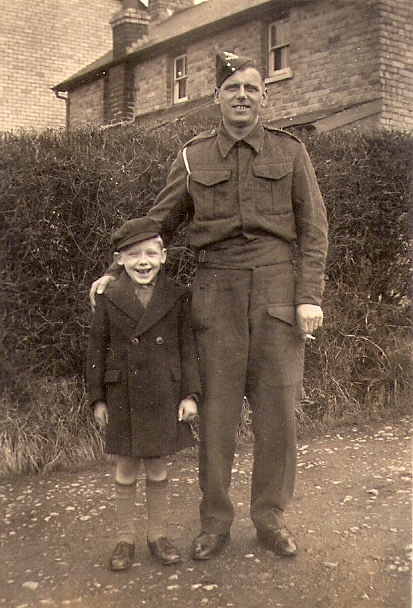
Months later, when my father eventually got a 72-hour pass, he arranged for us to move into a two-bedroom house about half-a-mile away. But the day of moving was far from joyous. Loading our few belongings onto a hand cart we were followed by the local children chanting, “London cockneys ain’t no good, chop ‘em up for fire wood.”
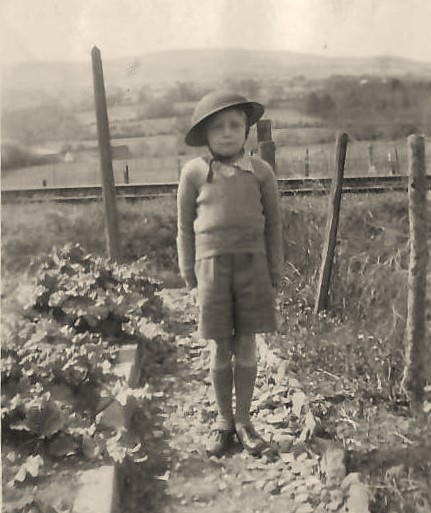
The new lodgings in Tremont Road gave us more room, although since Mum and Nan occupied the two bedrooms, I slept on a sofa in the front room, enjoying the remains of that day’s coke fire. Additional coke supplies (solid fuel) were obtained from the back of the coke factory, where Mum would fill up the well of an old pram and sit me on top.
The warmth from the embers of the fire late at night may have protected me from the severe bout of influenza, which my mother and Nan were to suffer.
Later on, in one of the worst winters in Wales for many years, I was to push the old pram through the snow to get the family shopping.
Food had been rationed since the beginning of 1940, but not offal, so providing we could afford it I was able to come home with an assortment of liver, kidneys and sheep’s brains, the later a war-time delicacy that I would describe in the playground to squeamish girls. Fish, apart from snook and whale meat was very scarce, but Freddie, a close friend of my Mum’s workmate Emily, would occasionally drop in a fresh salmon that he had poached from the river by torchlight.
Freddie certainly came up trumps the following Christmas, making me a large scale fort with turrets and a drawbridge. Lead soldiers were now very scarce, but I remember my father coming home with a beautiful set of Scots guards, charging with fixed bayonets and, a model of a Spitfire carved in wood by his army pal. These were high times for me, preceded and followed by what we would now call deprivation.
A Letter from Dad and a visit from Auntie Mary
Letters from a loved one during the war were rare and unlike the emails of today, were regarded as a cause for celebration, to be treasured and reread many times. Also, incoming telephone calls were virtually non-existent, since very few people had a telephone in their house.
Eventually, my mother learned that Dad had been posted to the Royal Artillery unit on Drakes Island near Plymouth. His letter told us he was in good heart, despite having to man the big guns that followed the searchlights at night, then sleep on the ammunition during the day. Not all his letter was readable though, for the troops mail was read by an Army censor who would run a thick blue pencil through any location or sensitive information.
During the following summer my Auntie Mary and her year-old baby Peter came to stay with us. Mary had wanted to get away from the doodlebugs (V1 rockets) that passed over Woking every night and told us how she had made a nightly home for her and Peter in the large cupboard under the stairs. Her hideaway was furnished with a single mattress and pillows, together with a card table on which she kept a pot of tea, a packet of Craven “A” ciggies, Peter’s bottle and the latest Daphne du Maurier novel.
Her husband, Henry, meanwhile, worked the nightshift at the nearby Vickers munitions factory.
On one occasion, whilst cycling to work across the airfield, a stray German plane flying very low scattered the workers with a burst of machine gun fire.
Strangely, on the two occasions she stayed with us, after the first week she would tell us that it was really too quiet for her and she ought to be getting back to see Henry and hear the local gossip.
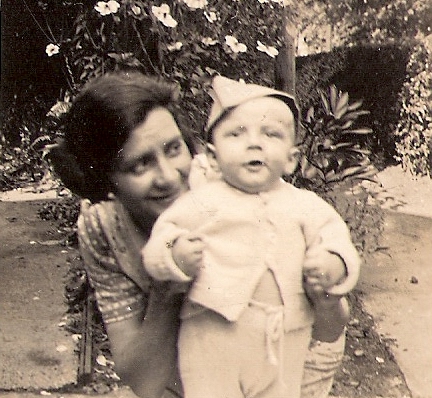
Llandrindod and the neighbouring towns were “Strict Chapel,” while Mary, an ex-barmaid was appalled by the closure of public houses and the railway station on Sunday.
“I don’t know how long I can stand it,” she would say pleadingly to my mother. But she did for about a month, until she claimed, she was deafened by the silence.
It was a wonderful surprise when the following summer, Dad was posted to Swansea. And after settling in, he booked us into nearby rooms for a month, having received permission to lodge with his family in the evenings.
Swansea itself was just getting back on its feet after a continuous blitz from German bombers; the town centre and most of the surrounding area having been completely flattened.
This was the first seaside holiday I can remember – bareback horse riding on the beach and the excitement of a local Donkey Derby remain with me to this day. Sadly, the time passed all too quickly and we never saw much of Dad again until he was demobbed over a year later.
Meanwhile, back at school we were encouraged to bring in small tins to receive allocations of dried eggs and cocoa. And as the allied troops got ready for “The Big Push,” so our playground war games became more exuberant. I kept a map of Italy and Germany on the wall above my bed, marking in the allied attacks and German panzer movements with red and blue crayons.
On the May 8, 1945, my mother’s birthday, people came running out into the street to celebrate our “Victory in Europe” or VE Day as it became known.
A week later, running through an ally at the back of our house with a toy machine gun, a neighbour looking over the wall shouted out, “Put that gun away Michael, the war’s over,”
“Not yet Mrs Llewellyn,” I replied, “We’ve still got to beat the Japs,” and fired an imaginary burst of bullets into a hostile bunker, which in reality was a cold-frame of rhubarb!
Three weeks later, rent paid and goodbyes said we were on our way back to Woking. And Nan having bought me a large cardboard suitcase in which to put my dismantled fort, made sure it was I who carried it.
Returning to Woking after our war time evacuation was not all we had hoped for. The couple who my father had rented our bungalow to, had not only left owing three months’ rent, but had removed all the internal doors to use as firewood and, kept coal in our bath. To cap it all, the agents employed to collect the rent had left town with no forwarding address. Even so, despite all these inconveniences, we all agreed it was great to be back
In celebration of our return, our first family reunion took place on the Sunday before the 1945 Derby. And introduced to five of my Dad’s eight brothers, who seemed to be there solely to discuss the race, my life was irrevocably changed.
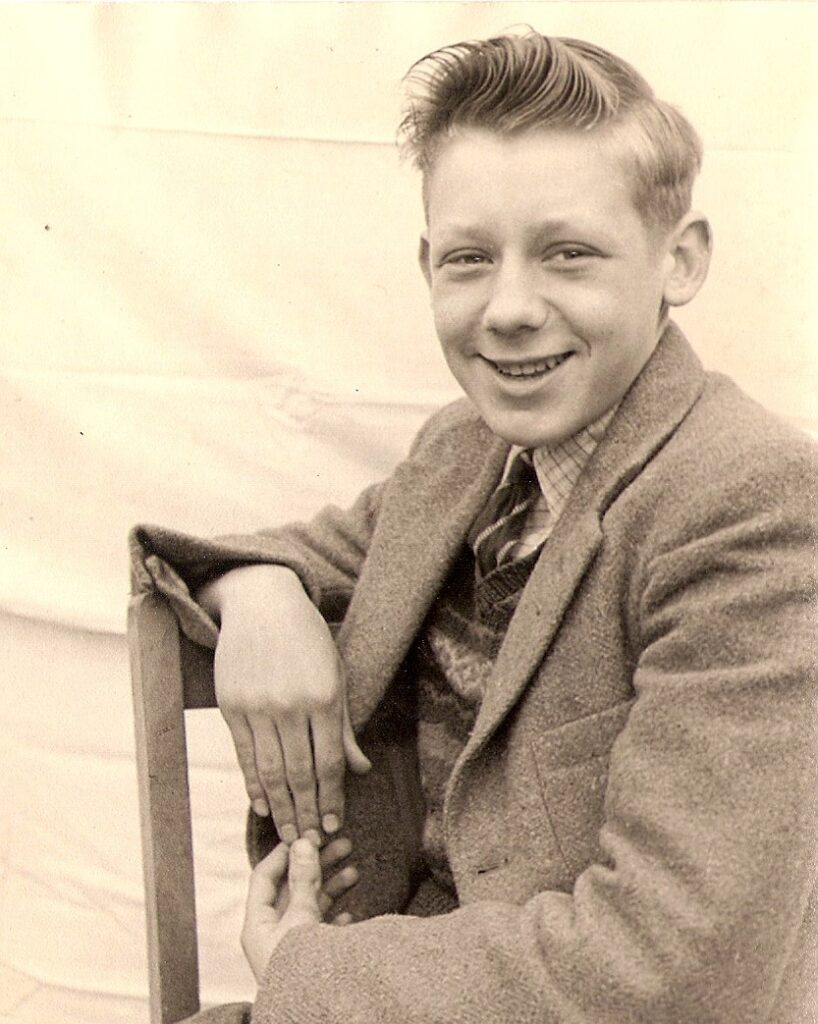
James Hillman author of The Souls Code would call this moment an annunciation – “This is what I must do, this is what I have got to have. This is who I am.”
I still retain the vivid memory of that morning, when all the talk was of the forthcoming Derby. My impressions and senses were quickly swamped by their enthusiasm and amid the smells of beer and Woodbines, the magical names of the horses: Dante, Midas and Sun Storm and the famous jockeys: Billy Nevett, Harry Wragg and Gordon Richards, would in time become as familiar to me as my school mates.
Uncle Henry made a valiant effort to discourage me, saying it was all a mugs game and that he had never backed a winner. But it was all quite useless, for I took to racing like a duck to water, as readers of this website can now testify.
************************************************************
To see Michael’s interviews go to the foot of About Michael