Michael Church Racing Books
Michael Church has a worldwide reputation as an authority on the history of Thoroughbred breeding. Apart from his lineage chart compilations of the Derby, 2,000 Guineas and Champion Sires, he has also written a dozen books, including the highly acclaimed, The Classic Pedigree, Dams of Classic Winners, and The Derby Stakes.
Archive for the ‘Uncategorized’ Category
Daughters of Eclipse
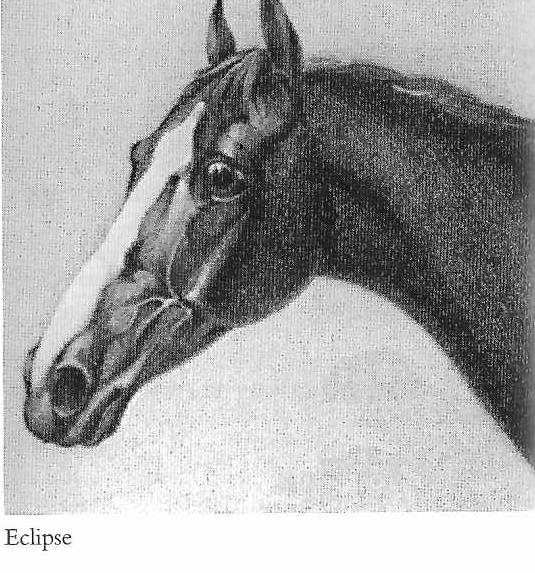
Eclipse was bred by William, Duke of Cumberland and named after the great eclipse in the year of his birth 1764.
Eclipse won all his 18 races including 11 King’s Plates. Although never Champion Sire he was second 11 times between 1778 and 1788 inclusive.
Eclipse died of colic at Cannons in Middlesex, on 27 February, 1789. No racehorse has achieved greater fame or left a more lasting legacy through his progeny.
Now, 235 years after his death, a growing to 97% of all modern thoroughbreds, trace back to him in male line.
Whilst his Derby winners and Champion Sires are well known, many of his daughters have slipped under the radar and so, that they not be forgot, I have listed below those who made an outstanding contribution to the Thoroughbred.
(To view a larger point size Mobiles please now turn sideways)


For more racing history see Michael’s Books for Sale.
To see Michael’s interviews go to the foot of About Michael
Who won the Epsom Derby? – Spreading the News
Who won the Derby ? – Spreading the News
The most dramatic change in the history of the Derby has been in the speed and the method by which the result has been transmitted.
From when Sir Charles Bunbury’s Diomed won the first Derby in 1780, it took a few years and some notable winners for the racing fraternity to acknowledge and promote the Derby.
Certainly, the 12th Earl of Derby’s success with Sir Peter Teazle in 1787 helped and later, when Champion won both the Derby and St Leger in 1800, the race begun to be accepted as an elite prize.
The final acknowledgement, however, came in 1827, when the Derby, Oaks and St Leger were grouped together in the Racing Calendar as “The Three Great Races”.
It follows that, for the first 40 years, the majority of people who wanted to know the result of the Derby had to be at Epsom. In the meantime, the staff of the training stables left behind would have to wait for the returning parties to be told who had won. As the prestige of the race grew, so did the outside interest in the betting. Stagecoaches would bring details of the race to the Coaching Inns, although carrier pigeons were sometimes quicker and kept the result ‘confidential’ in places where betting would sometimes continue for a week after the race.
In 1830, the year the great Priam won the Derby, the railways took communications a giant step forward. Louis Henry Curzon describes an incident in his book “The Blue Ribbon of the Turf”, that not only gives the feel of the times, but, exposes the lengths that gamblers would go to in order to gain an advantage.
“Priam! It’s Priam that’s won I tell you. I heard the guard say so.”
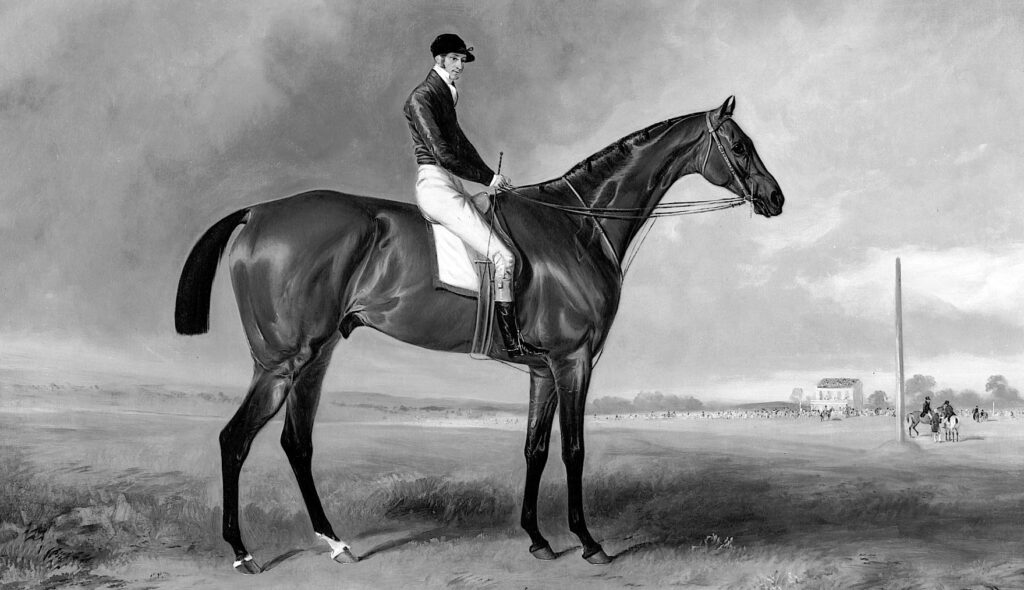
It must have been on the Saturday forenoon after the Derby of 1830 (the race run the previous Thursday) that I heard these words spoken by a stableman at one of the Hotels in the town of Haddington. I did not at the time know to what they related, being then a boy of some six years or so at school there. I soon became enlightened by a bigger boy, who told me Priam was a horse, and that it was the Derby it had won.
Next year some of us boys took such an interest in the race that half a dozen went two miles out of town to learn the news of Spaniel’s victory. A man on horseback was before us, but we heard him get the tip, and, setting spur to his horse he galloped off to Edinburgh with the news by a cross road at full gallop. And next Derby the same man I noticed was again in waiting…”
Curzon later explains the mystery. “After leaving Haddington, by which town the mail came to Edinburgh, I discovered why a man on horseback had come there – a distance of 17 miles – to obtain from the guard the news of ‘what had won’. On some occasions there were as many as five messengers employed to bring on the news of what horse had won the Derby…. and the speed of their horses, were able on some occasions to beat the stage-coaches by as much as 25 minutes, which enabled those who had arranged the express to do a good deal of business…”.
In conclusion, the ‘sting’ took place in the Black Bull in Edinburgh, where up to 100 people would be waiting, “most of whom had backed something for the race and betting would go on till the mail reached the post-office. Meantime, two or three in ‘the know’ had ample opportunity for laying the horse that had lost the race and backing the one that had won it.”
Fifty years on, technology had produced the ‘ticker-tape’ and when the American owned and bred Iroquois, won the Derby in 1881, the transatlantic telegraph sent the coded message ‘IROPERTOW’ to the New York Stock Exchange, informing them the result: first IROquois, second PERegrine and third TOWn Moor. After which, bedlam broke out, quickly followed by chaos, when all Wall Street came to a halt and for a few minutes the New York Stock Exchange ceased trading entirely.
From the end of the 19th century, ‘communications’, or later, ‘the media’, focused their attention on the Derby with the following innovations:
In 1895, the Derby, with a record attendance of 750,000, was filmed by the English pioneering cinematographer Birt Acres; this the earliest piece of moving film in existence, shows just 50 seconds of Sir Visto’s Derby victory with the crowds rushing across the course after the finish.
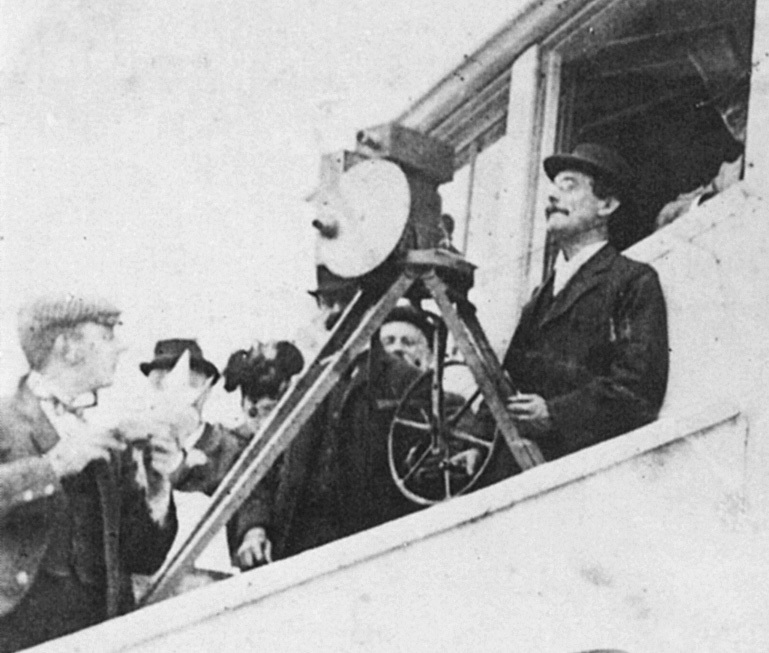
When at Racing Post I had the privilege of verifying details of the footage, then part of a collection owned by Ray Henville, a retired civil servant, before it featured on the TV show Schofield’s Quest.
In the early 1900’s, it was just possible, to hear a commentary on the Derby by a “cat’s whisker” radio. However, from 1931, BBC radio commentaries became an annual event. Also in 1931, the BBC made a crude attempt to televise the race, when a camera stationed at the winning post recorded the horses as they finished. This however, was the first TV recording of any sporting event in the world!
In 1913 the Gaumont Company set up cameras at Tattenham Corner, historically capturing the suffragette tragedy. Then from 1919, Pathe News recorded the race, and with very few exceptions these can still be seen on You Tube.
Following on, many TV Companies have televised the Derby including the BBC, Channel 4, ITV and more recently Racing TV, from which people can watch the race on their phones and place their bets in running.
From pigeons and stage coaches, sending the Derby result has come a very long way.
Footnote: Priam was the greatest horse of his era, winning14 of his 16 races. At stud he sired three Oaks winners in four years, including Crucifix, who also won both the One Thousand Guineas and the Two Thousand Guineas. Sent to America, Priam was their Champion Sire four times in five years from 1842-1846.
For more Racing History see Michael’s Books for Sale. To see Michael’s interviews go to the foot of About Michael
“The Derby Day” – William Powell Frith
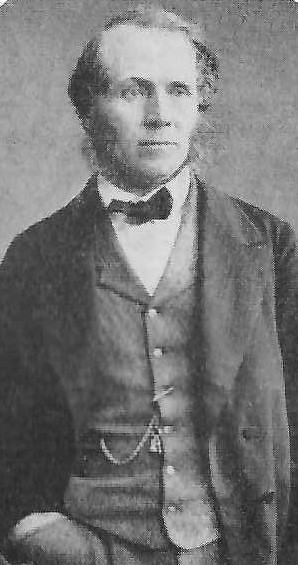 William Powell Frith was born in Aldfield, North Yorkshire in 1819, and although keen to be an auctioneer, was encouraged by his parents to take up art.
As a lad of 16, armed with a portfolio of drawings, he was accompanied by his father, an innkeeper in Harrogate, on a 24 hour stage-coach journey to London. There he studied at Sass’s Art School, going on to win a place at the Royal Academy Schools in 1837, and becoming a full Academician in 1852. Success quickly followed when Queen Victoria bought the first of his large scale narratives, Ramsgate Sands.
On his first visit to a racecourse – Hampton – in 1854, he was struck by the contrast of human life there. In particular, a gypsy family enjoying a large Fortnum and Mason’s pie and to his horror an unsuccessful punter attempting to cut his own throat.
Frith’s first attended Derby Day in 1856, and whilst he admitted to having no interest in the race, he spent the afternoon studying the people – the card sharps and ‘thimble riggers’, the acrobats, minstrels, gypsy fortune-tellers, young bucks and carriages filled with beautiful women. Later, with the assistance of Robert Howlett’s photographs of Derby Day crowds lining the straight, he began work on the painting
On seeing the sketch for Derby Day, Mr Jacob Bell paid Frith £1,500 to paint him the picture and a Mr Gambart paid him a further £1,500 for the copyright of the engraving.
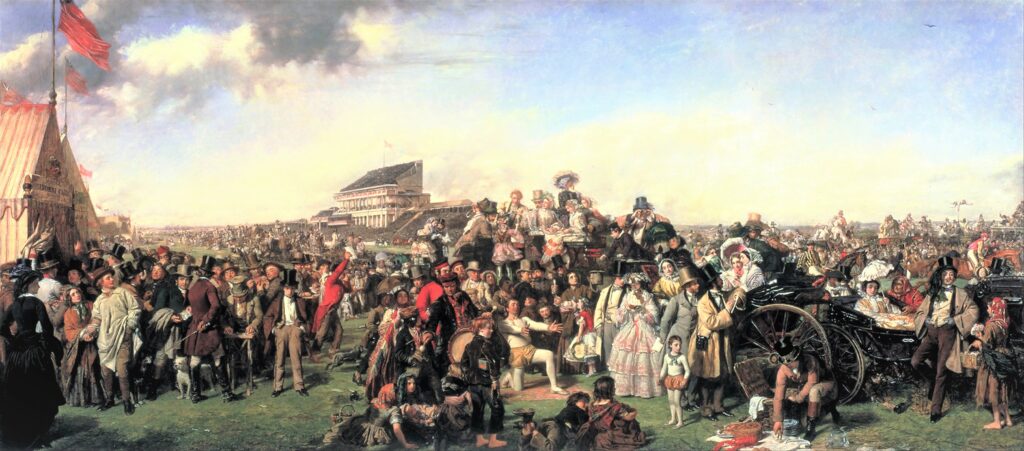
The work was first exhibited at the Royal Academy in 1858, after which Frith wrote:
“When the Queen came into the large room, she went at once to mine; and after a little while sent for me and complimented me in the highest and kindest manner. She said it ‘was a wonderful work’, and much more that modesty prevents me repeating.”
Frith’s painting proved an enormous attraction at the Exhibition as snippets from his diary tell:
May 2 – Private view. All the people crowd about the “Derby Day”.
May 3 – Opening day of the Exhibition. Never was such a crowd seen round a picture.
The secretary obliged to get a policeman to keep people off. He is to be there from eight in the morning. Bell applies to the Council for a rail which will not be granted.
May 7 – To the Exhibition. Knight tells me a rail is to be put round my picture. Hooray!
May 8 – Couldn’t help going to see the rail, and there it was sure enough; and loads of people.
After the Exhibition, the owner of the copyright, Ernest Gambart, organised a huge publicity campaign, sending the painting on tour, first to the provinces then to Europe, finally culminating in a tour of the United States and Australia. At that time, very few paintings had achieved comparable fame and it was generally recognised that Frith had faithfully captured the manners, dress and behaviour across the classes at a world famous event. Walter Sickert, the post-impressionist painter, said in 1922, the painting was, “the most popular…. the most unaffectedly enjoyed picture in the collection,” of the National Gallery.
To appreciate the painting in detail I have divided it in to four sections below, together with a close-up picture of the horses being saddled in front of the new grandstand.
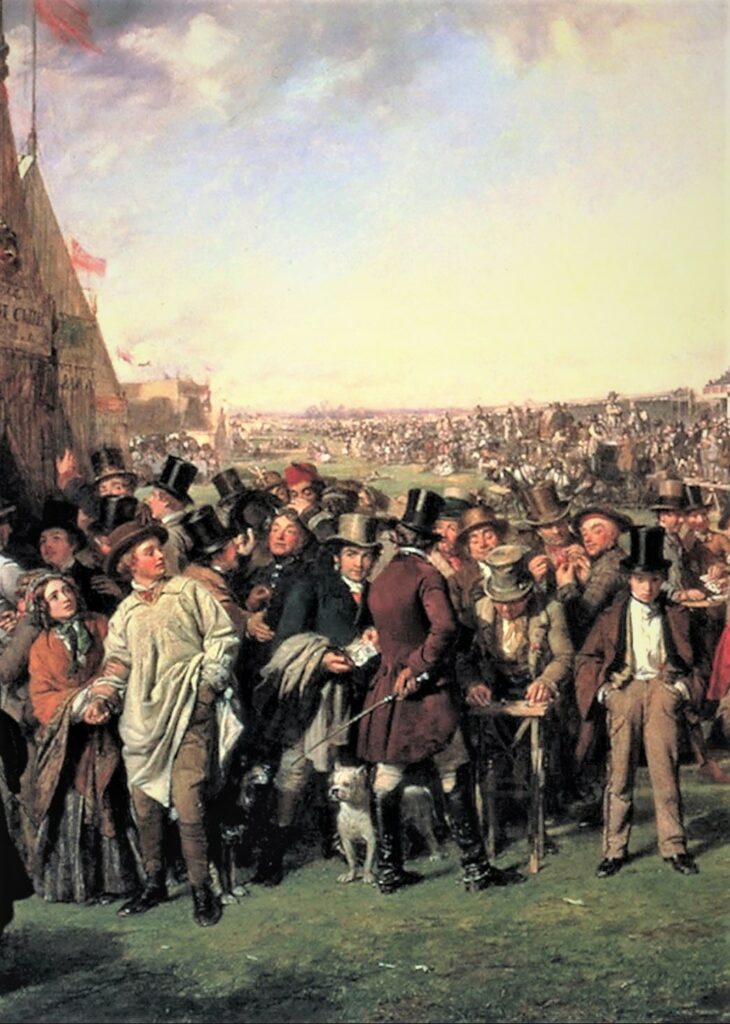
The tents on the left housed various gambling set ups including E O, a form of roulette where the individual numbers were replaced by an E for even numbers or an O for odd numbers, each paying even money with one zero for the house. This prevented the owners from paying out large sums on individual numbers.
In the centre a thimble rigger plies his trade, while to the right of the pennyless boy, card sharps tempt you into another “easy money” card game. Above the white dog an accomplice shows the money he has supposedly won. Meanwhile at the foot of the next picture, gypsy children cradle a baby.
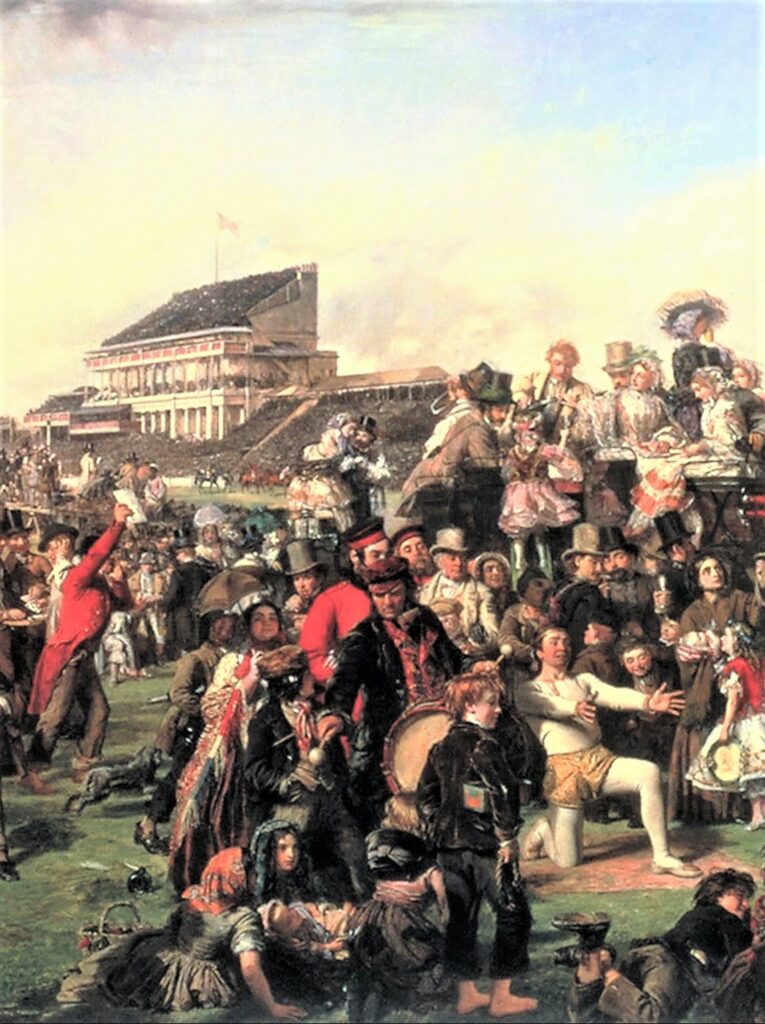
William Dorling, a local printer, produced from 1825, a racecard known as “Dorling’s Genuine Card List” – a seller of which can be seen holding the card aloft to the left in the picture. The racecard, revolutionary at the time, not only gave the list of runners, but also their owners, pedigrees, jockeys, colours and, for the major races, the ‘state of the odds’. The point of sale for these racecards was The Spread Eagle in Epsom’s main street. There in the courtyard of the last coaching stop before ascending the hill to the course, assembled owners, grooms, jockeys, together with some of the darkest element of the betting fraternity
In 1845, with the Epsom Grandstand running at a loss, William’s son Henry, a prominent share holder in the new grandstand, came up with the proposal, with support from Lord George Bentinck and negotiations with the Grand Stand Association Committee, to put the racecourse back on a sure footing. This that all races be saddled in front of the Grandstand (see below); proposing an additional £300 to the prize fund and making improvements to the lawn and accommodation in the Grandstand. Previously, saddling had taken place in ‘The Warren’, where the horses surrounded by well-wishers often prevented the jockeys finding their mounts, so causing considerable delays.
The move became an instant success, insuring a packed Grandstand of 5,000, in order to see what was popularly known as ‘The Preliminary Canter’.
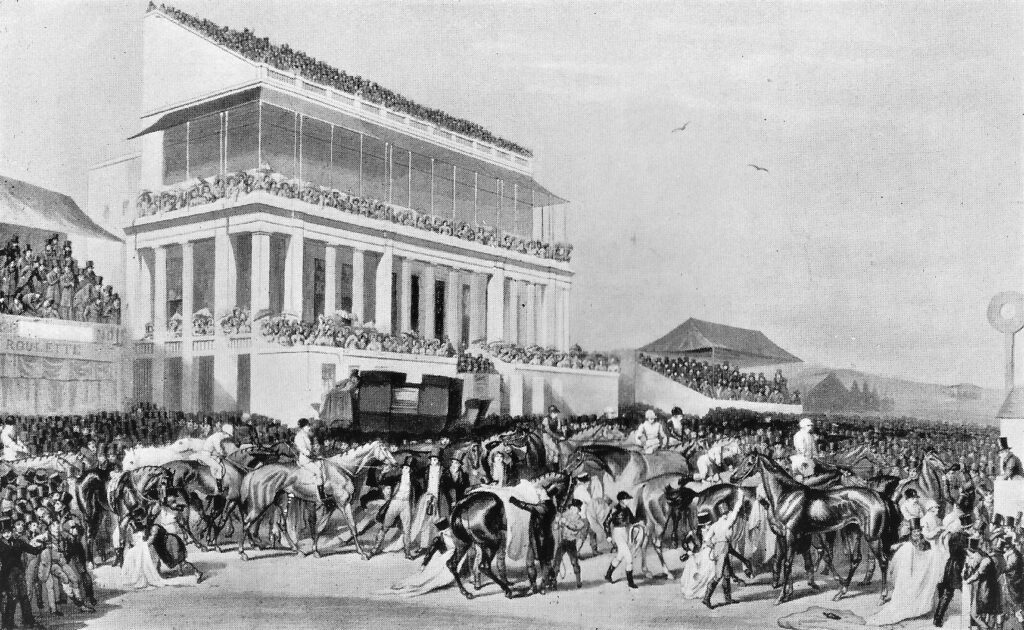
The more wealthy racegoers now enjoyed the benefit of seeing the horses saddled, then cantered down the straight and back to the start.
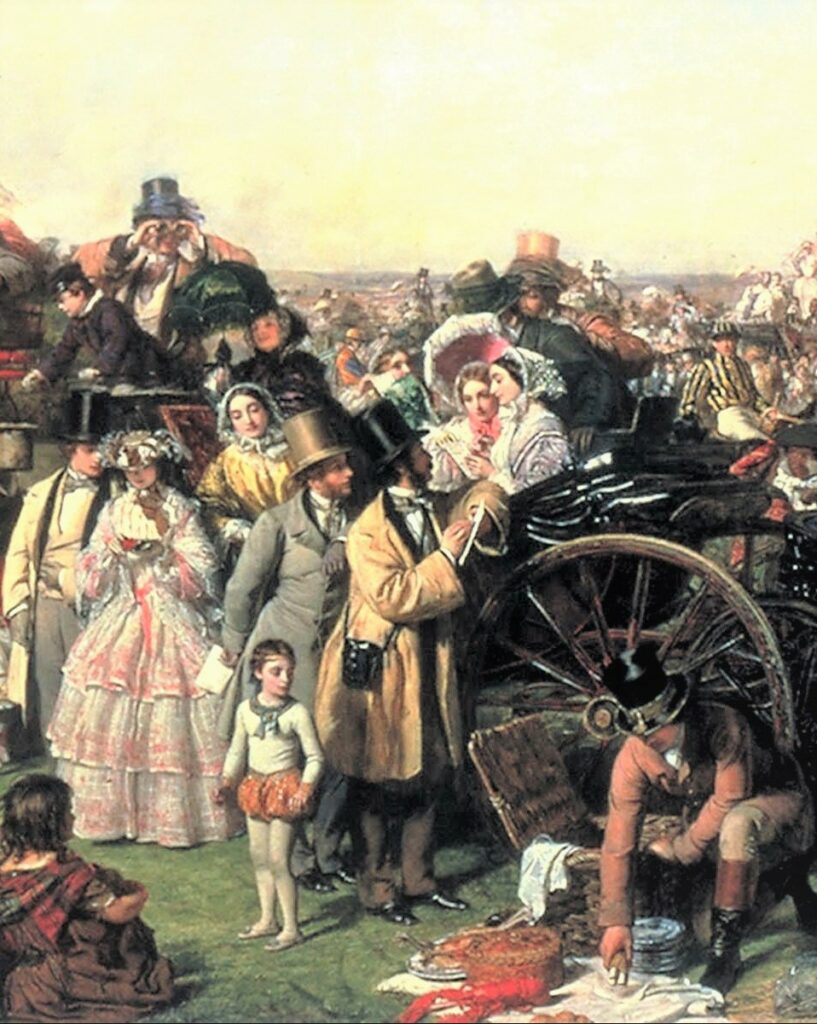
Behind the fashionable ladies and the hungry boy, the horses are about to turn back to the grandstand in what was known as “The Preliminary Canter.”
It was generally accepted that although very few of the crowd saw much of the racing, the attraction was just being there!
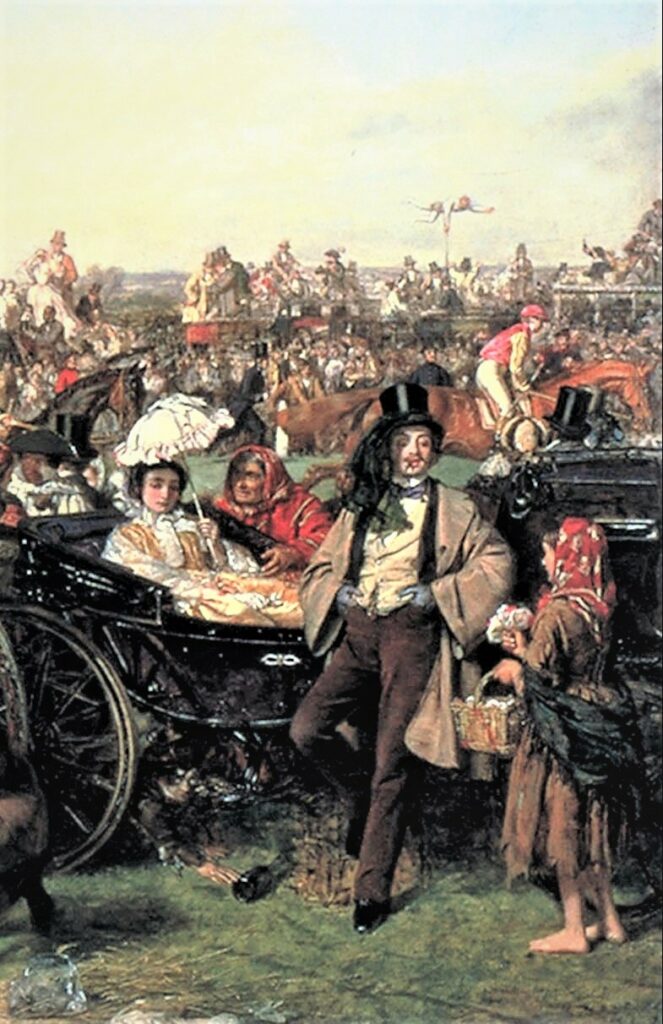
Barefoot gypsies try to sell a posy to rakish toff and his embarrassed companion, while a character under the coach reaches out for the dregs of a bottle. In the background an acrobat balances on a tall pole for pennies.
Despite his wonderfully observed painting, Frith was not really interested in horseracing and across the scene there are no sign of the bookmakers. However, years later, an etching study of rails bookmakers at Ascot, entitled The Road to Ruin appeared in 1879.
Although Frith appeared to be a pillar of Victorian society, like most artists he was far from an open book.
Living with his wife Isabelle in the London district of Bayswater, they had 12 children. Nevertheless, unbeknown to Isabelle, William started another family with Mary Alford only a mile away, where he sired a further seven children. For many years, Isabelle had no suspicion of her husband’s infidelity, until one day, when he was supposed to be on holiday in Brighton, she caught him posting a letter close by their home. What agreement they came to was never published, but soon after Isabelle died in 1880, William married Mary.
William Powell Frith died on the 2nd of November 1909 at his residence in St Johns Wood, and is buried at Kensal Green Cemetery, in North Kensington, London.
For more Racing History see Michael’s Books for Sale.
The Derby Stakes 1780-2016 — See Michael on Racing UK
To order Michael’s book from Raceform ring 01933 304858