Archive for 2024

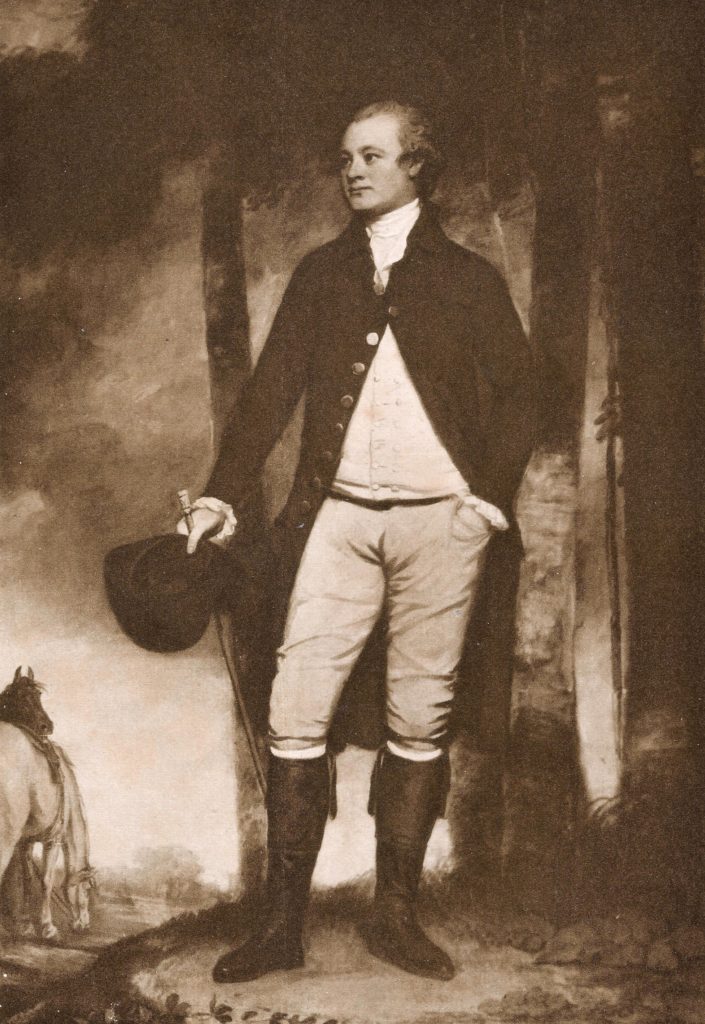
Dennis O’Kelly – The Man behind Eclipse

Posted on:


Dennis O’Kelly – The Man behind Eclipse

 Dennis O’Kelly was born around 1720, a legitimate son of Philip O’Kelly of Tullow in County Carlow, Ireland.

To get away from his family’s frugal existence, he came to London at the age of  25  in the hope of improving his situation.

Described by a contemporary, O’Kelly was:“A short, thick-set, dark, harsh-visaged and ruffian-looking fellow”, yet with “the ease, the agremens, the manners of a gentleman and the attractive quaintness of a humorist.

 Another witness added:

 “His voice, the very reverse of melody, not only assailed , but wounded the ear . . .the broadest and most offensive brogue his nation ever produced.”

In due course, O’Kelly, already an opportunist, found work as a sedan chairman and from this station slowly made inroads into society. It is recorded that, on the occasion of George II’s birthday reception, he carried Lady Blank from the top of St James’s Street to the Palace for a guinea, and was later employed by her as a regular chairman. But as O’Kelly’s fortune ebbed and flowed, we next hear of him as a billiards marker in a smart London club, from where gambling led him to Fleet Prison for debt. In prison, he scratched a living by carrying beer to the inmates; for this, together with his jovial manner, the elected ‘King’ of the prisoners gave him the courtesy title of ‘Count’.

Whilst in the Fleet, O’Kelly met up with Charlotte Hayes, a woman with a notorious reputation. Together they formed a relationship that wove itself into society, providing O’Kelly with a network of contacts throughout the racing world.

The death of George II in London on 25 October, 1760, saw Dennis and Charlotte pardoned from their sentences and, soon after their release, with financial support from Charlotte, he purchased an ensigncy in the Westminster Regiment of the Middlesex Militia. Through courage and initiative, O’Kelly gradually worked his way up to Lieutenant-Colonel, and to celebrate his new rank he put on a ‘splendid entertainment’, attended by Lord Derby and many of the nobility of Lancashire.

In time, the success of Eclipse at stud profited Dennis O’Kelly in excess of £25,000. This enabled him in later years to live a life of style, either entertaining friends at his Cannons Park estate at Stanmore, Middlesex, (previously owned by the Duke of Chandos), or at his stables and stud at Clay Hill, near Epsom.

It was at Clay Hill Stud that he stood Eclipse and two of his sons, Dungannon and Volunteer. In addition he kept around 50 mares, including the famous Tartar mare, who when put to Eclipse produced ten chestnut foals: five colts, including Mercury and Volunteer, and five fillies including Queen Mab.

O’Kelly  also  kept  a  house  at  the  corner  of  Half-Moon  Street  and  Piccadilly; in later years this  became  the  home  of Charlotte  Hayes  in  the  company  of O’Kelly’s celebrated parrot “Polley” .

Hatched in Bristol, “Polley”, was the first parrot born in Britain. It  cost  O’Kelly  50  guineas  and  was  reported  by  an  eye  witness to “not only repeat everything it was commanded, but it would answer many questions, which appeared to require a higher degree of perception “. As well as this, it could on request, ‘sing a variety of tunes with exquisite melody ‘. Listed in the Dictionary of National Biography it reported that it “whistled the 104th Psalm and was among parrots what Eclipse was among racehorses “.

 Polley, a constant source of amusement to visitors to Half-Moon Street, died in October 1802, from “a purging and Bloody Flox”. It was later stuffed, returned to Half-Moon Street and, continued to be visited as a curio.

Dennis O’Kelly died of gout on 28 December, 1787, at his house in Piccadilly. Charlotte Hayes assumed the name of Mrs O’Kelly and lived to the age of 85.

Racing  in  the  18th  century  was  far  from  straight  and  according to a contemporary historian it was only O’Kelly’s  hard work and concentration that,“enabled him to counteract the various and almost incredible deceptions then in constant practice in the sporting world”.

Moreover, his anticipation and perception of events were frequently referred to as the luck of the Irish”. However,  for  all  his  success , Dennis O’Kelly  carried  one  grievance  to  the  grave – the continual  refusal of the Jockey Club to admit him as a member. The prejudice  against  him  must  have been very strong, for almost any other top society owner of a horse as great as Eclipse would have been welcomed. Nor did it stop there, for many of the nobility and gentry preferred to take their mares to Herod, rather than deal in “the rough and ready ways” of O’Kelly for the services of Eclipse. In consequence, Eclipse was never Champion Sire, although he was second 11 times between 1778 and 1788 inclusive.

 Eclipse died of colic at Cannons, in Middlesex, on 27 February, 1789.

No racehorse has achieved greater fame or left a more lasting legacy. Now, more than two and a quarter centuries after his death, 97% of all modern thoroughbreds trace back to him in male line.

Whatever the failings of Dennis O’Kelly, the ongoing world of racing and breeding owes him a tremendous debt. His management of Eclipse’s racing and stud career were handled with both wisdom and patience, sometimes in difficult circumstances.

Now, 235  years after  his  death, his name is still mentioned in the same breath as the legend of the horse he once owned .


   For more racing history see Michael’s Books for Sale. 


The Life and Times of Eclipse – Parts One and Two

Posted on:

Trained on Epsom Downs

THE LIFE AND TIMES OF ECLIPSE

Part One
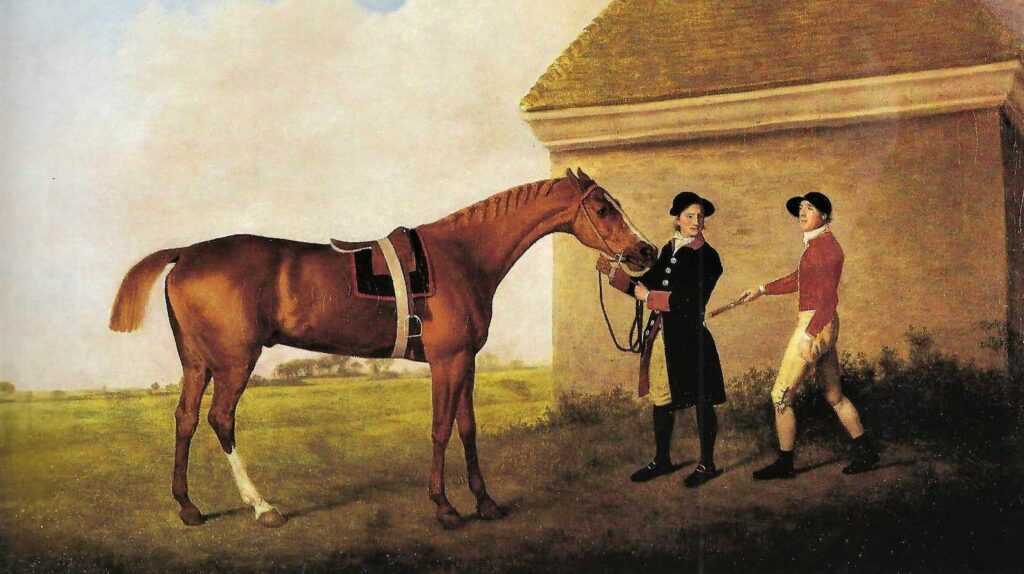
 

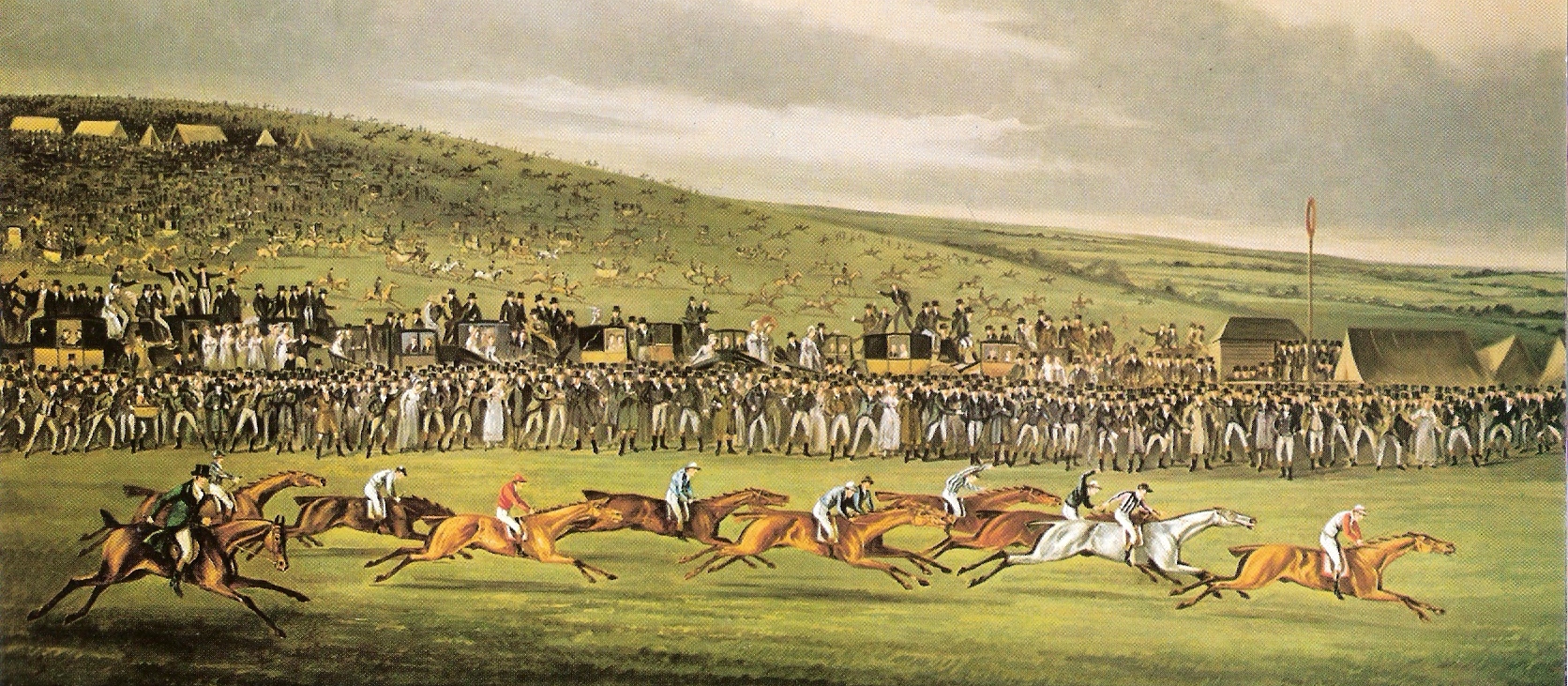
On Wednesday, 3 May 1769, the third day of Epsom’s six-day meeting, Eclipse ran his first race in the Nobleman and Gentleman’s Plate. This, a typical competition for the time, was open to five and six-year-olds and run in four-mile heats. Between heats, 30 minutes would be allowed for the ‘rubbing down’ of horses and the Plate would be awarded to the winner of two heats. If the race needed three heats to decide and had three different winners, a further heat would be run. Any horse that was a distance (240 yards) behind a heat winner would be eliminated, the rules also stipulating, that any jockey who “shall or do, whip or lay hold of any rider, his horse, saddle or bridle”, would be regarded as being distanced.


To set the scene, races in the mid-eighteenth century horses rarely ran before they were four years old. The most prestigious events were the King’s Plates. Eighteen were contested in 1769, with three being at Newmarket. These were usually run in heats over four miles for horses not older than six and carried a prize of 100 guineas.

At this time, there were 92 racecourses operating in Britain. Newmarket held ten meetings a year, while the others would host only one or two. Meetings often began on the Monday and continued through to Saturday. The number of races run each day would vary, but often there would be three, interspersed with cock-fighting and, on occasions, bare-knuckle boxing.

For his debut, Eclipse, then a five-year-old, carried 8st 7lb, while the six-year-olds carried 9st 3lb; the value to winner was £50. In opposition to Eclipse were two five-year-olds, Gower and Tryal and two six-year-olds, Chance and Plume.

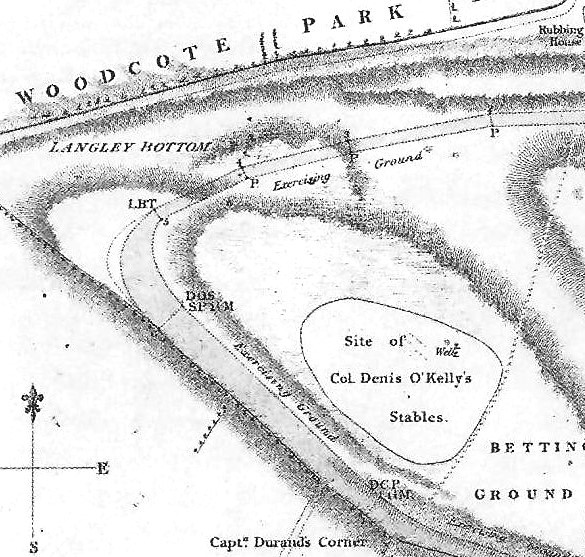
Significantly, before Eclipse ran his first race, Dennis O’Kelly, an Irish adventurer, had purchased both a house and stables situated on Epsom Racecourse, these were between the future first mile and a half Derby start and the present one, (See stables marked on map below). Local news of Eclipse having preceded him, forced his odds in to a skimpy 1-4, although O’Kelly had previously made a large wager at a better price.
In the first heat, Jack Oakley, as planned, allowed Eclipse to go on as he pleased, sitting quietly in the saddle, while making no attempt to hold him up. Eclipse taking an early lead, then drew further away from the opposition.

Before the second heat, O’Kelly, made two large bets at 6-4 and Evens, that he could forecast the correct order of all five runners. To the surprise of the layers, when asked for the order he replied “Eclipse first, the rest nowhere”, implying, Eclipse had to finish a distance (240 yards) ahead of all his rivals.

The second heat off and running, all five runners were grouped closely together at the three-mile post, then Oakley let Eclipse draw away to fulfil what has become a famous racing prophecy.


The birth of Eclipse was entirely in keeping with the legend he was to become.

Foaled at noon on Sunday, 1 April, 1764, in a paddock near Cranbourne Tower in Windsor Great Park, his birth coincided with an annular eclipse – an eclipse of the sun in which the moon, seen projected on the solar disc, leaves a golden ring of light visable. Writers of the day called it “The Great Eclipse”.

The breeder of Eclipse was William, Duke of Cumberland (1721-65), the second surviving son of George II. A professional soldier, Cumberland was a Major-General at the age of 22 and, in the company of his father, was seriously wounded when defeating the French at Dettingen in Bavaria, this the last battle where an English king was present.

In 1745, Cumberland was promoted to Captain­ General of the allied army in Flanders and, the following year, defeated “Bonnie Prince Charlie,” the Young Pretender, at Culloden Moor, Inverness. So severe was his crushing of the Stuart rebellion that he gained the nickname Butcher Cumberland. However, in 1757, when head of a Hanoverian army, he was defeated by the French at Hastenbeck, after which he resigned all his military commands.

Cumberland, a dedicated and ruthless soldier, now transferred his passion to the Turf. Already an early member of the Jockey Club and the only royal member (his colours were all purple), he took up the position of Ranger of Windsor Forest, where, from his Cumberland Lodge residence, he set up his Windsor Forest Stud.

Within seven years he had bred the two most influential racehorses in the history of thoroughbred breeding – Herod (b.c. 1758), the eight-time Champion Sire 1777-1784 and Eclipse.


The sire and dam of Eclipse were both in the ownership of the Duke of Cumberland at the time of their mating. Spilletta (b.f. 1749), was a good-looking daughter of the eight-time Champion Sire, Regulus and purchased by the Duke from Sir Robert Eden. Beaten in her only race at Newmarket in 1754, she was later sent to the Duke’s Stud. Altogether, she produced five foals before her death in 1776, incl. Proserpine (b.f. 1766) and Garrick (ch.c.1772) also by Marske.

Although just below top class, Marske won three times, his most notable victory coming in the Jockey Club Plate, when, as a four-year-old he beat Brilliant over Newmarket’s Round Course (3 miles, 6 furlongs and 93 yards). However, at Newmarket in 1756, when twice matched against the future Champion Sire, Snap, he was beaten both times.

Before the Duke’s death, Marske was considered of little value as a stallion, commanding only a half-guinea fee, and at the subsequent dispersal sale, he was sold to a Dorset farmer for a trifling sum. However, also attending the sale was William Wildman, a large-scale grazier and meat salesman at Leadenhall Market, who raced for a hobby, keeping a small stud at Mickleham in Surrey. On his arrival, he found that Eclipse had been sold for 70 guineas before the advertised time of the sale. His forthright objection caused the lot to be put up again and this time Wildman secured Eclipse for 75 guineas.

Mindful of the Dorset farmer after Eclipse’s sensational victory at Epsom, Wildman, paid him a visit, and on the exchange of £20, returned home with the sire of Eclipse. Thereafter, the success of Eclipse boosted Marske’s popularity and he went on to become Champion Sire in 1775 and 1776. Finally purchased by Lord Abingdon, he stood at his Rycot Stud in Oxfordshire, for the then enormous fee of 100 guineas. Marske died in July 1779, aged 29 years, having sired the winners of 352 races.

Mr Wildman, realising he had obtained a bargain, decided to allow Eclipse time to mature. Of some concern, however, was the horse’s temper, at one time so bad, that Wildman considered having him gelded. However, after due consideration, he sent him to George Elton (or Ellers), a ‘rough-rider’ near Epsom, who rode him about all day and occasionally throughout the night to quieten him down. Although the horse was never vicious, he always kept his fiery temper and, at this stage, Wildman’s first priority was to find a patient jockey. Jack Oakley fitted the bill and was engaged to ride Eclipse in almost all his races.


Part Two
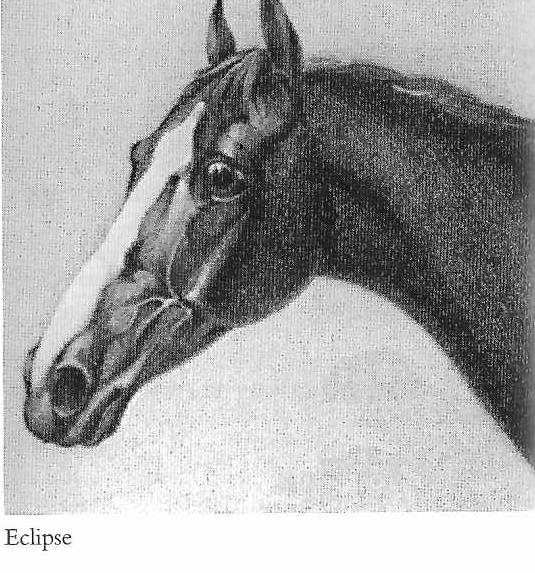
 

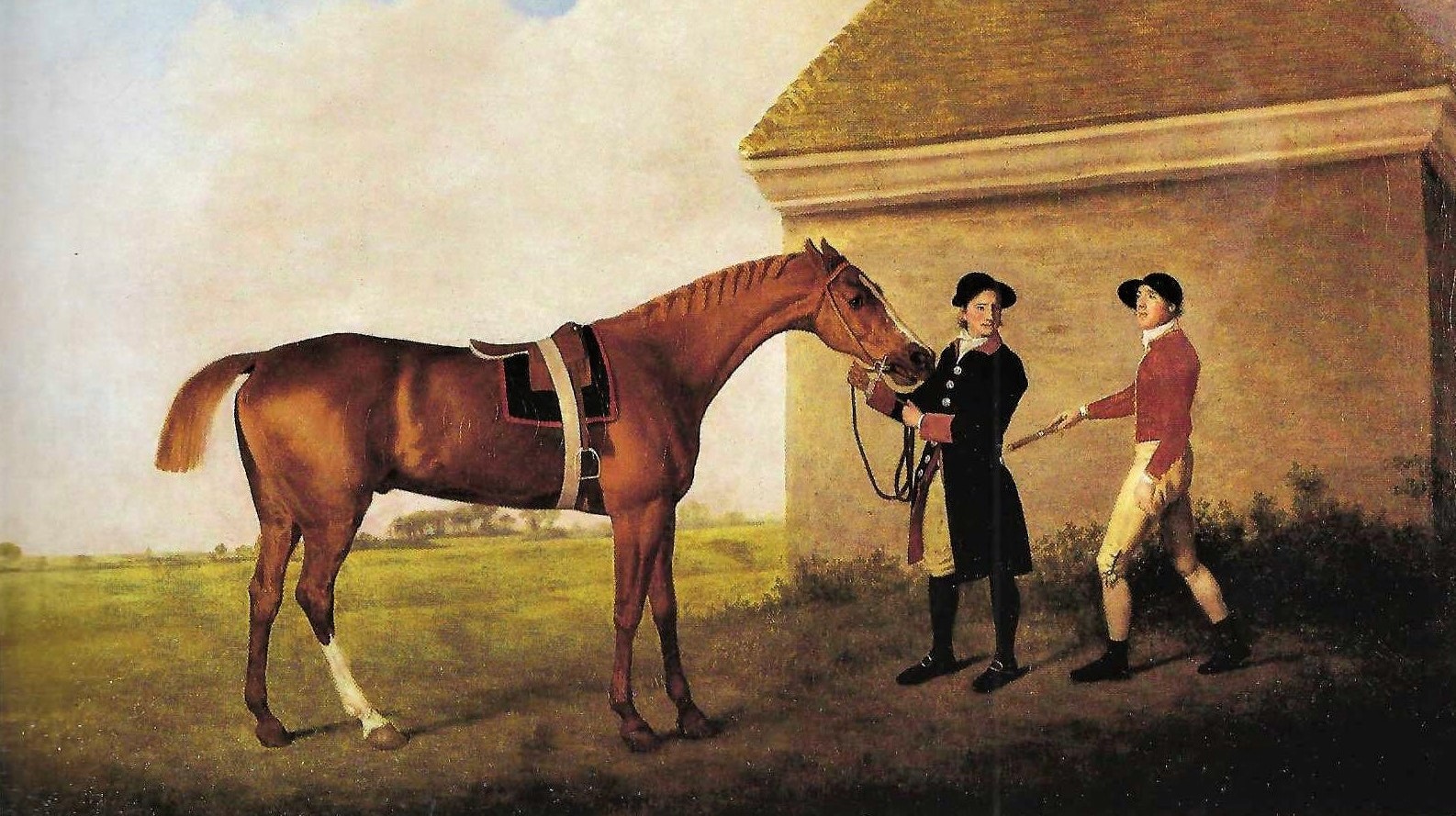
    A chestnut horse with a white blaze and a white stocking on his off-hind leg, Eclipse grew to be a magnificent horse, measuring 15.3 hands at the withers. This at a time when very few horses reached 15 hands and Lord Rockingham’s Sampson (1745) by Blaze was recorded at 15.2 hands as “the largest-boned bloodhorse ever bred”.

Other contemporaries complete the picture:  Mr John Lawrence, who saw Eclipse and later published a History and Delineation of the Horse” in 1809, said of him:

“When I first saw him, he appeared in high health, of a robust constitution, and to promise long life. I paid particular attention to his shoulder, which, according to the common notion, was in truth very thick, but very extensive and well placed”.

“His hindquarters and croup appeared higher than this forehand; and in his gallop it was said no horse ever threw his haunches with greater effect, his agility and stride being on a par, from his fortunate conformation in every part and his uncommon strength”.

   “He had considerable length of waist and stood over a great deal of ground, in which particular he was of the opposite form to Flying Childers, a short-backed, compact horse, whose reach laid in his lower limbs . . . Eclipse was thick-winded , and breathed hard and loud in his exercise . . . “


Mr William Percival, a noted veterinary surgeon and lecturer, wrote:

“He was a big horse, in every sense of the word, tall in stature, lengthy and capacious in body, and large in his limbs. For a big horse his head was small and partook of the Arabian character; his neck was unusually long; his shoulder was strong, sufficiently oblique, and although not remarkable for, not deficient in depth. His chest was circular; he rose very little on his withers, being higher behind than before; his back was lengthy and over the loins roached; his quarters were straight square and extended ; his limbs were lengthy and broad, and his joints large; in particular his arms and thighs were long and muscular, and his knees and hocks broad and well formed .”


To keep his exceptional race-record alive, following Eclipse first heats at Epsom, he next ran at Ascot on 29 May, again in a Noblemen and Gentlemen’s Plate worth £50, but this time in two-mile heats. Only Mr Fettyplace’s five-year-old bay horse Cream de Barbale opposed him, with both carrying 9st 3lb. The betting was long odds-on Eclipse, who duly won both heats. Shortly afterwards Dennis O’Kelly bought a half-share in  him for 650 guineas, although for betting purposes Eclipse  continued  to  run  in Wildman’s name.

On 13 June, Eclipse won his first King’s Plate. Run at Winchester, in four-mile heats for six-year-olds (horses a year younger were permitted to run, but all carried 12st. 0lb). Eclipse won both heats and the 100 guinea-prize, beating Slouch, Chigger  and  Juba,  with  O’Kelly’s  other runner, Caliban,  and  Bailey’s  Clanvil  both  distanced in the first  heat.  Two   days  later  at  the  same  meeting, Eclipse  walked  over  for  the   City  Plate,  winning  a  further £50.

On 28 June, Eclipse walked- over for a King’s Plate at Salisbury and the following day ran two four-mile heats for the City Plate at the same venue. The conditions of the race required horses of all ages to carry 10st 0lb. Eclipse, starting at odds of 1-8, attracted opposition from Mr Fettyplace’s Sulphur (7-y-o) and Mr Taylor’s Forrester (6-y-o). Forrester was distanced in the first heat and Eclipse beat Sulphur comfortably in both heats.

On 25 July, at Canterbury, Eclipse walked over for the King’s Plate and two days later travelled to Lewes, where, ridden by John Whiting, he defeated Mr Strode’s Kingston in two four-mile heats for the King’s Plate, conceding a year at 12st 0lb.

Eclipse did not race again until 19 September, when he took on Mr Freeth’s Tardy for the King’s Plate in two three-mile heats for five-year-olds at Lichfield. He won both heats at odds of 1-7.


The following year, Eclipse reappeared in a match against Mr Wentworth’s Bucephalus at Newmarket on 17 April. At this time, horses did not officially age one year until 1 May, so both competitors were recorded as five-year-olds. Bucephalus was one of the cracks of his day and Wentworth put up 400 guineas against Wildman’s 600, with the general betting also 4-6 Eclipse.

The match was to be one heat over the Beacon Course of 4 miles 1 furlong, 138 yards, each carrying 8st 7lb. Bucephalus certainly made Eclipse gallop, but he couldn’t beat him and his heroic effort took its toll, for he never raced again. Dennis O’Kelly now persuaded Wildman to sell his remaining half-share for 1,100 guineas and when  Eclipse  reappeared  two days later for Newmarket’s King’s Plate over the four-mile Round Course, he did so in O’Kelly’s colours of scarlet with a black cap.

Eclipse was opposed by Mr Strode’s five-year-old Pensioner, and  two  six-year-olds – the Duke  of Grafton’s Chigger and Mr  Fenwick ‘s bay  mare  Diana, a  previous  winner  of King’s Plates at York, Lincoln and Newmarket. All carried 12st.0lb.

In the first heat, Eclipse beat (in order) Diana, Pensioner and Chigger. Diana and Chigger withdrew from the second heat and the opening betting of 1-10 Eclipse was revised to 6-4 Eclipse to distance Pensioner, which he did easily.

Eclipse now walked over for three King’s Plates: at Guildford on 5 June, Nottingham on 3 July and at York, with S. Merriott aboard on 20 August. Three days later at York, Eclipse turned out for the Great Subscription – one four-mile heat for six-year-olds and upwards, with a value to the winner of £319.10s. He was opposed by two notable horses: Mr Wentworth’s eight-year-old Tortoise and Sir Charles Bunbury’s seven-year­old, Bellario.

Eclipse, now six years old, received 7lb from the other two and was made favourite at 1-20. There was also much interest in taking 4-7 that Tortoise beat Bellario. Eclipse, with Merriott up once more, despatched the opposition, while Tortoise repaid his supporters by beating Bellario.

Jack Oakley returned to the saddle for Eclipse’s final three races. The first, a walk-over for the King’s Plate at Lincoln on 3 September, followed, a month later, by a 150 guineas  plate at Newmarket, run in one heat over the Beacon Course. Here the sole opposition came from Sir Charles Bunbury’s five-year-old Corsican, who, at level weights, proved no match for Eclipse, as the betting of 1-70 had indicated. The following day, 4 October, 1770, Eclipse walked over for a King’s Plate at Newmarket.

He had then been due to meet Goldfinder, a six-year­ old colt by Snap, who had earned a high reputation, previously winning a Cup and 2,000 guineas at Newmarket. Sadly, his intended rival broke down the day before the race.

After two seasons, Eclipse had won 18 races, including 11 King’s Plates, and had retired unbeaten .

The opponents were no longer there, and if a horse had occasionally challenged, obtaining odds better than 1-20 would have been difficult.  Instead he was retired to O’Kelly’s Clay Hill Stud, near Epsom where his fee was set at 50 guineas. Although it took time, together with Herod, they changed the face of thoroughbred  breeding.


_______________________________________________________________________________________________
The Origins of Racing at Epsom – Parts One and Two

Posted on:

The Origins of Racing at Epsom

Part One


Strangely, the events that led up to the foundation of the Derby started in the dry summer of 1618, when a humble herdsman, Henry Wicker, stumbled across a small hole full of water on the common, to the north-west of the turnpike road, between Epsom and Ashtead.

To Wicker’s amazement, after enlarging the hole in order to water his cattle, they refused to drink. And when he sampled it, neither would he. Some months later, samples of the water were examined by local physicians, who deemed it aluminous and recommended it for external use on cuts and sores. It was not until about 1830 that the highly purgative qualities of the water were discovered; this quite by chance, when a group of labourers drank deeply from the spring.

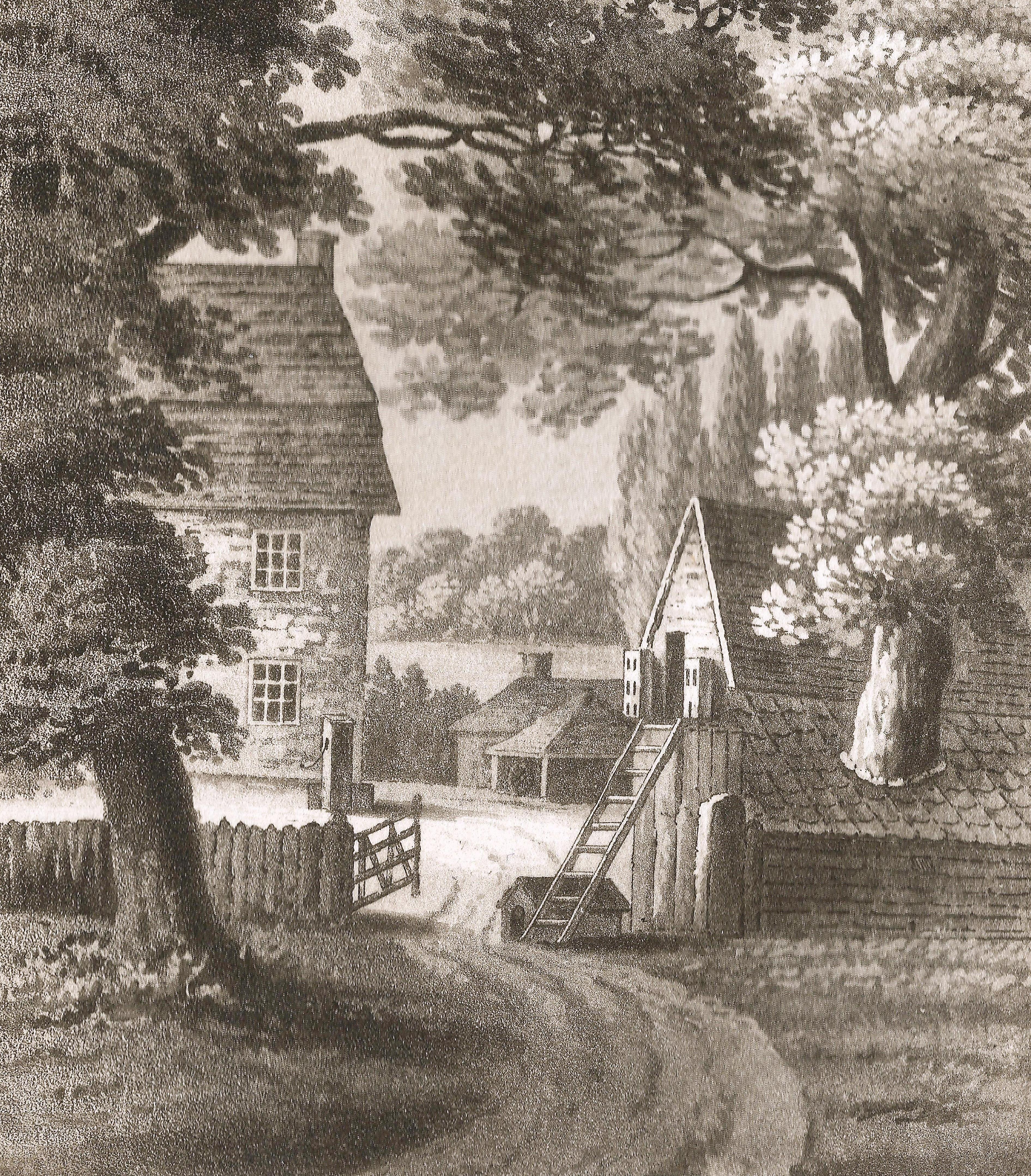
Epsom’s old wells


While at first knowledge of the waters remained local, word soon travelled to wealthy Londoners, whose appreciation of the remedy eventually brought patronage from the nobility of England, with Epsom then rivalling Tunbridge Wells for its famed cures.

John Toland, the famous religious writer noted, “Since it hath been inwardly taken, diseases have met with their cure, though they proceed from contrary causes.” He also observed that citizens of London arriving “from the worst of smokes to the best of airs”, quickly found themselves restored to perfect health. Very soon, the waters were amongst the most analysed substances in England (one gallon of water containing 480 grains of calcareous nitre), with entrepreneurs extracting and selling what became known as Epsom Salts at extravagant prices – five shillings an ounce being recorded in 1640.

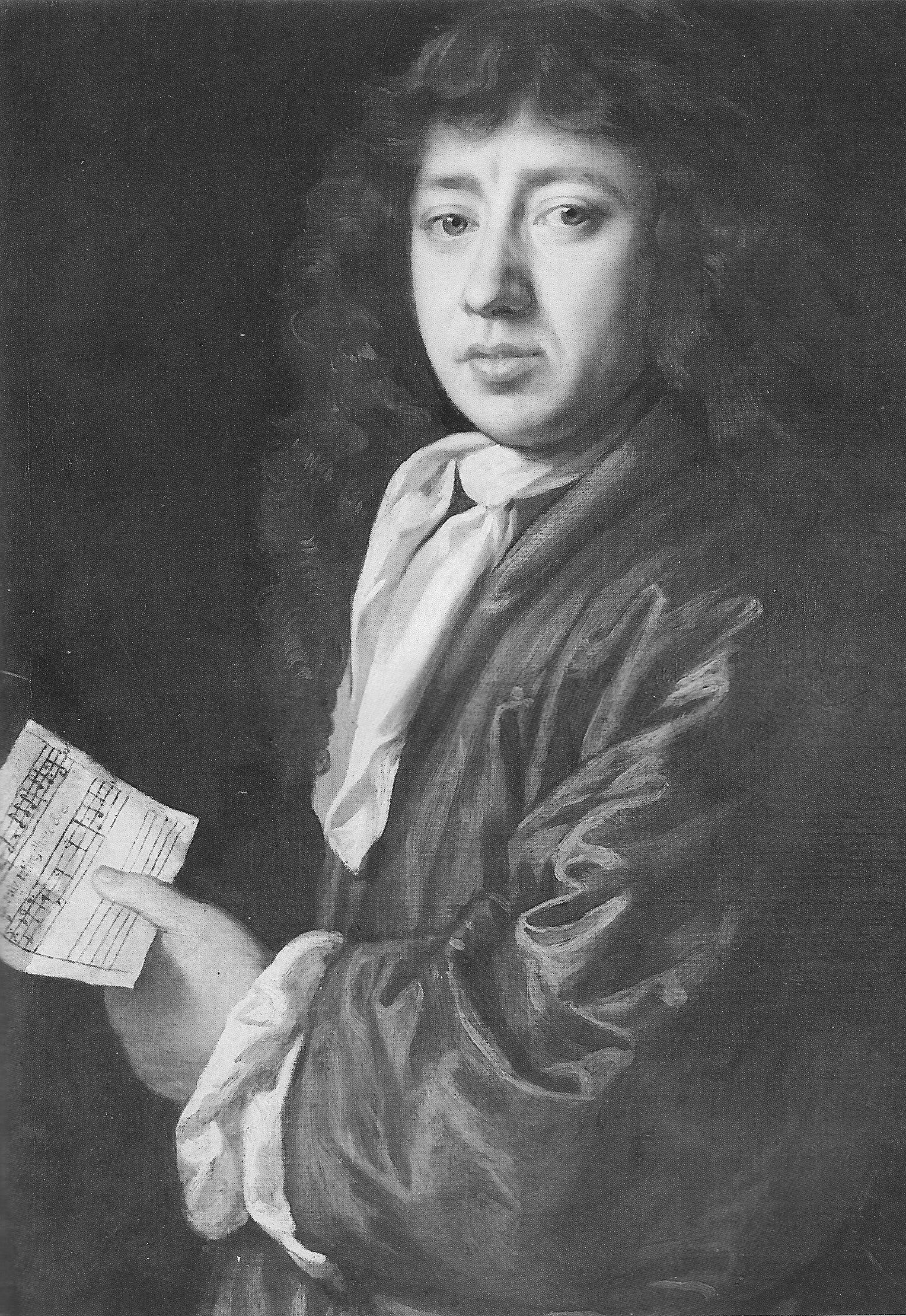
Samuel Pepys wrote in his diary of 1667, “We got to Epsom by 8 a-clock to the Well, where much company; and there we light and I drank the water; they did not, but do go about and walk a little among the women, but I did drink four pints and had some very good stools by it.” Later he visited the King’s Head, the nearest inn to the Downs, “where our coachman carried us; and there had an ill room for us to go into, but the best in the house that was not taken up; here we called for drink and a bespoke dinner. And hear that my Lord Buckhurst and Nelly (Nell Gwynne, the King’s mistress), is lodged at the next house, and keeps a merry house.”

Lord Buckhurst was described by Beauclerk as, “Cultured, witty, satirical, dissolute, and utterly charming”. Pepys reports the news on 13 July: “[Mr. Pierce tells us] Lord Buckhurst hath got Nell away from the King’s house, lies with her, and gives her £100 a year, so she hath sent her parts to the house, and will act no more.” However, Beauclerk later informs us “Nell Gwynne was acting once more in late August, and her brief affair with Buckhurst had ended.”

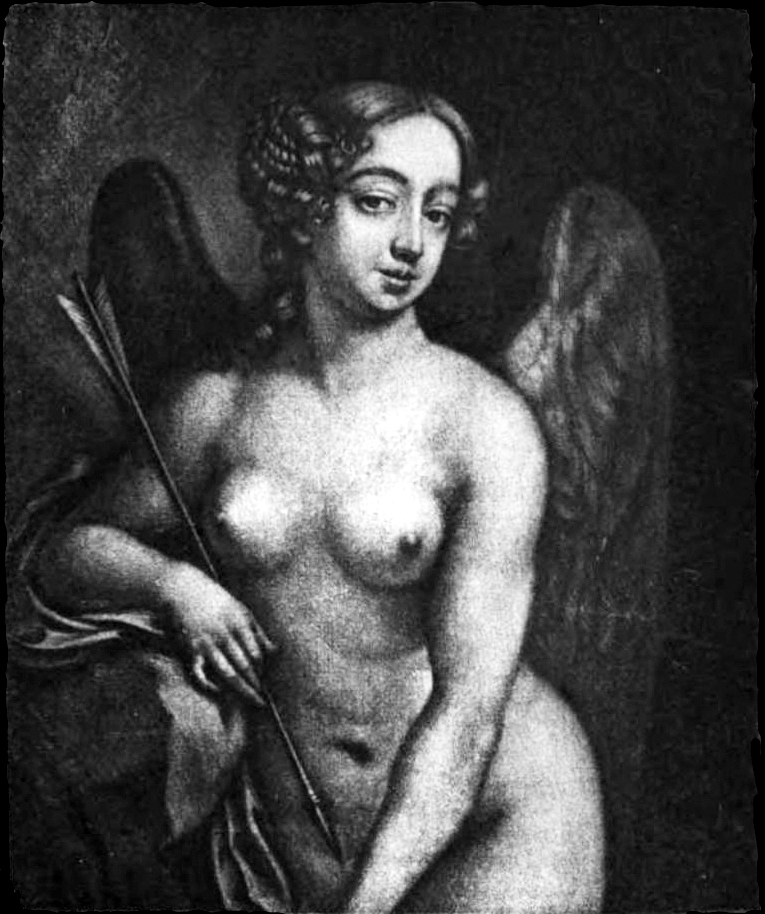
Pepys, himself was enamoured with Nell Gwynne and kept this Richard Thomson engraving of her as Cupid c.1672, above his desk at the Admiralty.

By the year 1690, after the many improvements made by Mr Parkhurst, Lord of the Manor, the village of Epsom had grown into a thriving town, and the humble shed originally erected for the convenience of invalids had now been replaced by a sumptuous ballroom.

 Henry Pownall, in his History of Epsom, published in 1825, said, “It became the centre of fashion; several houses were erected for lodgings, and yet the place would not contain all the visitors, many of whom were obliged to seek for accommodation in the neighbouring villages. Taverns, at that time reputed to be the largest in England, were opened; sedan chairs and numbered coaches attended.  There was a public breakfast with dancing and music, every morning at the wells. There was also a (betting) ring as in Hyde Park; and on the downs, races were held daily at noon; with cudgelling and wrestling matches, foot races etc., in the afternoon. The evenings were usually spent in private parties, assemblies or cards; and may we add, that neither Bath nor Tunbridge ever boasted of more noble visitors than Epsom, or exceeded it in its splendour, at the time we are describing.”

The earliest indications of horseracing on Banstead (Epsom) Downs are in the 1640’s. In mid-May 1648, during the throes of the Civil War, the Earl of Clarendon in his History of the Rebellion relates, “a meeting of the royalists was held on Banstead Downs, under the pretence of a horse race, and six hundred horses were collected and marched to Reigate.”

This suggests that for such an undercover rendezvous to take place racing at Epsom must have been a regular and well-attended occasion. Under the Commonwealth (1649-60), horseracing was banned, but upon its demise, the first recorded race meeting in the country took place at Epsom on 7 March, 1661, in the presence of Charles II.

Two years later, on 27 May, Pepys wrote in his diary, “This day there was a great thronging to Banstead Downes, upon a great horse race and a foot race; I am sorry I could not go thither.”


 Part Two


Following on from Samuel Pepy’s disappointment in not being able to attend Epsom’s races, there was however, an early 18th century account of an Epsom race meeting recorded by Conrad von Uffenbach:


“At three o’clock in the afternoon we rode out to the place where the races are usually held, called Banstead Downes near Epsom. We found there vast crowds on horseback, both men and females; many of the latter wore men’s clothes and feathered hats, which is quite usual in England…We were amazed that the racecourse was so uneven and hilly. All around, almost as far as the eye could see, were placed coloured sticks or posts, round which the horses had to run twice in one race… The five horses that were to run were first covered with blankets and led by hand round the paddock so that everyone might see them and the betting on the winner begin.”

A servant of Uffenbach then timed one of the four-mile heats at nine minutes, which greatly impressed their party.

In 1706, John Livingstone, having previously established himself as an apothecary in Epsom, purchased a plot of land in the town to build a pleasure-palace for dancing and gaming, adding a jewellers shop and a bowling green. Livingstone’s ambition went further. A distance from his amenities he sank a well, installed a pump and, with a great deal of publicity, laid underground pipes directly into his establishment. Furthermore, to ensure his success, he bought up the lease on the original well and then locked up the site.

Although tasting similarly foul, the new spring water had no medicinal properties. This however, did not stop Livingstone, who sent faked samples to reputable chemists to enhance the water’s reputation and, since the old wells were shut-up, no lawful comparison could be made.

In 1716, after two genuine mineral springs were discovered at Cheltenham, Epsom’s fortune went into decline, although in 1720, the time of the South Sea Bubble, Pownell relates, “There was, however, a temporary renewal of its former gaiety and dissipation….when the alchemists, Dutch, German and Jews, again filled the village; its balls and amusements were revived, and gaming with every other description of profligacy and vice, prevailed to an enormous extent.”

When the bubble burst, Epsom was again deserted, but in 1736, its fortunes took a turn at the arrival of a celebrated female bonesetter – Sarah Wallin – known to all as ‘Crazy Sally’. Apparently, she could put a man’s shoulder back without assistance and her success with fractures and dislocations caused the inhabitants of Epsom to raise an annual subscription of £300 a year to induce her to stay. She did for while but then, at the height of her fame, she fell in love with a Mr Hill Mapp, from Ludgate Hill – a footman and by all accounts a rogue. The marriage, strongly opposed by the Epsom residents, was a disaster, Mapp taking all her money and then abandoning her to die in a pauper’s grave in the London slum of St Giles.

A final effort to restore Epsom as a spa came around 1760, when a surgeon from London, Mr Dale Ingram, offered public breakfasts, washed down with a concoction of magnesia and Epsom salts. His success, however, was limited and many years later, in 1804, the buildings of the Old Wells were demolished and replaced by a private house.

Throughout the fluctuating fortunes in the town, race meetings on the Downs had become a regular feature in May and October from 1730, with prizes of cups and plates provided by the local nobility.

In 1775, a year after his marriage to Lady Elizabeth Hamilton, Edward Stanley leased The Oaks, a country house with 180 acres at Woodmansterne, near Epsom, from his uncle by marriage, General John Burgoyne. Burgoyne acting as a ‘father confessor’ to Stanley, ran the gamut of being a gambler, soldier, playwright and M.P. for Preston. However, on a wider plain, he is best remembered for surrendering Saratoga to the rebels in the American War of Independence, after which he became a prisoner of war.

In February, 1776, the 11th Earl of Derby died and Edward Stanley succeeded to become the 12th Earl. At the Epsom May Meeting in 1778, Lord Derby, who often acted as a steward at the meeting, invited a party of friends to his house, including Burgoyne, Richard Sheridan the playwright and Charles Fox, the prominent Whig politician.

Burgoyne, impressed with Anthony St Leger’s previous one-off sweepstakes at Cantley Common (forerunners of the St Leger), suggested to Lord Derby, that since the four-day race programme consisted solely of heats of either two or four miles, that the following year, a single race over one and a half miles for three-year-old fillies, would add some spice to the meeting.

12th Earl of Derby

The race named after Lord Derby’s house, The Oaks, was first run on Friday, 14 May, 1779 and was considered a great success, members of Lord Derby’s party all won money and that evening, another new race for both colts and fillies was planned for the following year. While there are no details in the archives at Knowsley concerning the foundation of the Derby, history has passed on the tale that the 12th Earl of Derby and Sir Charles Bunbury (the leading figure in the Jockey Club, who was staying at the Oaks) spun a coin as to whether the race should be called the Derby Stakes or the Bunbury Stakes.

The first running of the Derby Stakes was on Thursday, 4 May 1780. Open to three-year-old colts (8st 0lb) and fillies (7st 11lb), at 50 guineas each (half forfeit) and run over the last mile of the Orbicular Course. There were 36 subscribers and nine runners, and although Lord Derby won the toss of the coin, it was Sir Charles Bunbury who owned the first winner – Diomed.

In addition that day, a race for the Noblemen and Gentlemen’s Purse of £50 (for five and six-year-olds, run in three heats over four miles), was won by King Fergus, a future Champion Sire and son of Eclipse, who notably, sired three of the six winners at this four-day meeting.

The day’s entertainment also featured a main of cockfighting between the birds of the Gentlemen of Middlesex and Surrey, and those of the Gentlemen of Wiltshire. Enthusiastically supported by Lord Derby and his guests, cockfighting was at this time regarded the country’s principal sport, with results carried in the National press.

At the end of that day, no-one could have predicted that Diomed would provide the first link in a chain of winners extending over more than two and a quarter centuries, one that has made the Derby, together with the Oaks, the two oldest sporting events, continually run, in the world.


For more racing history see Michael’s Books for Sale.