Archive for the ‘Michael’s Latest Gambling Yarn’ Category

Silver and Gold

Posted on:

Very soon all roads will lead to Cheltenham. However, many of those who make their annual pilgrimage to the jumping Mecca, will have had to reshuffle their commitments.

Father Green, travelling from his East End parish, was one such enthusiast, borne on by the hope of an anti-post double, then dragged back on the wave of conscience.

This story is taken from,  The Gambling Adventures of Father Green.

Silver and Gold

Father GreenFather Perry looked out on the paddock at Cheltenham; it was Thursday, March 18, 1982 – Gold Cup day. The answers as to how he had got there and what the repercussions would be, he preferred not to think about, at least until after the Gold Cup.

Just before the King George on Boxing Day, he had placed a tenner bet on Silver Buck at 3-1, doubling it with him winning the Gold Cup at 12-1. A copy of his bet, still intact after the first leg, and showing £510 to £10, was safely in his trouser pocket.

He checked his watch, 3:15 – 15 minutes to post time. Time to look at the principals, as the field of 22 runners encircled the paddock.

And what a star-studded field it was. Night Nurse, twice a winner of the Champion Hurdle, heading the market at 11-4; Diamond Edge (Hennessy Gold Cup), Tied Cottage (the disqualified 1980 Gold Cup winner), and a host of other fancied contenders – Captain John, Grittar, Venture to Cognac, Royal Bond and Silver Buck’s stable companion Bregawn – a veritable who’s who of steeplechasing.


As the runners filed out onto the course, Father Green made haste to find a vantage point, but he had left it too late. Every step with a view was taken, and so reluctantly, he stood at ground level, mid-way between the last fence and the winning post and relied on Peter O’Sullevan’s commentary.


From two fences out, Perry could hear that four horses – Silver Buck, Bregawn, Sunset Cristo and Diamond Edge, had the race between them. Then, over the last, Silver Buck went on from Bregawn, Perry, now unaware he was shouting and jumping up and down in pogo stick fashion to catch a glimpse of the final yards.

He will tell you that what he saw – Silver Buck’s two-length victory over Bregawn – would stay with him for the rest of his life.


It was 4 o’clock before his elation subsided.

“Four o’clock, yes, 4 o’clock, I must get a taxi quickly.”

He hurried through the crowds to get to the carpark in the hope he would be lucky.

“Let me see,” he thought, going though his pockets for the symposium programme, until finally pulling it out with his anti-post voucher.

“Here we are….ah yes, 2 o’clock ’till 4, a lecture on the Early Popes, then 4.30 to 6.00 – Reincarnation and the Progression of Past Lives. Must try and get in for that during the interval,” he thought. And he did.

Directing the cab driver to the Holy Name Hall, an offshoot of St Gregory’s Church in Cheltenham, he breathlessly rejoined the other Catholic priests. For this was a three-day symposium, run by the Dominicans, with the benefit of a Buddhist monk guest speaker.

Father Perry, having successfully slipped in during the interval, was now gasping for some refreshment. However, after being introduced to the Lama, he was taken to a table offering the choice of some unusual vegetarian dishes and a selection of herbal teas.

Deeply frustrated by drinks he could never understand or condone, he enquired if they had anything stronger, whereupon he was offered a brew of Chinese Oolong tea. Although at pains to graciously accept, he still found it necessary to discreetly add some brandy from his hip flask.


Five minutes later, he joined conversation with the Dominican Father Matthew, and to his credit kept a straight bat by remembering the life of Pope Adrian, the only Englishman to occupy the papal chair, 1154 – 1159.

Father Matthew had encountered Perry in the past and always regarded him with baffled suspicion. However, Father Green knew that the good priest was valiantly trying to understand his eccentricities.

Sadly, after indulging in one or two more cups of Oolong a la Perry, he slept soundly through the lecture on reincarnation, only to be woken, by the rousing round of applause for the Lama at the end of question time.

Still feeling drowsy, Father Perry felt the need to excuse himself from the friendly, but dogged Father Matthew, who pursued him for his thoughts on reincarnation. Suddenly, Perry felt the instant need of some fresh air, and so, walked out to the front of house, still accompanied by Father Matthew, who seemed to relish a debate ‘on the hoof.’

At that point, a taxi driver pulled in to inquire if Father Green was his pre-booked fare – his face looked familiar,

“Oh, hello Father, did you get to the racecourse in time to give that old gentleman the last rites?”

Earlier, having flown by the seat of his cassock to fast track to the racecourse, Perry was now on the spot for an ingenious reply.

Miraculously, he was saved by the taxi driver’s knowing expression and exaggerated wink.

“Oh yes,” he replied, returning the wink on Father Mathew’s blind side, “but the rites were not strictly appropriate, as I saw him later in the Tote queue!”

Then, assuming the ride, Perry gratefully clambered aboard, turning to wave a cheery goodbye to the open mouthed Father Matthew.


Copies of Michael’s other books available

can been seen under Books for Sale


The first Derby photo-finish

Posted on:

The first Derby photo-finish

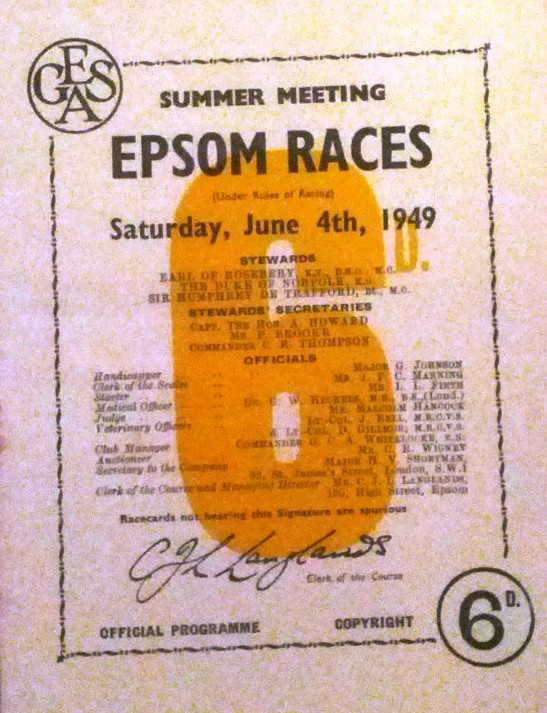
1949 Derby photo-finish

The first photo-finish for the Epsom Derby was in 1949.

The race was the focal point of the racing year and I was determined to be there.

Here follows an account of that day from the tales of my misspent youth.


“Are you going to the Derby next Saturday, Michael?”  Don called across the smoke filled snooker room.

“Is the Pope Catholic?” I retorted, breaking off from lining up a red.

“I’ve got space in the old Humber,” Don added graciously. “I’ve just asked your Dad; he says it’s OK if I keep an eye on you.”

“Sounds super,” I replied, “much better than getting the coach.”


Just then, Master of Ceremonies, Bernie Stevens rang his bell, calling everyone back for the second half of the Whist Drive.  This was Woking’s ambiguously named Railway Athletic Club, where, in these pre-bingo days of 1949, their Saturday night big-money drive was, along with the Atalanta ballroom, one of the two hot spots in Woking.  My Father, Mother and Nan obviously preferred the Whist Drives: jitterbugging was never their strong suit, where as playing cards was as much a part of their life as queuing at the Co-op.


The Whist over, I got the Derby details from Don – pick up opposite the Railway Station, 10 o’clock sharp. Vicky, his fancy woman, (as Mum called her, among other things) and the Giant, were to be the two other passengers.


At this point, I must fill you in on my fellow travellers.  Don was an ex-Guardsman, handsome, middle-aged and dashing. Vicky was four feet something, 40 going on 20, full of fun and covered in jewellery.  Both were divorced and lived together in digs – this in the late 1940s was not only risque, but gave them a touch of celebrity.  The Giant on the other hand was grotesque. Seven feet tall, and in his younger days a sparing partner to Primo Carnera, the 18½ stone Italian, who later became the World Heavyweight Champion. But now, bent almost double with arthritis, his face bore the scars of his profession and he was often referred to as Boris, after Boris Karloff of Frankenstein fame.


In spite of the journey being only 17 miles, it took us almost two hours to get to Epsom, and another half hour to park, this with every road jammed and crowd estimates of half a million people covering the Downs.  Boris, for reasons of convenience, went straight into Tattersall’s, where he would sit high up on the steep terraced steps to watch the afternoon’s events, while Don, Vicky and I sallied around the funfair.


Don was drawn towards the rifle range where, after examining and changing his rifle, he hit four consecutive clay pipes.  Vicky was delighted and so was I, although I respectfully declined the privilege of carrying the prize of a very large stuffed donkey around with me for the rest of the afternoon.  We then had a go at the coconut shies, hoopla and rolling pennies down a shoot, but nothing doing.  Vicky insisted that we all went on the Chairaplanes – rows of swings that rotated at speed.  Don said that he and Neddy preferred to sit this one out, but asked me to accompany Vicky.

Once the wheel got up speed, all the chair-swings fanned out over the crowd; Vicky was shrieking and waving down at Don, but to me, it was terrifying.  I seemed to remember reading about a young boy who had been flung off at a fair and killed.  “What a way to go!” I thought, “and on Derby Day.”  Eventually, when all the swings returned peacefully, Vicky was still in a state of high excitement, and bought us each a stick of candy floss.

“You look a bit pale Michael,” she said mischievously. I tried to grin, but felt as if I had passed through a near-death experience.


As we moved through the crowds, we saw an escapologist at work, an elderly man, thin but wiry looking.  He was wrapped in chains, handcuffed and then put in a canvas sack, which was then padlocked.  We watched and waited.  From time to time we saw the sack wriggle about as crowds pressed in on all sides and the barker entertained the crowd with details of The Great Murcurio’s past feats.  Then, slowly, a hush fell over the crowd, the sack was still.  People began to murmur their concern; one woman shouted across to the barker,

“You’ve killed the poor old bugger, you rotten sod.”

To allay everyone’s fears, he went over to the sack and shouted,

“Is The Great Murcurio all right in there?”

There was no reply. The woman shouted out again, “Now you’ve done it, you rotten bugger, you’ve killed him, and all for a few bob.”


Don dashed off to find a Red Cross man, but no sooner had he gone, than the sack started to wriggle again.  The barker wiped the sweat from his brow and by now the onlookers were pleading with him to open the sack. Then, as he removed the padlock, the old man sprang out of the sack like a jack-in-the-box.  There was much cheering and great relief all around.  Needless to say, the barker’s collection yielded a shower of silver and not a few ten-bob notes.  When Don did get back, he said the Red Cross had been called every half-hour since nine this morning with the same story!


Vicky looked at her watch; it was one o’clock. The first race was in half-an-hour, so we scuttled off to squeeze into the old Stewards’ Stand opposite the main grandstand.  Although you looked head-on down the course, it was a great place to watch the race from, and by now we were all pleased the enclosure had its own toilets.


Don and I were Gordon Richard’s fans, but Vicky just went by the horses’ names.  Saucy Boy, ridden by an apprentice, caught her eye, and it caught the judge’s eye too, romping home at 6-1, while Don and I searched in vain for Gordon at the tail end of the field.


In the next race, another five-furlong sprint, Gordon rode the Aga Khan’s Malindi, which Don and I both backed, in spite of the odds-on Lightning Sketch.  When I say we both backed, in reality it was Don who put the money on, as a skimpy 13-year-old would have been, rightly or wrongly, turned away.  Anyway, Malindi won at 7-2, with the favourite finishing last of five.


There was now an hour before the big race, the sun was shinning, there was just a slight breeze, and then as now, there is no finer place to be than on Epsom Downs on Derby Day.


In order to see the parade, we squeezed in on the terraced steps as the 32 runners filed before us.  To make the most of this occasion, I had painted their colours in a little notebook, as racecards of the day were printed in black and white and had no pictures.


Having had an ante-post bet on Lord Derby’s Swallow Tail after he had won the Chester Vase, I was content to have a saver on Gordon, who was riding the 9-2 favourite Royal Forest.  Don also backed Royal Forest, but Vicky, being an admirer of the glamorous Suzy Volterra, backed her husband’s horse, Amour Drake.  Also fancied was the Two Thousand Guineas winner, Nimbus, owned by Mrs Marion Glenister and ridden by Charlie Elliott.


Unable to get to the top of the terraces, we got our first glimpse of the race as the runners came around Tattenham Corner. Nimbus and Swallow Tail were clear.  Inside the final furlong, Swallow Tail gained the advantage. But Nimbus, on the rails, gamely fought back, before tiring and drifting across towards the stands, taking Swallow Tail with him.  Meanwhile, Amour Drake, having been 10 lengths adrift earlier in the straight, came storming up the centre of the course on to the heels of the front two.  His jockey, Rae Johnstone, finding his path blocked, had to switch Amour Drake to the rails, losing both ground and momentum.  A desperate battle ensued over the last 50 yards with all three contenders crossing the line together.  “Photograph, photograph,” it was to be the first in the history of the Derby.


I was sure Nimbus had won, but many around me thought Amour Drake had; further down the terraces, would be those who thought Swallow Tail had held on.  And although the race was over and I had lost my bets, I immediately saw an opportunity of making a profit on the Derby.  Urgently, I persuaded Don, another man of chance, to walk ahead of me along the first two rows of the terraces to call out, “I’ll lay evens Amour Drake and 3-1 Swallow Tail.”

Those around us were keen to hedge their bets and some were confident of their eyes.  As Don took the money, so I wrote the bets in my note book, adding the punters’ names, for we had no tickets to give out.  The result of the photo took so long that Don took about two dozen bets, mostly pound notes.

“I hope you’re sure about this Michael,” said Don, realising we might not have enough money to pay out if I’d got it wrong.


I didn’t have to answer; suddenly the result frame was being hoisted up, and at the top was number 13, Nimbus; 26 Amour Drake was second and Swallow Tail third.


1949 Derby photo-finish


“How much have we won?”  I said excitedly.

“Well done,” replied Don, “I was beginning to get worried; it took so long.”

“How much,” I persisted.

Don gave way and emptied his pockets.

“Twenty-two pounds. How do you want to split it?” he said.

I paused, “How about a tenner each, and two quid for a slap-up supper?”


Soon a rumbling roar went up over the Downs, as various sections of the crowd were relayed the result.

I tugged on Don’s sleeve: “Come on, we’ve got to get out of here, in case someone has reported us to the ring inspector.”

Fortunately, many others were leaving the enclosure at the same time, so our exit was not conspicuous. Very soon, my 13-year-old brain was buzzing with the potential betting opportunities surrounding this new technology.  What a wonderful thing this photo-finish is!


We decided to join the Giant and, in spite of the gateman’s reservations, Vicky and her donkey charmed us through the entrance.  It was more crowded than the enclosure we had left, but we knew roughly where the Giant would be and he wasn’t difficult to spot. Vicky saw him first, towering above the rest, eating a tiny ice cream cone like a big kid. I’m sure, if he had wanted to, he could have held a dozen cones in one hand.

“Back any winners Boris?” Don asked, as the runners went down for the next.

“Not yet Don, but you’ve just missed the sight of the afternoon – Rita Hayworth.”

Vicky was all ears.

“You know she married Prince Aly Khan earlier this year? Well, he bought her a horse as a wedding present – But Beautiful – it’s running in the next. I watched her walk down the line of bookmakers; everyone was speechless, not a word and, no-one struck a bet.”

“Well someone’s backed it,” I said. “It’s showing odds of 4-7 now.”


A minute later, But Beautiful and the Duchess of Norfolk’s Suivi headed the field at the furlong marker and, after a thrilling finish, passed the post together – another photo finish.  Not so long to wait this time; first Suivi.  We decided to stay put for the rest of the afternoon, sitting on the terraced steps.  Favourites won both the last two races, with ‘Last race Cook,’ living up to his monicker and coasting home four lengths ahead of Doug Smith.

There were many unseen dramas that followed that afternoon, some we heard of in days, others months and one, over three years later, when Mr Henry Glenister committed suicide in his car in Sussex.  Glenister was an employee of the Midland Bank when he paid 5,000 guineas (equal to £190,000 today) for Nimbus as a yearling, as a present to his wife.  Later, the inquest revealed that Glenister had defaulted on ‘a considerable sum’, although the extent of the fraud was never made public.


A more poignant end had taken place the day after the Derby, when Suzy Volterra returned to her dying husband in Paris.  Leon, whose health had suffered during wartime internment by the Germans, had been too ill to listen to the broadcast, and so, before his death, his wife allowed him to think his colt Amour Drake had won the Derby.

1949 Derby racecard Nimbus

This account of the 1949 Derby

comes from Michael’s book of short stories

Born To Bet

To see more of Michael’s books go to Books For Sale

West Brom 2 – Woking 4

Posted on:

West Brom 2 – Woking 4


With the F.A. Cup once more upon us, the BBC football website is showing the best 50 goals scored in the competition. High on the list is Tim Buzaglo’s third goal for Woking against West Brom. So needing little encouragement, I have revised my short story from Born to Bet. It was a memorable day for both me and my family, so I hope you enjoy it.


Most good F.A. Cup stories involve giant-killers. This one in 1990 is no exception, and was one of the biggest upsets in the history of the competition. West Bromwich Albion manager, Brian Talbot, hitherto not known for his psychic powers wrote in the match-day programme:

“There is no worse feeling than being the slain giant” – and so it came to pass.

To put things in perspective, Woking, in their 102 year history, had never beaten a Football League team. At this time, they were playing in one of the three feeder leagues below the Conference, but in the previous rounds of the F.A. Cup had beaten three Conference Clubs successively – Bath City 2-1; Kidderminster 2-1 (after two replays) and finally Merthyr Tydfil 5-1.

After the draw for the third round, which sent Woking to West Brom, Geoff Chapple, the Woking manager, was besieged by the press for his comments.

Woking- Geoff Chapel  “Let’s face it,” he mused, ” on paper we’ve got no chance, but fortunately for us, the game isn’t played on paper.”

All of my family agreed with Chapple, and we readily took the 11-1 odds available for a Woking victory. In fact our optimism ran so high that more than £50 was placed on Woking to win 3-1 at odds of 100-1.

At this point, I think it only fair to tell you the source of our enthusiasm. Stan, my father, had loyally watched Woking from 1911, until his death in 1989 (sadly 18 months before this match), and had started my obsession with the Cardinals or Cards, from my first home game at Christmas in 1945. But that explained, we are now driving in cavalcade, red scarves flapping out the windows, to Birmingham – The Hawthorns – West Bromwich.

Having parked our car 100 yards from the ground (a considerable achievement) on tarmac an inch under water, we went in search of a toilet, a pub and a sandwich, in that order. After a quick recce, it looked impossible to achieve the treble under one roof. The two pubs we passed had more than a hundred fans standing outside and they seemed to be getting their beer passed through the windows. The supporters’ club-rooms outside the ground needed a membership card, but half a mile away, a locked up garage allowed us to buy some snacks through a security hatch. As for the toilets, well, we managed with a little improvisation.

Forty minutes or so before kick-off, we climbed the steps to the away-end terrace turnstiles. Here we were searched for weapons and alcohol (usual practice), but whilst my family and friends were allowed to proceed, I was taken to one side and questioned about my hip flask of gin (a constant companion at all sporting events and funerals).

“For medicinal purposes is it sir?” A bean-pole of a policeman going on 19 towered above me.

“Y-y-yes, it calms me down,” I said feebly.

“Look here,” he said, “I have to confiscate this to get you through the barrier, but when you’re through, stand over there by the railings and I will pass it back to you!”

And he did.

To say that policeman, or more directly the flask of gin, was crucial to my afternoon might be pushing it, but I was deeply grateful for its soothing qualities at times of intense stress.

Our allotted enclosure (from the far left of the goal to the corner flag), had not got the best view of the pitch, but the 5,000 or more Woking fans wearing red and white Santa hats, scarves and carrying banners and flags, made that corner of The Hawthorns their own.

Football fans amongst you will appreciate our novel chants of “Give us a Wubbleyou,” “Woking, Woking, boing, boing,” (accompanied by manic synchronised  leaping) and “When the Cards go steeeeeaming in,” (When the Saints Go Marching in).

But for all that, we were one down at half-time; Colin West heading the Baggies ahead from a Craig Shakespeare corner. By now it was bitterly cold and a sharp wind swirled around our corner of the ground – time for another gin. The strains of the pop instrumental “The Liquidator” welcomed the teams back on the pitch. Woking were kicking towards us this half – dare we hope? Woking - Bazaglo 2

For me and those loyal 5,000, the next 14 minutes and the name of Tim Buzaglo will probably be among the things that flash before our eyes when we are about to die.

Buzaglo’s hat-trick kicked off in the 59th minute with a precision left foot curler. six minutes later, he ran through two defenders and the goalkeeper, to head Woking into the lead, then, on 72 minutes, he sealed his place in history with a diagonal left-foot drive.

Woking - Tim Bazaglo  West Brom were truly in tatters, my flask was drained and rumour’s of the Church family’s correct score coup began to circulate. But it was not to be. Terry Worsfold, an 87th minute substitute for Woking, who incidentally lived in the same road as my Dad, scored a minute later – 4-1. Suddenly, reality replaced our suspended belief; we really were going to win. Wildly abandoned singing, dancing and laughter lit up our corner of the stadium. But, at the other end, there were very different emotions.

Disillusionment, discontent and anarchy broke out from their Birmingham Road End.

“Sack the board, sack the board, Talbot out, Talbot out.”

The Brommie fans’ chants grew louder and louder, so loud in fact, that no one noticed or cared that Darren Bradley had made it 4-2 a minute from time.


I had never before, or since, witnessed scenes like those that followed. On the final whistle, the West Brom fans invaded the pitch, not to cause trouble, but to congratulate the Woking players and their fans, especially Tim Buzaglo, who they lifted up on their shoulders and paraded in front of the stands to taunt their board of directors.

From these amazing scenes we left the terraces and made our way back to the car. Moving bumper to bumper along the road that runs parallel to the stadium, our red scarves trailing triumphantly out of the windows, we were suddenly surrounded by West Brom fans banging on our windows. Fearing the worst, I cautiously wound down mine an inch. Woking - celebrations

“It’s all right mate, you lot were brilliant. We just want to swop scarves and hats.”

And so we did, and wore them as trophies for the rest of the season.

After the match, it was reported that up to 4,000 WBA fans took part in a 40 minute pitch demonstration, calling for the board and their team manager, Brian Talbot, to be sacked. There was no violence.

The West Brom Chairman, John Silk, stated that, in view of the result, his board would discuss Talbot’s position over the next few days, adding, “It is best to look at these things dispassionately. And we will do that when things have calmed down.”

Talbot was sacked within 24 hours.

That evening, Tim Buzaglo (a computer operator) appeared as a guest on BBC’s Match of the Day programme. Des Lynham commenting on the events in and after the game, said to Tim, “See the trouble you’ve caused today? Terrific.”


POSTSCRIPT: “Are you West Brom in disguise?” So sang the Woking fans at Everton in the fourth round of the F.A. Cup. But sadly, here the dream ended. Woking going down 1-0, before a crowd of 34,724, which included over 10,000 Woking supporters.


Percy the Watchman

Posted on:


Percy the Watchman

  Uncle Percy was a remarkably jovial fellow, despite having a leg amputated after the Battle of the Somme, and then later, losing the sight of one eye in curious incident with a magpie. The latter, finally putting an end to his career as a watchmaker.

  Percy was married to Mitzie, a small vivacious lady, now grown buxom with age. She had often recalled her life as a chorus girl in the music halls, before she became part of a novelty act – plates on bamboo poles and that sort of thing – often footing the bill at the Kingston Empire.

  One Sunday, back in the mid-sixties, my wife Pat and I took a trip on our Lambretta scooter to the Devil’s Punchbowl – a well-known beauty spot near Hindhead in Surrey. And, it was whilst hiking near the top ridge I remembered that Uncle Percy, one of my maternal grandmother’s seven brothers, lived on the rim of the Punchbowl.

  Eventually, for the path was both narrow and rough, we spotted a bungalow above us. Venturing forth, I recognised Percy (eye-patch and limp) out in the garden. I called out my name and introduced him to Pat.

  Very soon, we were seated around the fireplace with mugs of hot tea and buttered scones. Percy asking after his younger sister, Alicia Margaret (Nan), who lived with my parents in the centre of Woking, while Mitzie took over Pat with questions about our new house in St Johns and our scooter, which we had parked a little way off. Our lively conversations, however, were punctuated by another voice – that of Henry, a large white parrot with a plumed head, who had settled on the back of Percy’s chair. Alas, his profanities overtook our pleasantries and Mitzie swiftly returned him to his cage.

  After a while, I told Percy of my new job at the Horserace Betting Levy Board and to my surprise, found him to be both interested and knowledgeable on racing. It seemed he had an old friend connected with Staff Ingham’s yard in Headley and occasionally had a bet on, “Something a bit special.”  

  Later, we bade farewell and promised to keep in touch. However, nothing ever came of it – that was, until two years later, when one night, quite late, I had a call from Percy.

 “Michael, how are you? You remember us talking about Alec, a contact of mine with Staff Ingham at Thirty Acres Barn.”

 “Yes,” I answered cautiously, wondering what was to come.

 “Well, I’ve got some news of a smart two-year-old; finished second at Lingfield, and they are taking it to Windsor for the ‘Star and Garter’ on Saturday.”

  Continuing, his voice now wavered with anticipation, “Would you like to be there and help me get some money on? Everything’s got to be hush-hush you understand.”

 “Yes, sounds exciting,” I replied.

 “O.K., meet me in the Members Bar under the grandstand before racing.

 “Percy, what’s the name of the horse?”

 “Oh yes, Watchman, good name for me eh? They’ve booked Geoff Lewis to ride.”


  That Saturday, with Pat heavily pregnant with our second child, Sarah, and me a non-driver, I set out on the convoluted journey from Woking to Windsor racecourse – two trains, sometimes an hour apart, and a boat trip. The latter, a tourist attraction, which had the ill-founded reputation for being quicker than the local bus.

  Windsor RacecourseArriving 20 minutes before the first race, I quickly spotted Percy – county tweeds, eye-patch and walking stick. He told me he had spoken to Alec, and learned that Lewis had picked up a full book of rides and, apart from Watchman, Kitty’s Grey, trained at Epsom by ex-jockey Kenny Gethin, “Should do the business.” Percy’s passing shot as he went to the bar to order our lunch was, “A monkey each on Watchman and I’ll look after Kitty’s Grey myself – alright.”

  Whilst devouring the sausage sandwiches, Percy revealed he had recently sold a prize antique grandfather clock and, as yet, had not been able to bank the £1,500 in cash!

  Just before three o’clock, Percy went off in search of a price against Kitty’s Grey in the five-furlong Maiden. He returned saying he had just had a small bet, but I noticed, meanwhile, the price had gone from 2-1 to 7-4.

  Off and running, Hen-Pecked (far from Percy’s predicament), went straight to the front and stayed there. However, soon after passing the post, the Tanoy announced haughtily, “Objection to the winner by the second,” followed by “Stewards enquiry, stewards enquiry, please retain all betting tickets…..”

  Percy later learned that Geoff Lewis had objected to the winner for crossing and, in the jockey’s words, “Cutting him up.”

 In the ensuing delay, bookmakers took the opportunity to make a little extra or, as they would suggest, to allow punters to hedge their bets.

  Percy felt he was now between ‘the devil and the deep blue sea’ – he could back Hen-Pecked and so negate most of his winnings, or do nothing and hope the result didn’t reduce his intended stake on Watchman.

 As the runners for the next race were going down, a crackly Tanoy interrupted with authority, “Objection sustained, objection sustained……first Kitty’s Grey, second Hen-Pecked, third…..the rest was drowned by Percy’s cheering – more than usual for “Just a small bet,” I thought.


 Time for a celebratory drink, before Watchman’s race at four o‘clock.

  Percy, flushed with excitement, insisted we both downed double whiskies, before dividing up his grand into two five-hundreds for us to bet on Watchman.

  I knew there were only five runners, but the odds of 8-13 were disappointing; worst still, by the time we went forward, it had gone to 4-7. However, we got on at opposite ends of the line at exactly the same time to get £285 to £500 twice. 

 The race was a complete joy. After settling Watchman down, Lewis took him to the front and won in a canter by six lengths.

  From then on, we planned to spend the rest of the afternoon in the bar, rather joyously, I’d hoped, but strangely, not so.

Suddenly, Percy caught sight of Alec hovering in the doorway and after quickly pushing back his chair, he said nervously, “I need to disappear for a while; I think Alec’s come to put the bite on me.”                                                 

  “Perhaps I can help,” I feebly suggested, “I’ll, I’ll, h-hold him up for a w-while,” I stammered. But Percy was in full flight now, leaving me to choose whether to hold-up or not to hold-up – that was the question?

  Out of family loyalty to Percy, I made the effort and while Alec was furtively scanning the room for Percy, I approached.

  “Excuse me,” I politely asked,“Who won the last?”

  “Err Watchman, Geoff Lewis up,” he replied.

  “What price was that?” I persisted.

Alec, now looking agitated, ignored me, until….

 “Haven’t I seen you with Percy,” he questioned – he’s got an eye-patch and a bit of a limp?”

Still giving Percy a chance to get away, I replied, “Was that one eye patch or two?

  Alec looked angry and I thought at one point he was going to hit me, but he didn’t.

 “If you see him,” he said, scowling, “tell him, Alec would like a word and, odds to a ton – tell him.”

 “Bloody hell,” so that’s why Percy wanted to scarper. Even so, a ton at 4-7 wasn’t going to hurt him, but, if Kitty’s Grey was part of the deal, then that was a different kettle. Meanwhile, Geoff Lewis continued his rich vein of form winning the next race at 6-1 and so, landing me three S.P. doubles. But was that another of Alec’s tips, I wondered?

  Needing to allow time for the situation to resolve, I went out to the paddock and then watched a race from the terraces. When I returned to the Members Bar, Percy had got there before me and, had continued with the double whiskies.

  Strange as it may seem, this turned out to be a blessing for all concerned. For soon after insisting that he drove me back to Woking, Percy slumped forward onto the bar and passed out.

  At that moment, I caught sight of Alec enquiring at the other end of the bar. Thinking quickly, I called him over. He surely couldn’t put the finger on Percy in this state and, it might defuse an ugly confrontation.

  “Is he alright?” Alec enquired, looking down at an unconscious Percy.

I gave him a look of disbelief.

 “We’ve got to get him home,” I said.

 “You knew him after all then,” Alec said, revising his take on the situation.

 “Who, Percy?” I retorted, still hoping to buy some time.

  In the end, I came clean with Alec and to my surprise, he came clean with me.

  “Look, I don’t know your connection, but Percy and I go back a long way. Leave him to me, I’ll run him home.”

   “But why was he worried about paying odds to a £100?” I asked.

 “No, that wouldn’t bother him. He’s been desperate to avoid me because he knows he sold me a fake antique grandfather clock – the bloody thing’s quartz.”


  I helped Alec drag Percy back to his car. Percy suspended between us with his arms drooped round our necks.

  After propping Percy in the back seat, Alec said, “Don’t worry Michael, I’ll get him home alright.”

  I was in no position to argue, but I dare not tell Alec, that not only had Percy won around one and a half grand, but he also had his pockets stuffed with the fifteen hundred that Alec had given him for the clock!


  The following day, I telephoned Mitzie to find out if Percy got back all right.

 “Oh he’s fine, thankyou.” she said breezily, “He’s out celebrating with Alec at the moment,” and put the phone down.

  Celebrating, celebrating – no mention of the clock – and sadly, there never was, because to this day, I never, saw or heard from either Percy, Alec, or Mitzie, ever again.


This short story is from Michael’s book Black Horse – Red Dog ,

of which he has a few signed copies for sale.


Mary’s Boxing Day Bet

Posted on:

Mary’s Boxing Day Bet


  Christmas Day was always kept at home with the family; Mum, Dad, Nan, Judy the dog and me. With similar regularity, on Boxing Day, we walked from our little bungalow in Clarence Avenue, Woking, to Auntie Mary’s terraced house in Church Street, a distance of 500 yards exactly.

   I was quite sure of that, having regularly paced the journey to visit my cousin Peter on Sunday mornings. And, significant to me, a 14-year-old boy on the slippery slope (see below), as the standard distance at Wimbledon dog track.

  Young Churchy

   Greeted at the door of 199 by Mary, Henry and Peter, we were shown to their front room. A welcoming sight, with its colourful paper chains, large paper bells, sprigs of holly and a small artificial tree covered in lights.

  “Henry fixed the lights just an hour ago,” Mary said joyfully.

  “One of the bulbs had worked loose, but we didn’t know which one!” her voice booming with the sense of occasion.


   To cross the room, however, was in truth, akin to crossing a minefield, for another of Dad’s brothers, Albert, owning the property and renting it to Henry, had done nothing to repair the dry rot that lurked perilously beneath the freshly hoovered carpet.

  “Mind how you go Stan,” Mary cautioned, shepherding in Dad like the usherette she once was.

  “The seat over by the fireplace is quite safe, and Dorothy, if you sit on the settee with me.” Then in a hushed and dignified tone, added, “We put two large metal trays under the casters to save us falling through.”


  Warming to her roll as hostess, Mary directed, “Oh Henry, go into the kitchen and get us all a cup of tea and a mince pie, and Nan, there’s a wicker chair for you under the radio.”

  Peter and I, a little squeezed for room, were told to play in the kitchen, “You know, the game you like to play on Sunday mornings,” Mary continued, tirelessly, “Guessing the football crowds in the paper, I’ve saved last Sunday’s News of the World ‘specially for you.”

  Hardly a school certificate subject, but perhaps it should have been, since we both excelled at it. Anyway, true to form, Mary had put up a children’s see-through Christmas stocking as a prize for the winner – the ones with chocolate money, sugar mice and those tiny packs of playing cards with Scotty dogs on the back. Oh, and those small tin scales to weigh sweets on. Not much for a 14-year-old boy you might say, but then, Mary called out from the front room that she had included Old Moore’s Almanack.

  “It usually gives some veiled hints for next years Derby and Grand National. And somewhere in there,” she enthused, “there’s trap numbers to back in reversed forecasts for all the London dog tracks!”


   An hour later, I was enjoying a thumb through Old Moore’s, a little guiltily I must confess, since it had fallen to me to guess the Blackpool home crowd, which as every schoolboy knew, was invariably a capacity 30,000 – like taking a penalty kick really.

  Anyway, Henry topped us up with more tea and mince pies on yet another tin tray – The Laughing Cavalier this time. If there was one thing Auntie Mary had in spades it was tin trays – multi-purposed in her house!  

     Meanwhile, spirits were high in the front room, with Mary telling Mum how her friend Phyllis, had, during the war, seen the King and Queen inspecting the bomb damage in the East End of London.

  “They were very friendly, Phyllis told me, and she gave me the cuttings out of her News Chronicle – for my Royal scrapbooks you know.” 

  Auntie Mary was a devout Royalist; she had dozens of these scrapbooks, allegedly, full of Royal births, deaths and marriages, even pictures of past Royal Ascots – so she said.

  However, mysteriously, as yet, we had never seen any of them, and, despite our enthusiasm, we didn’t see them today either.


   Suddenly, there was a knock at the door. Mary, peering round the aspidistra and, slightly twitching the net curtain, “Bloody hell it’s Albert, surely he hasn’t come for the rent on Boxing day?”

  Uncle AlbertAlbert entered with his usual cocky smile, to produce from behind his back with a flourish, a bag containing a bottle of Sandiman’s port, a Christmas pudding, laced with brandy and a wrapper containing 200 Craven A ciggies, the ones with the black cat on the box – the latter a life or death line for Mary and Henry. Then, going back to his Fish van, parked across the road, he returned with an oblong wooden box – a top grade Scottish salmon – “A rarity, even among the gentry,” said Albert with another broad grin. And, no, he hadn’t forgotten Peter either, who disappearing into the scullery with a brown paper parcel joyfully unwrapped a bright new red and white Woking football scarf.

     Mary seemed a little flummoxed at Albert’s sudden generosity and for once, untypically, steered him clear of the dangerous carpet zones.

   In the meantime, my dad, oblivious to the latest turn of events, inevitably redirected the conversation to Woking’s recent 3-0 victory over Wimbledon, “Alfie Welland scored two and …” his account was suddenly interrupted by cheers of relief at Peter’s perfectly timed entrance in his pristine scarf.

  Mary, meanwhile, was disappearing upstairs, when Albert, anxiously fearing that the weight of the gathering might prove costly, nervously called after her, “I can’t stay Mary, I’m just going to pick up Charlie; we’re going to Kempton.”

   Mary returned, slightly out of breath, to ask in a confidential whisper,           

  “Do you know anything good?”

  “Well, Charlie says the Queen’s got Manicou in the ‘King George’ and, it’s a live’un!”

  Mary thrust a small white envelope into Albert’s hand, “Two weeks rent, Albert. Sorry for the delay, but it’s Christmas yer know.” She followed him out to the van.

  “You’re a real brick Mary,” Albert said earnestly, turning to meet her face on, “That’s very much appreciated,” he said with a wink, “It’ll make my day!”

  Mary started to hover from one foot to the other, like a little girl.         

  “Albert, that Queen’s horse Manna-something or other, would you put a bit on for me?” Albert nodded and with that, she slipped something into his overcoat pocket.

  “Must fly now Mary”, said Albert, “Enjoy the salmon,” and with that, his fish van disappeared round the corner and out of sight.


    Kempton was cold, bright and sunny and, there was a feeling of optimism amongst the packed crowd. The first three favourites had all gone in and now, the seven runners for the King George were making their way to post.

  Albert, who had the questionable system of backing horses with the initial letters of A, C, and E in a treble, had already landed the first two legs with Easy Winner and Attentif, and was now sweating on Coloured School Boy in the big’un.

  Just as the field came into line Albert remembered Mary’s bet and, thrusting his hand into his overcoat pocket, rushed up to Stringer’s joint in the front row and pushed the bet into his hand, shouting out, “Manicou, on the nose.”

  There were no ‘big screens’, or even commentaries on racecourses in 1950, so binoculars of all shapes and sizes were trained up the home straight. First round the final bend was the ‘Blue; buff stripes, blue sleeves and black cap’ of Queen Elizabeth’s Manicou, who, although joined two out by Silver Fame (ridden by the future crime writer, Dick Francis), drew away to win by three lengths.

   After the race, Uncles Charlie and Albert met up in front of the bookies. Charlie had collected a nice touch, while typically, Albert, having stayed faithful to his ACE system, had nothing to collect from third placed Coloured School Boy. Then, almost as an afterthought, he remembered Mary’s bet on Manicou, and rummaging in his pocket for the ticket, gave it to Charlie to collect.

   Returning a few minutes later, with an expression of veiled incredulity, Charlie enquired cautiously, “How much did Mary have on that Queen’s horse?”

  “Don’t know, exactly,” Albert said, “Stringer did say, but we were both in such a hurry I didn’t catch it,” continuing, “She had it wrapped up in an envelope.”

  His hand slid back into his pocket and as it did, so Albert’s expression changed. Pulling out another envelope, he opened it – a ten bob note!

  Mary’s two weeks rent had amounted to £6 and now, at 5-1 …“Blimey, I’ve put the rent money on,” Albert exclaimed, his conscience suddenly working overtime with the thoughts of, “If only I had collected the bet myself.”

   Albert thrust out his hand to Charlie, “Give me the money, I’ll deduct the rent and pay Mary her winnings.”

  “OK,” said Charlie, but knowing Albert of old, added, “But won’t Mary be delighted when I tell her she’s won £30. I’m sure she’ll forgive you the cock-up.”  

  Albert’s face was a study; for once, he had been completely thwarted,


 The story of Mary’s Boxing Day bet was often recalled at Christmas and on family holidays – see below, Mary, Henry & Peter, a few years later, on Brighton Pier.


Mary,Henry and Peter on Brighton Pier 

This story comes from Michael’s Black Horse – Red Dog,

of which he has a few signed copies for sale.

See also his list of books for sale by clicking on Books for Sale

at the top of the page.  


Shooting Craps on the 8.27

Posted on:

Craps on 8.27 - small

Shooting Craps on the 8.27


In the early 1960s, there was a quartet of commuters who passed the journey from Portsmouth to London Waterloo, by shooting craps.  For the uninitiated, craps is a popular American casino game, played with two dice.  Briefly, to win, the shooter has to roll a seven or 11 on the first throw. If unsuccessful, he has to throw the number he rolled the first time again, before he throws another seven.  The shooter looses if a two, three or 12 appear on the first throw (this is known as craps), or a seven thereafter.  Simple isn’t it?


     Of course there are variations and side bets.  In our travellers’ case, the players took turns to act as the banker or bookie for the journey, while the other three bet on the game.  The original bets are at evens, but if the shooter doesn’t win on his first throw, various odds are laid that he will throw the original number before a seven.  For those still with us, or for those who have read the first paragraphs for the third time and now think they have a vague understanding of the game, I can now introduce you to the quartet.


     Chris, an overweight accountant, would sit in the corner by the window, his shirt sleeves rolled up, forehead slightly sweating whatever the weather, 20 Rothmans and Ronson lighter to hand.   Fair Enough Smith, or to his intimates, Smithy, had acquired his handle by repeatedly saying “Fair enough” after almost everything said to him.  Also a smoker, he had the worrying habit of laughing and coughing at the same time.

    The third member of the quartet was Joyce, an S.P. Settler who worked with Smithy and appeared to be slightly more than a close friend of his.  Unfortunately, she had one blue tooth, which showed when she laughed and sometimes stopped others from laughing when they saw it.  Finally, Monty was a short, dark, dapper man in his late 50’s, now a messenger in the City, but reputedly an ex-member of a Brighton race-gang after the war.  Oh yes, observing all this, I boarded the train at Woking, and on Monty’s invitation (I’d met him a couple of times at White City dogs), sat or stood as near as possible to the action. So, when one of the players was absent, I was invited to play.


    On this particularly Friday, as the train rattled through Vauxhall Station, Monty pushed the dice across the table.

    “Your roll Chris – I can double the limit for you as it’s the last roll today.”

    “Yeah fine,” said Chris who, after vigorously cleaning his glasses, made the pretext of searching through his wallet.

    “Can you lend me a fiver until tonight Monty?”

    Monty nodded and Chris rolled – “Three – craps – oh shit,”

    Chris groaned as he slumped back in his seat.

    Passengers began reaching up into the luggage racks for their coats and briefcases as the train pulled into Waterloo.  Soon, hundreds of commuters spilled out onto the platform to start their day, but not Chris.

    Looking dazed, he lingered, lighting yet another cigarette and fumbling through his briefcase.  A respected £1,000 a year accountant, Chris had told us he lived with his elderly mother in a big house near Fratton.  Lately, however, even I had noticed his loses were getting to him.


    The following Monday morning, I located their carriage.

    “No Chris?” I enquired hopefully, seeing the vacant seat.

    “He’s gone to the loo,” Monty said, adding, “his luck today is diabolical.”

    Smithy and Joyce urged Monty to restart the game, but Monty said he would wait and put the dice into his shirt pocket.  As the train sped on, they talked of racing and football, until Monty said, “You might as well sit in Churchy; it looks as if Chris is involved in another sort of crap game!”


    Doubling up on three straight sevens, my enthusiastic shouts drew the attention of other passengers away from their newspapers, adding fuel to my ambition to be a regular in this corner seat.

    “Who let Churchy in this game?” said Joyce, flashing her tooth.

    Just then Chris appeared, “Gyppy tummy,” he said sheepishly.

    “I see Churchy’s getting stuck in – no, no, that’s OK, I’ll watch – we’re nearly there now anyway.”

    Chris waved his hand to brush aside my offer of his usual seat, looking slightly relieved.


    On Tuesday morning. I made my way to the quartet’s carriage.

    “Chris in the loo?” I asked seeing his place vacant.

    “No, he’s not with us. Sit in if you like,” said Monty.

    “Yes, that’s fair enough,” said Smithy, stifling what was either a laugh or a cough, or both.

    Once again I was a few pounds up on the trip, and the following day, with still no sign of Chris, I made a strong finish as the new shooter, after Monty had nearly wiped me out before Clapham Junction.

    Before we left the train, Joyce, who had been noticeably quiet throughout the journey, said she would look up Chris’s address and Smithy added “We’ll try and phone him – see what’s happening.”


Craps on 8.27Next day, hoping to add to my run of luck, I watched the windows of the 8.27 as it arrived at Woking and, catching a glimpse of Monty, hurried along the platform to join him.

“How’s Chris?” I said, seeing he wasn’t there and eagerly moving across into his place.  Looking down at the table, Joyce said, “He’s dead. He died late Friday night, after coming back from the pub.  Heart, I believe. Sadly, his big house was really a small flat that he shared with his mum. And she’s worried stiff.  He hadn’t paid the rent for three months and the landlord’s been threatening to throw them out.”

   I looked across at Smithy’s black tie.

       “Fair enough, I suppose,” he said, “but a bit harsh, wouldn’t you say?”

Joyce started to cry.

    “There, there,” said Monty, leaning across to comfort her.

    “I tell you what,” he added, taking three dice out of his shirt pocket, “as a mark of respect, we won’t be needing these again,” and, reaching up to the window, he hurled the dice out onto the track.

    “Why three dice Monty,” I asked irreverently,

    “Always carry a spare Churchy.”

    “Fair enough,” said Smithy, “but I’d never seen the third dice before!”


   Throughout the day and that evening, I could think of nothing but Monty’s third dice.  But next morning, resolving to get into the office a little earlier, I caught the 8.05.


This short story is taken from

Ripping Gambling Yarns,

of which Michael has a few signed copies for sale.

Illustrations by Julia Jacs

A Tip from Charlie Smirke

Posted on:

Charlie Smirke - head

A Tip from Charlie Smirke


For many years, Charlie Young had been the most popular hairdresser in Woking and his backroom gambling set-up handled more than a third of the town’s betting turnover.  Charlie’s acquaintances were legendary and, a few days before the 1952 Derby, one such character – Solly Bernhart – was an unexpected visitor to his Saloon.

   “Something for the weekend Solly?”  Charlie enquired.

   “No thanks,” replied Solly, whose sexual experiences where now purely academic. “Actually, I’ve come down to-day to do you a little favour.”

   “Let’s go through to the back room then,” said Charlie, remembering some of Solly’s previous favours.


   Solly Bernhart was a flamboyant character, who resembled Mr Pickwick in appearance but not in motivation.  He had been a friend of Charlie’s since before the war, and having recently sold his jeweller’s shop in the East-end of London, was now flirting with a life of leisure.

   Once in the betting room, Charlie introduced Solly to Alice and I, who were pouring over the day’s runners.

   “You’ve met my wife Alice, and this is young Michael, runs a penny book at Goldsworth School, but comes in to hedge-off the occasional hefty double.”

   Solly shook hands, but hastily declined Alice’s offer of tea and Woodbines in favour of Charlie’s Cognac.

   I was all ears as Solly told his tale of how, on a recent visit to the Savoy Turkish baths in Jermyn Street, he had bumped into Charlie Smirke.

   “He was full of himself,” said Solly, “whistling away, he was, told me Tulyar was the best Derby mount he could remember.  In fact he kept on saying ‘I’ll Tulyar this and I’ll Tulyar that,’ to hammer home the message.”

   Young rubbed his chin thoughtfully.

   “Have you backed it yet Solly,” he enquired.

   “Well, I had £30 at 100-6 with my local man, but that’s his limit, and I’d like to get a bit more on with you.”

   “That’s OK,” said Charlie, sipping his Cognac, “I’ll make some calls, take a price and you can pay me cash, how much are we looking at?”

   “Fifty or sixty quid if you can – we can’t miss this one,” responded Solly.  Charlie made the calls on the ‘business phone,’ keeping his voice to a whisper. Suddenly he looked up “100-7 do yer, Solly?”

   “Fine.”

   “He will lay you a £1,000 to £70,” said Charlie, “but,” covering the mouthpiece, “I’ll want the cash here before the race, say Monday.”

   “Of course, of course,” Solly nodded vigorously, “don’t forget yourself.”

   Charlie lowered his voice and completed the added investment.

 Sinking their second Cognac, they congratulated themselves on their expected good fortune.  Feeling rejected at being left out of the negotiations, I got up to go.

   “Off now,” said Alice, then, “here Charlie, aren’t you going to cut Michael in for something?”

   “Yes of course, I almost forgot about the boy; what would you like Michael?”

   “Well, as I am actually going to Epsom; perhaps you’ll give me the price to five shillings?”

   “Yes that’s OK,” Charlie replied nonchalantly.  “You have a few bob to come, so I’ll take it out of that.”

   “You’re all heart Charlie,” I replied and promptly legged it back to school.


   Monday came and went with no sign of Solly. Tuesday lunch-time, he still hadn’t shown. Charlie began to panic.  Alice suggested that he try to cancel the bet, but his reputation was at stake and Charlie wouldn’t hear of it. However, after failing to trace Solly, he phoned his big players to try to lay off – they were not interested.  Charlie’s panic mounted and he suffered a troubled night.


    1952 - Tulyar - best Early Wednesday morning, having got special permission from Headmaster, Bonk Peel, to have Derby Day off, I dropped into the hairdressers to hand in my family’s bets. Charlie and Alice, looking the worst for wear, were already occupied with a steady stream of shilling each-way’s and any-to-come’s. Alice confided, “Charlie’s  furious with Solly – it isn’t the first time you know.  If he doesn’t show and Tulyar loses, we’re buggered – it’s like doing a thousand hair cuts for nothing.”

   Charlie came over, “Don’t listen to her, she’s got no bottle,” he said bravely.

   “But you could do me a favour as you’re going to Epsom.”

       “Sure,” I piped up, eager to help.

    “Look, phone here as near as you can to the big race, if Solly hasn’t brought the dosh, I want you to spread £30 over the first three in the Derby betting – the race is wide open and I know you’ll beat the S.P. Hopefully it will save our bacon.”

     I stashed the small fortune carefully into my blazer pocket. I shall be the biggest punter on our coach I thought, and perhaps, this could be the start of the big time for me.

    Arriving at Epsom with my telescope, sandwiches and raincoat, my heart sank on seeing the length of the telephone queues behind the stands. If I was going to phone, it had to be now – still no Solly.

    Walking across the course I was surprised that Tulyar was not only as low as 10-1, but now third favourite. I waited. The showers forecast for the afternoon didn’t arrive. Instead, the sun beat down on the packed crowd, causing hats and coats to be relegated to carrier bags.


    Just before the Derby, the money for Tulyar became an avalanche, forcing him into favouritism. Some bookmakers, in danger of a one-horse-book, off loaded their commitments onto other bookmakers, so forcing the price down further to 11-2. In consequence, the five French-trained horses who had previously vied for favouritism, were now all on the drift. I was now faced with the problem of which three of the five Frenchies to back for Charlie, as they were forever interchanging and increasing in price. And it now became obvious from the crowds pressing in on the bookies, that I had to choose between seeing the race or trying to beat the S.P.  My 16-year-old priorities won the day – I watched the race.


    Throughout the Derby parade, the heat, and the endless inane chatter of two uncommitted ladies immediately in front of me, caused me to feel queasy. I must have slumped forward as, moments later, I felt myself being passed over heads to a perfect position, normally reserved for members of the constabulary. I sustained a miracle cure.


     There was no racecourse commentary in those days, and my first view of the race was when the field turned into the straight – 33 runners were an eyeful, but I could pick out Tulyar, moving up on the outside. Steadying my telescope, I got a better view two-furlongs out as Charlie Smirke gave him a crack and they stormed into the lead, the green and brown hoops of the Aga Khan getting bigger and bigger until my hopes became a reality.

Charlie Smirke - full   Apparently, at the finish, my unrestrained celebrations had convinced a nearby policemen that I had made a full recovery and I was promptly escorted back into the enclosure.

Later, checking the number board with my racecard, I noted that the second, Gay Time, had been ridden by the young Lester Piggott, and Faubourg, one of the French horses had finished third.

The relief of Tulyar’s victory and the saving of Charlie Young’s £30, together with my skin, seemed to have solved everything.  So after a near-perfect day and after being dropped off in Woking, I hurried to the hairdressers.


“Come in Michael,” Charlie said beaming from ear to ear.

“Did Solly turn up?”  I blurted out.

“No, and not a word on the phone. Just as well, thank God, what a result.  Do you know I’ve won about £1,200.”

“I think it is a little more than that,” I said.

“How do you mean?” he puzzled.

“I saved the thirty quid for you.”

Alice intervened with a certain lack of perception, “Blimey Charlie, how’s that for honesty? I think he deserves a reward.”

“Ummm,” said Charlie, obviously considering the pros and cons of my actions.

“Tell you what, Michael, I’ll double your winnings and we can all celebrate.”


  Later clutching my seven quid and change, I made my way home with ambivalent feelings – the glow of nobility from my honest gesture vying with my mental calculation of just how many paper-rounds at six shillings a week equalled £30.

  On hearing my story, Mum had no such ambivalence in reaching her conclusion.

  “Charlie Young is a mean old miser!”


***         ***         ***         ***         ***        ***

Post Mortem:  Solly Bernhart died of a heart attack on

Monday, May 26, 1952, two days before the Derby.


 Tulyar went on to win the Eclipse Stakes, King George VI and Queen

 Elizabeth Stakes, and the St Leger Stakes.  He was unbeaten as a 3-y-o.


 Alice and Charlie had their first holiday since the war,

staying at the Carlton Hotel in Cannes.


This short story is taken from

Ripping Gambling Yarns,

Illustrations by Julia Jacs


Brighton Races

Posted on:


Brighton Races


This is a story of racing at the end of the 1940s, a young Michael, his dad and a dodgy bookies runner known to the family.


I had recently seen ‘Brighton Rock’, the film of Graham Greene’s classic crime thriller, where a young Richard Attenborough plays ‘Pinkie’, the leader of a razor gang, working a bookmaker protection racket at Brighton races.  And although this era was at an end, the film had given the racecourse a popular folklore notoriety that added a buzz to the meetings.

    On learning that a race meeting at Brighton coincided with our family holiday, I persuaded my father to take me, and, it proved a day to remember for this impressionable 13-year-old.  To begin with, I spotted Billy Cook, the Australian champion jockey, walking towards us at the back of the stands.  Hastily producing a racecard and pen, I asked him for his autograph.  Cook, who had been in England for about three months, already had the tinge of a London accent, and his gaunt face and heavy eyebrows belied his pleasant manner.  Plucking up courage I said, “Are you riding anything good today Billy?”

    “Well I’ve only got two rides; the one in the first is a long shot, but my ride in the last has a chance.”

    “Last race Cook, eh?” I replied, for this was what Fleet Street had dubbed him after a recent run of last race successes.

    Getting into racecourses was quite expensive in those days, and as I recall, Dad paid an uncomfortable amount to get into Tattersalls, followed by a small contribution to the Gateman to look the other way as I scrambled over the turnstile.

    Once inside, we found our bearings and marked our selections in the racecard.  It was a bright sunny day, the smell of freshly cut grass, mingling with the shimmering heat-haze and the sound of horses hooves, created a sudden assault on my boyhood senses which crystallised itself into a lasting memory.

    Neither Dad nor I had a bet in the first race, and Billy Cook’s long shot finished well down the field. But running in the next was National Spirit, a long time favourite of mine, who, trained by Vic Smyth at Epsom, had twice won the Champion Hurdle.  I made him my ‘Nap of the Day,’ and, having obtained evens to a pound note, our cheers were drowned in the deafening roar, as the old fella drew away coming up the hill.

    Just after Dad had collected our winnings, an incident occurred that changed our day.  Frank Rogers, a bookies runner and one of Uncle Albert’s shadier friends, appeared hurrying towards us.

    “Are you staying for the last, Stan?” he anxiously enquired.

    “Yes it’s a lovely day isn’t it,” said Dad.

    “Would you do me a great favour and look after my briefcase?”

    Dad hesitated. “It will get me out of a spot,” Frank added.

    “OK, but where will we meet you?” Dad cautiously enquired.

    “Up there at the back of the stand,” Frank said pointing, “after the weigh-in.”


As the runners were leaving the Paddock for the next – the Brighton Mile – I persuaded Dad to go halves on Star Signal in the first leg of a Tote Double, while I looked after Frank’s case. Once again we had something to shout about, as Star Signal won in a canter, while Dad resumed control of the briefcase.

    Finding a place to sit while enjoying our tea and buns, we began to question why Frank had trusted us with his briefcase and why he looked so anxious about it.

    After the second sticky bun, I could no longer contain my curiosity.

    “Come on Dad, let’s have a quick look inside.”

    “Its probably locked,” he replied.

    “It isn’t Dad, I’ve just tried it.”

    “Well, OK then,” Dad said with uncharacteristic abandon, “just a quick look.”

    I flicked the case open … “Bloody hell!”… and shut it smartly.

It was full of bundles and bundles of pound notes.  Just then, the loudspeakers announced the overweights for the next race and Dad scuttled off, unsteadily, to bet a few shillings on the Tote, leaving me to clasp the briefcase tightly with sweaty hands.

    In stark contrast to the contents of the case, Dad’s place on the Tote paid 4/3d (21p).  And even then it took us a minute or two to sort out the right ticket, since in those days, they had to be held up to the light to read a series of perforations that revealed not only the number of the horse and race, but also a four letter code-word.  This persistent scrutiny tested the patience of both the punters and cashiers alike, and continually caused lengthy, slow moving queues at the pay-out windows.

    Exchanging our Daily Double ticket for the second leg, we both agreed on the Duchess of Norfolk’s Suivi, the long odds on favourite, and, after checking the safety of the briefcase for the tenth-time, Dad was able to relax in time to see the horse skate home by four lengths.

    It was now time for the last race and, remembering to back Billy Cook, we opted to bet with the bookies, as the Tote queues continued to grow. The bet on, Dad and I stood high in the stand to watch the race and wait for Frank.  Cook was riding Dorothy Paget’s Wynola, and we watched her famous blue, with yellow hoop colours glide gracefully to the start. The best price available was 13-8, but, having bumped into Billy at the start of the day, we felt duty bound to back it.

    A furlong out, the roar of the crowd told the story, as Cook cruised into the lead to win easily, and whilst by our standards we had had a stunningly successful day’s racing, the presence of Frank’s briefcase put our profit into perspective. Ten minutes later, when we were just beginning to worry about him, he suddenly appeared at our side.

    “Thanks for looking after the case Stan. Saved my day. Have to dash now I’m afraid.”

    And with that, he took the case, looking back to say “Must buy you a drink next time.”

    For a moment we stood there stunned, until Dad said, “Thank heavens for that, I thought we were going to get stuck with all that money!”

    Suddenly, we remembered we hadn’t collected our winnings, so in a bit of a panic, Dad gave me the bookie’s ticket to collect, while he went off to cash our Daily Double.

    I caught up with Dad at the back of the Tote queue.

    “One pound sixteen shillings between us,” he said.

    “Oh well, it could be worse,” I replied, “but I’d have rather hung on to the briefcase!” And part of me meant it.

  It should come as no surprise to the reader, that flashbacks of Frank’s briefcase haunted me throughout my teenage years.


This short story is from Ripping Gambling Yarns,

of which Michael has a few signed copies for sale.

Illustrations by Julia Jacs

The Italian Job

Posted on:

The Italian Job

This is a story from the golden age of greyhound racing – hugh crowds, highly competitive betting and a stage full of characters that have all but disappeared.


During World War II, Wimbledon Greyhound Stadium was very badly bombed, and in order to continue racing and offer some basic amenities, the authorities moved the traps, winning line and stewards’ box to the opposite side of the track.

Soon after my fourteenth birthday, my parents finally consented to me attending the track on my own, although my wish had been granted with reluctance.  First, to get in unaccompanied, I had to pretend to be a year older; secondly, I had to be four years older to bet. But, such was my enthusiasm, I managed to achieve both.

However, first I must tell you of my plan to compile a personal form book, covering a longer period than the racecard. Cutting out the Wimbledon results from the Greyhound Express, I pasted them chronologically into an exercise book and compiled an index, listing each greyhound’s finishing position, his time and the date of the race.


One thing I learnt very quickly was that some dogs, whatever grade they ran in, rarely won, whilst others often ran their ‘Best Recent Time’ when second. I labelled all these as chasers, since many did not like to lead, and if they did, some would idle in front until another dog joined them.  My developing plan, which I disguised at school as an applied mathematics project, was to find races where three or four of these chasers ran together, preferably behind one or two fast starters.  This scenario, used in Tote forecasts, looked to me like a key to a treasure chest.

After a few weeks of cutting and pasting, I had promised to give myself a month’s dry run, just checking through and making nominal bets on paper to find out if I were on the right track. But having selected five races in the first two weeks, from which I had predicted two straight forecasts and two others in combinations, I found it hard to resist. And so every Wednesday and Friday, throughout Nature Study and Double Woodwork, I would pour over the Wimbledon card looking for races that fitted my plan.  After school on Wednesdays, I would take my shilling forecasts and three dog combinations into Charlie Young’s betting room, but on Friday nights I went to the track.


One such night, when I was above an archway on the first bend, one of the regulars who I knew as Tony came over.

“What’cha got in that book kid – all the winners?”

“Sometimes,” I grinned.

But my reluctance to give him any details seemed to heighten his curiosity.  And although we would chat about the dogs most Fridays, it was not until the night I landed two forecasts both paying over £3 for two bob a time, that my tongue ran away with me.

Tony was mid-20’s, and wore a long black jacket with sideburns to match; a few years later he would have passed for a teddy boy.

“I’ve got some friends who’d be interested in your system and that book of yours – they might pay good money.”

Naturally, I was flattered by his suggestion and fortunately, I hadn’t given him all the details, for having almost perfected what I thought was a passport to riches, I had no intention of sharing it.

At this time, I think it fair to tell you that the sources of my income were many and varied: six shillings (30p) a week from an early morning paper round; a profitable school bookmaking business; a lawn-cutting and dog-walking service and irregular amounts from collecting manure from the milkman’s horse.  But, if my new system stood the test of time, all but the bookmaking business could go.


The following Friday, Laurels semi-final night, Tony introduced me to the gang – all Italians – Berni, Ricardo and Alfredo, whose flashing smiles never quite reached their eyes.  When they fell to talking amongst themselves, it was about ‘deals’ and ‘goods,’ and I quickly found out that they supplied the black market – that is, when they weren’t racing or at the dogs.

Alfredo, the main man, bore an air of menace, a black suit, slick black hair and a pitted face.  He seemed to know most of the bookmakers and when he made a bet, no money changed hands until after the race.  For most of the evening Tony stayed close at hand, as if keeping an eye on me, but after gabbling something about the need for cigarettes and a slash, he disappeared under the stands.

Being a big night, there were ten races, instead of the usual eight – the ninth, fitted my system – a 700 yard graded stayers’ event. On Ricardo’s invitation he bought me a meat pie, a pale ale and then came straight to the point:

“I hear you win money here.  A good system Tony tells me?”

“Keeps the w-wolf from the d-door,” I replied, in a desperate attempt to sound cool.

Ricardo smirked, tolerating a stammering schoolboy.

“What’s going to win this then,” he pressed.

“Three with the field’s the b-bet,” I replied.

At eight shillings a time this cost me £2, a very big bet for me, but I did it for bravado, and the pale ale helped.  As it happened, the three-dog won easily, albeit as the 6-4 favourite, but the second, one of the five chasers, was the complete outsider and the forecast paid me £7 and change.  Aware that Ricardo and Co. were close by, I suppressed both my relief and delight, and, on their suggestion, I joined them at the bar, after collecting my winnings.

“Nice forecast,” they all agreed, until Alfredo cut in with, “How you gonna getta home kid?”

“Train from Wimbledon,” I said.

“We givva you a lift to the station, OK? Tony does the driving.”

“Thanks; saves my legs,” I replied.

Strange words from 14-year-old, but I had had two beers!

Once in the car, Ricardo told me that they ran a tipping service – horses and dogs – for about 40 clients; wiring or telephoning their advices on the morning of the race.  Approaching the station, Alfredo half turned from the front seat, his slicked back hair reflecting the orange street lamps along the Alexandra Road,

“Listen kid, we wanna you to give us a copy of your system see. Just a copy you understand, we’ll pay £5, OK.?” He looked at me hard, “OK?” he repeated.

“I’ll let you know next Friday,” I hedged, “and thanks for the lift.” Then, glancing at Ricardo, “and for the beer.”

I scurried through the barrier and down to the platform.

I can tell you, I wasn’t too happy about giving anyone a copy of my system, especially not for £5. Perhaps they thought for a kid I was as cool as a cucumber, but I certainly wasn’t as green.


Throughout the week, I day-dreamed about employing someone like Tony to drive me about in a big car, and then stopping all homework. “Who’d ever heard of a professional punter writing about Roundheads and Cavaliers?”

But when the following Friday came and I had no system written out, I began to get nervous. But what the heck! I couldn’t miss the final of Wimbledon’s big Classic.

Travelling up on the train, I had the idea of missing the first two races, to let the crowd build up while I had a cup of tea outside the station. Then, if I were to go to the other end of the track, they surely wouldn’t look for me there?  Twenty minutes later, I caught the red double-decker bus that went to the track. I pulled an old flat cap over my eyes to disguise my age and squeezed through the turnstile to join the crowds that flooded into every available space.  The trade papers said there would be catering to suit every taste. Where I was, you had a choice between cockles, mussels and jellied eels served in a dish, with vinegar and crusty bread.

Inevitably, there was a Crown and Anchor dice game going on in the ‘gents’ and at Wimbledon, this was always played with five dice rather than the usual three, the operators paying out on doubles or more to get a better profit margin.

While the third race was being run, I was able to move more easily along the walk-way under the stands. I then hit on the idea of transferring into the main enclosure.  This way I would avoid the gang and get a better view of the dogs.  I paid the additional five shillings and climbed the stairs.  All the seats were occupied, but if I went down lower I could stand on the terrace. No sooner had I found a perfect spot than I felt a hand on my shoulder.

“What-cher got for tonight kid?”

“Oh bloody hell!” I thought, “and I’ve paid for the privilege.”

I straightened up to my five foot three inches and told Ricardo, “A 2-4-5 combination in the next looks good.”

Suddenly, Alfredo appeared on the scene,

“Have you gotta dat system with you kid?”

“Er n-no,” I stammered. “I started writing it but, my pencil ber-oke and Dad said I had to g-get on with my homework.”

It sounded weak, and it was – I hadn’t the nerve to tell him I had changed my mind.

He paused for a while, then enquired, “What’s agood tonight then?”

I told him what I had given Ricardo, and as he walked away to join the queue for the  forecast, I breathed a sigh of relief.

The dogs now going into the traps, I rushed up to another forecast window to place my bet.  Out whirred six ten-bob tickets, down came the seller’s hatch, the traps sprung open and released a wall of noise.

First I could see, then I couldn’t, pushing, shoving, jumping up and down and then falling into the gangway. But I did catch a glimpse of the orange and blue jackets going into the third bend.  Scrambling to my feet, I asked, “Who won?” I didn’t have to wait long.  A crackly Tannoy annouced  “First trap five, second trap two.”

Minutes later, I collected £8 and some silver from the payout window.  Ricardo spotted me.

“Well done kid! Alfredo’s got a table upstairs; come and join us,” adding as an afterthought, “make yourself comfortable, you can write that system out for us.”

Surprisingly, Alfredo was in a good mood.

“Good boy, nice divi, come and sit down.”

But then, staring hard into my face, he said,

“Look, I think we stop messing about. I’ma gonna give you £20 and you’re gonna write out the system, OK?”

To soften his order he smiled and handed me a pen.

What could I say?  It was twice what my Dad would earn in a week.

For a while, out of stubbornness, I hesitated, until finally, I asked him for two sheets of paper.  He waived my request away, spreading four fivers on the table before me.

“Write it out in your book and tear out the pages.”

He then took out a long blade flick-knife and started to clean his nails.

A rage of resentment welled up inside me, and so, with a trembling hand, I started to write.


The system that I gave him was not worth £20; neither was it my system.  What I did write was, I hoped, a convincing concoction of selections based on trap numbers and odds, together with a staking plan.  Enough I thought to occupy their minds for a few meetings before the truth hit home.  We shook hands, although mine were still shaking, and he counted out the dosh.

“Was that your only bet tonight kid?” he enquired, I nodded.

“That’s good,” he said, putting the pages into his inside jacket pocket along with his knife.

“Perhaps we’ll have a little drink later?”

They all got up and moved away, pushing through the crowd.  I stayed, feeling what I thought big poker players felt when they’d bluffed a big pot.

Over the next half-hour, I remained at the table reading my torn book.  At intervals a crowd would rush out and then back in again; the alternating babble and roar coming and going like a tide.  A Tannoy voice announced the weights for the Laurels and, walking down to the lower terraces, I was able to get a good look at the dogs in the parade.

Last year’s winner, the brindled Ballymac Ball, looked a picture. Trained by Stan Martin at Wimbledon and drawn again in Trap 6, he would be difficult to beat.  At 14, as now, nothing focused my mind faster than the anticipation of the traps opening.

Instantly, Ballymac Ball hit the lids and from the shrieks, yells and cheers that followed, you would think that everyone in the stadium had backed him.

A minute later, I was legging it out on the street.  All I wanted now, was to get on the train and get home.  From over the railway bridge, and halfway down the Alexandra Road, I had 10 minutes to catch my train.

Suddenly, a black sedan pulled up alongside me. Ricardo leaned out.

“Get in the back kid.”

The back door swung open. Fearing they had rumbled me already, I slid on to the back seat. The door closed with a sickening thud.

“Saw you striding out kid – didn’t want you to miss your train – great dog that Ballymac Ball eh?  We cleared two ‘C’s’ on him.”

They pulled up at the station.  I trapped out of the back seat.


Aboard the train, I re-thought the situation.

“What had I done?”

Here was a racy, black-market gang in the big-time, wanting me in and I’ve just double-crossed them – out of the frying pan into the fire!


From then on, Friday night followed Friday night, but I never returned to Wimbledon Stadium until the Laurels Final the following year.

What happened to my well crafted system? It served me well for a few years – but more of that another time. As for my pseudo system, I often wondered if I had been rumbled, or if the gang had moved on, until nearly a year later when Uncle Albert excitedly burst into our kitchen.

“You won’t believe it, but I’ve found a great way to make money,” he said.

“Oh no” Mum replied, “not again.”

“I have,” Albert continued, “and it’s just up Michael’s street – have a look at this.”

He handed me two typewritten sheets.

“It’s a greyhound system,” I exclaimed.

“Yes, yes, read it,” he said.

“I’ve seen something like it before,” I said slowly.

“No, no, you can’t have; it’s a new system, I’ve just paid £5 for it – it never fails.  An Italian geezer at Wimbledon has made a fortune with it!”


This story is from Michael’s book Born to Bet,

of which he has a few signed copies for sale.

The illustrations throughout the book are by Julia Jacs
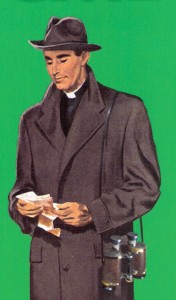
Escape to Newmarket

Posted on:

Escape to Newmarket

Between the ages of 18 and 20, I, like every other able-bodied young man in Britain in the 1950s, did my two years’ National Service.

Starting off at RAF West Kirby, just outside Liverpool, I went through six weeks’ square-bashing, where they attempted to force my square peg personality through a round hole.  However, although it was brutal for some, having previously learned to play the trumpet, I found that band practice and pass-out parades regularly cut into the torturous schedule of crawling through barbed-wire, bayonet charges, gas attacks and giving pints of blood away. From there, having survived what should have been an onslaught on my passive lifestyle, I was posted to RAF Hospital Ely in Cambridgeshire, where, working as an orthopaedic clerk, with a little trumpeting on the side, I lived an almost useful life.


The highlight of my stay at Ely was undoubtedly an eight-day rest in bed with newspapers, fruit and a radio, owing to a suspected concussion sustained when slipping up on my first parade.  Other modest achievements included playing The Last Post in church on Armistice Sunday and landing a treble at Epsom to win our four-man syndicate £125 (at the time, my pay was £3 per week).


The journey from Newmarket to Ely is about 12 miles.  I had always wanted to go racing there, but they had no Saturday fixtures and I could never get time off during the week.  The thought began to bug me, and in view of my imminent posting to Bristol University Air Squadron, I might never be as close to the racecourse again. What was known as the First October Meeting started on Tuesday, September 27.  It was a three-day affair and to me, it looked like now or never.


Tom Lewis, the Station Warrant Officer, also Entertainment’s Officer, was known to be keen on sports, particularly athletics, and from time to time would organise cross-country runs.  According to the Orderly Room notice board, the next, over six miles of local terrain, was scheduled for Wednesday, September 28 – perfect.  Ben Jordan, camp pianist/punter, whose official job title was Medical Clerk, was also keen  to go to Newmarket. After much discussion, and to everyone’s amazement, we both entered our names for the cross-country.

On the morning of the run, SWO Lewis informed the various sections that, owing to a previous engagement, he would not be accompanying us on the run but Corporal Waterhouse would. We should assemble at the Guard Room at 13.00 hours in regulation shorts, singlet and plimsolls, signing out on our departure and in on our return.  Having seen a number of POW films, by comparison our Great Escape took the minimum of planning.

Our third party enabler was Leading Aircraftsman Bobby Barnes: MT driver/danceband drummer, and supplier of new-laid eggs. One of his tasks was to take the Hospital’s outgoing mail down to Ely Post Office and today this was conveniently arranged for 13.00 hours.

Ben Jordan and I had already rolled up our civvies into a spare mail bag, and thrown them into the back of Bobby’s van.  Our signatures and last three numbers having been recorded at the main gate, we set off at a steady trot. So steady in fact that, after half a mile, we were already 200 yards adrift of Corporal Waterhouse and the main pack.

Immediately turning off into a side lane, who should be waiting for us but our chauffeur for the day, Bobby Barnes.  We quickly changed into civvies and stuffed our running gear into the post bags.  Bobby then drove us to the racecourse, promising to meet our return train at Ely after racing.


The two principle races this day were the Newmarket St Leger and the Cheveley Park Stakes.  In the ‘Leger’, Ben and I plumped for Cardington King.  We had both recently been kitted out at RAF Cardington and had backed the horse each-way in the Derby at 100-1. Sadly he finished fourth that day, but we reckoned now was the time to get back our money – and that’s just about what we did.  Cardington King won by three lengths at odds of 4-7 and we spent our entire winnings on two half-pints of Mackeson Stout.

The next race was a two-runner affair, but by the time we had collected our previous winnings and queued for the beers, it was all over.  The Cheveley Park, for 2-y-o fillies, looked an interesting event and often threw-up a Classic contender.  This year, the French filly Midget was all the rage and, ridden by Roger Poincelet, won easily.   We collected on our modest even-money investment, then the sun broke through and our ‘away day’ seemed proof of our charmed life.  It was not to last.

Queuing at the bar for further refreshments, a familiar, but dreaded voice shattered our bonne fortune.

“What the bloody hell are you doing here Church? And you too Jordan?”

“Wer-wer-well Warrant Officer, we did our cross-country and c-came on here.”

“I can see that,” he fumed, “but sports afternoon is not intended for Horse Racing.”

“Oh, I didn’t realise,” I replied feebly, my voice trailing away.

As the three of us were strangely wedged together against the bar, he eventually succumbed to ask us briskly “How are you doing anyway?”

In my shaken state, it must have taken me fully five minutes to tell him we had backed C-C-C-Cardington K-K-K-King, and from the glazed look that came over him I knew he wished he hadn’t asked, worse still, we had all missed another race.  Lewis, unable to extricate himself from our unfortunate pincer movement in front of the bar, heard that his intended nap of the day – Sculpture – had been beaten in a close finish.

“Well, I suppose I’ve got you two twerps to thank for that,” he said grudgingly.

At this point, Ben thought it might help our predicament to order another round of drinks and although SWO Lewis accepted his offer, his expression gave us no sign of hope.

Eventually, we broke free in time to see the last race.  Neither of us had a bet on it and we watched the finish in a subdued silence. On the long walk back to Newmarket Station, we talked over various excuses to give the Military Police on our return, none of which I feared, would get us less than 14 days confined to camp.


Bobby Barnes met our return train as arranged, and we changed back into our crumpled, but spotless running gear in the station toilets.  Jogging the last half-mile back to camp we had our ‘got lost’ excuse ready and offered up prayers that SWO Lewis had not shopped us.

“Who goes there?”

“Ch-Church and Jordan.”

“Advance and be recognised.”

A corporal MP looked us up and down.

“What hour do you bloody well call this?”

“W-we g-got lost c-corporal,” I stammered.

“Yes, yes, yes, I’ve heard all about it.”

My heart sank.

“Lucky for you Station Warrant Officer Lewis saw you running in the wrong direction – half way to Cambridge he said.”


Later that evening, Lewis came into the NAFFI.

“You boys all right after your long run?” he enquired.

“Yes fine, and thank you for looking out for us.” I replied.

“Strange you didn’t see me,” he said meaningfully.

“Anyway, next week’s concert in the Town Hall wouldn’t have sounded the same without our pianist and trumpeter, would it?”

We nodded solemnly, knowing it was just another case of ‘birds of a feather.’


This short story is one of 22 from Michael’s book Born to Bet,
of which he has a few signed copies for sale.

Illustrations by Julia Jacs