Eleanor – Derby & Oaks winner 1801
Eleanor, one of the first great race-mares, was owned and bred by
Sir Charles Bunbury, trained by Jem Frost and ridden by John Saunders.
![Eleanor_horse[1]](https://michaelchurchracingbooks.com/wp-content/uploads/2014/09/Eleanor_horse1.jpg)

Eleanor, one of the first great race-mares, was owned and bred by
Sir Charles Bunbury, trained by Jem Frost and ridden by John Saunders.

On the day that the weathermen had predicted violent storms and flash flooding over Epsom Downs, Australia, who had previously drifted in the market due to the expected downpour, stormed home in glorious sunshine.
Bred in the purple by the 19th Earl of Derby, Australia, was by a Derby winner (Galileo 2001), out of an Oaks winner (Ouija Board 2004).
But the history did not stop there; Aidan O’Brien became the first trainer to win three consecutive Derby’s and the owners, their fourth on the trot.
Of the 16 that went to post, the main players were Australia, a runaway winner of a one mile, Group 3 at Leopardstown in September and a close-up third in the Two Thousand Guineas; Kingston Hill, winner of the Racing Post Trophy and a close eighth in the Guineas; Geoffrey Chaucer, winner of the Derrinstown Stud Derby Trial Stakes; and the second and third in the Dante Stakes, Arod and True Story, the latter the foremost of the Godolphin trio and ridden by Kieren Fallon.
When the field settled, Our Channel and Kingfisher took them along, closely followed by Kingston Hill, with Australia in mid-field. The order remained the same until Tattenham Corner, when the front two extended their lead to four lengths . Meanwhile, Joseph O’Brien brought Australia up the outside and, between the three and the two furlong pole, challenged Kingston Hill for the lead, as Our Channel and Kingfisher fell away.
Soon after, Australia asserted with a burst of speed, to win by one and a quarter lengths, from the gallant Kingston Hill, with Romsdal, who ran well throughout, staying on to be third, a further three and a quarter lengths away.
After the race Aidan O’Brien played down his own achievement, saying, “It’s very special, but we are in a very privileged position to have such horses to train every year. That is the reality of it with the horses with the bloodlines we have – they’re incredible.”
A glance at the records confirm that seven winners in the last decade were sired by, either Montjeu (died 2012), or Galileo, standing at Coolmore in Ireland.
Below is the result of the race in the style of my book
The Derby Stakes – The Complete History – 1780-2006

Within my history of The Derby Stakes 1780-2006,
I made a study of the Derby winning times.
Those pages follow, together with an update from the winning times 2007-2013.

2007-2013
2010 WORKFORCE 2 min 31.33 sec (record)
2012 CAMELOT 2 min 33.90 sec
2011 POUR MOI 2 min 34.54 sec 2 min 33.26 sec
__________________________________________________________________
The Current List of Fastest Times
2010 WORKFORCE 2 min 31.33 sec
1995 LAMMTARRA 2 min 32.31 sec
2001 GALILEO 2 min 33.27 sec
2003 KRIS KIN 2 min 33.35 sec


The average of the best three times in the span 2006-2013 is 2min 33.26 sec, the second fastest period in the history of the race.

Following my posting of the early Derby contenders, I have listed below six of the best in the Oaks line up – a far more open affair than this years Derby. To set the standard, I have featured below, the 2004 winner, Ouija Board, who incidentally, is the dam of the current Derby favourite Australia. 
From the list that follows you will see that Godolphin’s Ihtimal is the most experienced, winning four of his eight races, including the UAE 1,000 Guineas and the UAE Oaks. However, eight races for a Classic-bound two-year-old might not convince the purists.
My Titania, by Sea The Stars, looks a more serious contender – trained by John Oxx and winner of the Park Stakes at The Curragh. While Tapestry, by Galileo, is trained by Aidan O’Brien and has been a long time favourite for the race, since finishing second to Rizeena in the Group 1, Moyglare Stakes.
Bracelet, by Montjeu and Taghrooda, by Sea The Stars, have both won their Maidens, while Luca Cumani’s Volume comes via a competitive Nottingham Nursery.
No doubt, in such an open year, others will enter the picture, but until then, the following list will give you a headstart.

In order to try to put this winter behind us, I have put together a brief guide to the early contenders in the market.
 However, I would remind everyone, that bad weather is not just confined to winter, as you will see, the 1839 Derby, run on May 15th, was run in the severest snowstorm of the year and won by Bloomsbury (rails), a 25-1 longshot.
The runner-up, Deception, turned out again two days later to win the Oaks.
From the list that follows you will see that Aidan O’Brien has four contenders, most notably Australia, a colt by the 2001 Derby winner, Galileo, out of Lord Derby’s 2004 Oaks winner, Ouija Board – it would be hard to find a more suitable pedigree.
Free Eagle is by the 2002 Derby winner, High Chaparral and Geoffrey Chaucer by Montjeu (now deceased), who previously sired four Epsom Derby winners in eight years.
I hope that in studying the list, summer will seem a little nearer – good luck!

You made have read recently that Chicquita (b.f. 2010, by Monjeu ex Prudenzia by Dansili), winner of the 2013 Darley Irish Oaks, was sold at Goffs sales in Ireland for E6,000,000. A staggering figure, which may never be recuperated by the buyers. However, let’s hope they enjoy the forthcoming foals and their success, both in the sale ring and on the racecourse.
Nevertheless, there have been seven mares who certainly repaid their owners and I have listed these and their Classic winners in the table below.
Only seven mares have produced three Classic winners. And when Scintillate won the Oaks in 1979, her dam Set Free was the first mare to produce three Classic winners for 100 years.
Dam Classic winning produce
Penelope (b. 1798 by Trumpator) Whalebone (by Waxy) 1810 Derby
Whisker (by Waxy) 1815 Derby
Whizgig (by Rubens) 1822 1000 Gns
Pope Joan (b. 1809 by Waxy) Tontine (by Election) 1825 1000 Gns
Turcoman (by Selim) 1827 2000 Gns
Turquoise (by Selim) 1828 Oaks
Filagree (ch. 1815 by Soothsayer) Cobweb by (Phantom) 1824 1000 Gns & Oaks
Charlotte West (by Tramp) 1830 1000 Gns
Riddlesworth (by Emilius) 1831 2000 Gns
Rubens Mare (ch. 1819) May-day (by Lamplighter) 1834 1000 Gns
Phosphorus (by Lamplighter) 1837 Derby
Firebrand (by Lamplighter) 1842 1000 Gns
Cobweb (b. 1821 by Phantom) Bay Middleton (by Sultan) 1836 2000 Gns & Derby
Achmet (by Sultan) 1837 2000 Gns
Clementina (by Venison) 1847 1000 Gns
Araucaria (b. 1862 by Ambrose) Camelia (by Macaroni) 1876 1000 Gns & d-h Oaks
Chamant (by Mortemer) 1877 2000 Gns
Rayon d’Or (by Flageolet) 1879 St Leger
Set Free (b. 1964 by Worden) Juliette Marny (by Blakeney) 1975 Oaks
Julio Mariner (by Blakeney) 1978 St Leger
Scintillate (by Sparkler) 1979 Oaks

Nineteen sixty two was a bad year for the Derby and public relations were at an all time low. My lasting memory of the race was the loose horses coming in, one after the other, and the crowd too stunned to cheer the winner.
The Press and the public had struggled to cope with the three accidents, two years previous, when the Irish challenger Exchange Student broke a leg when exercising on the downs, Sir Winston Churchill’s fancied colt, Vienna, had to be withdrawn, when pricked by the blacksmith on the morning of the race and, thirdly, the well-backed favourite, Angers, broke a fetlock when at the top of the hill.
In 1961, Psidium’s friendless victory at 66-1 only added fuel to the fire. So after a Derby where seven horses fell, there were many who supported a move to run the race at Newbury. Nevertheless, Epsom survived as it had done many times before.
Here then is my account of the race from The Derby Stakes – The Complete History – 1780-2006.

HEROD on the Racecourse & at Stud

Although their paths never crossed on the racecourse, Herod and Eclipse were rivals at stud for a decade. Herod was Champion Sire eight consecutive years 1777-1784, whilst Eclipse, although never Champion Sire, was a runner-up in the 11 years 1778-1788.
One dominant reason for Herod’s overwhelming success at stud was the reluctance of the aristocracy to do business with the self styled, Count Dennis O’ Kelly.
O’Kelly left Ireland, coming to London in 1745, to improve his frugal living. He started as a sedan chairman then, became a billiards marker, until eventually forming a friendship with Charlotte Hayes, a woman with a notorious reputation. Both were released from Fleet Prison in 1760, on the death of George II, and from then on they worked their way through society, she, with her feminine ways and he, as a sharp practising gambler. At Epsom, in May, 1769, from winning his historic bet of, “Eclipse first, the rest nowhere,” Dennis O’Kelly went on to buy Eclipse outright, and despite Eclipse’s dominance on the racecourse – unbeaten in 18 starts – when sent to stud, many of the aristocracy shunned the uncouth O’Kelly and sent their best mares to Herod.
But now it’s time to hear about the life of Herod (b.c. 1758) – Champion racehorse and Champion sire.
“KING HEROD was a remarkable fine horse, with uncommon power, and allowed to be one of the best bred horses this kingdom ever produced, and as a stallion inferior to none, being sire of a larger number of racers, stallions and broodmares than any other horse either before or since his time.”
So reads a contemporary description in William Pick’s Racing Calendar.
First entered in the General Stud-Book as King Herod, he was later more commonly called Herod.
A bay colt by Tartar (a great-grandson of the Byerley Turk) out of Cypron by Blaze, Herod was bred by William, Duke of Cumberland (the breeder of Eclipse), at his stud in Windsor Forest.
Over his first two seasons as a five and six year-old, Herod was unbeaten in four starts. The last of these for 500 guineas, against Antinous (rec’d 3lbs), over the Beacon Course, at Newmarket, provoked the beaten connections to call for a return Match at double the stake and with a pull of 9lb. The Match caused a great deal of interest and was run the following spring, with Antinous once again starting favourite. But the difference in weight appeared to make no difference to Herod who again won easily. However, later that year, Herod’s first defeat came when conceding a stone to Ascham, over the Beacon Course, for 1,000 guineas.
After the death of the Duke in 1765, Herod was purchased by Sir John Moore. The colt was beaten a further twice the following year: first by Turf (rec’d 6lb), for 1,000 guineas over the Beacon Course in April, and then by Bay Malton in York’s Great Subscription Purse. During the latter race, Herod sustained a burst blood vessel in his head, and for a time was dangerously ill. He did not race again that year.
At nine, he finished second to Bay Malton over the Beacon Course, but ahead of both Ascham and Turf. The following May, Herod ran his last race, a Match over the same course, for 1,000 guineas, against Ascham (gave 7lbs), which he won in fine style.
Herod was the Champion Sire for eight consecutive years from 1777 to 1784. His best progeny were Highflyer (b.c. 1774), the 13 times Champion Sire; Woodpecker (ch.c. 1773), a winner of 15 races and runner-up Champion Sire four consecutive years, and Florizel (b.c. 1768), the sire of four Classic winners, including the first Derby winner Diomed (ch.c. 1777). Herod also sired the dams of ten individual Classic winners.
It was said that breeders of the day singled out Herod for his toughness and courage in running, despite a tendency to break blood vessels. They also discovered that, when his offspring were put to those of Eclipse, they produced winners – Classic winners.
Herod stood at Netherhall, Bury St Edmunds, Suffolk. The sire of 13 crops, he got the winners of 1,042 races, valued at £201,502 (the equivalent of more than £13 million today). He died on 12 May, 1780, aged 22 years.
As the St Leger will soon be upon us, I thought it of interest to return to the origins of the race and its fragmented history.
The St Leger is the oldest of the five Classic races and throughout the Victorian era it fiercely rivalled the Derby for supremacy. Its origins were, however, both obscure and humble.
First run on Tuesday, 24 September 1776, as an unnamed sweepstakes for three-year-old colts and fillies over two miles, it was run on the old course on Cantley Common, Doncaster.
Five ran and the winner was an unnamed filly owned by the 2nd Marquis of Rockingham, who he later named Allabaculia.
The following year the race was run under the same conditions, but in 1778 the race was given a name and a change of venue.
At a dinner party held at the Red Lion Inn, Doncaster that year, the Marquis of Rockingham proposed the race be called the St Leger’s Stakes as a compliment to the popular local sportsman Lt-Gen. Anthony St Leger of Park Hill. The venue was then changed to Town Moor, Doncaster and the race run on Tuesday, 22 September 1778.
The distance remained at two miles, until, with various changes, it was eventually run over the current distance of 1m. 6f. 132yds.
In a strange and varied set of circumstances, the St Leger has taken place at seven different venues: Cantley Common, Town Moor, the Cesarewitch Course, Newmarket, Thirsk, Manchester, the July Course at Newmarket and, in 1989 at Ayr.
Incidentally, the St Leger is the only British Classic to have skipped a year from its inaugural running, and in unique circumstances it happened so.
In 1939, the 6th Earl of Rosebery’s Blue Peter, having won the 2,000 Guineas and Derby, was undergoing his preparation for the St Leger. However, history intervened at 11 o’clock on Sunday 3 September, when Prime Minister Neville Chamberlain broadcast the news to the nation that Great Britain was at war with Germany. Subsequently, the St Leger was cancelled, thus denying Blue Peter the chance of the Triple Crown.
The last horse to win the Triple Crown was Nijinsky in 1970, seen below, winning the St Leger at Doncaster, with Lester Piggott aboard.

For more Racing History see Michael’s Books for Sale.
One of the pleasures of writing a book is, after publication, receiving appreciation for making known to a wider audience some hidden gem.
According to the readers of my The Derby Stakes – The Complete History – 1780-2006, the section on Films and the Derby, created a lot of interest.
And, as it has been a while since the Epsom Derby has been the focus of a major film, I thought followers of my website may like read my film reviews.


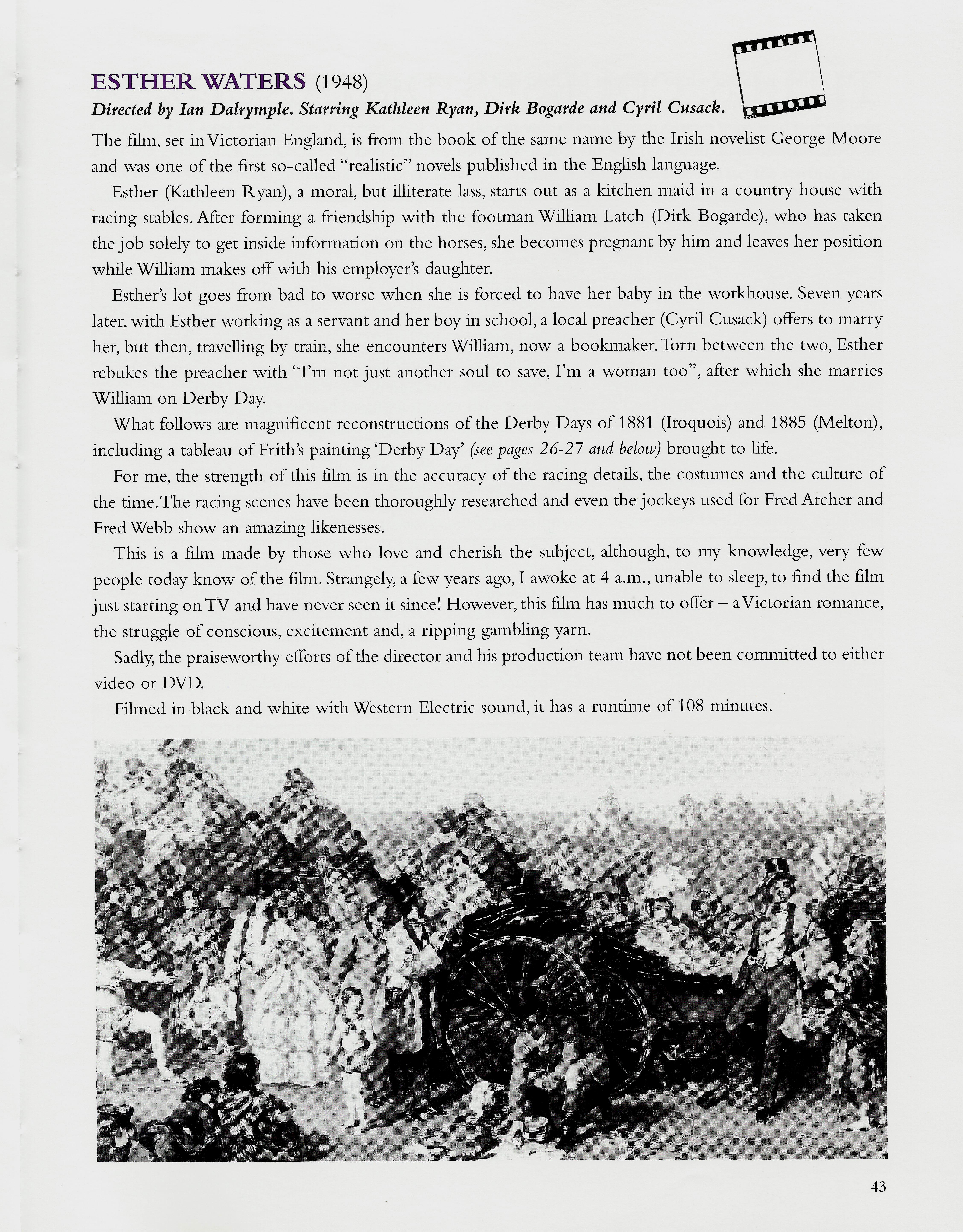
Incidentally, Esther Waters is now available on DVD.
Details of a few signed and numbered copies of Michael’s book
The Derby Stakes – The Complete History – 1780-2006
can be found on this website under Books for Sale.