Marcus Armytage of the Daily Telegraph reviews
Michael’s latest book – The Oaks Stakes 1779-2015


Whilst there’s a huge library of books chronicling the history of the turf, there’s been one standout omission – a history of the 237 year-old Oaks. That, however, is about to change with the imminent publication of racing historian Michael Church’s The Oaks Stakes: The History – The Winners—Their Breeding 1779-2015.
Its 256 pages include a comprehensive history of the race, its foundation, the results, all the winners and their breeding.
“Surprising as it is, no one had written a detailed history of the Oaks” says Michael. “I therefore raised the subject with Julian Brown at Raceform, who after consultation, said, ‘We would consider the history of the Oaks as a limited edition, say, about half the size of your Derby tome.’
 “And so, here it is – the earlier winners are two to a page (to keep down the pagination), but still with their pedigree, produce and the exploits of their sire and dam. “The later winners have a full page, with times, distances, SPs and the innovation of a race commentary. In addition to the illustrations, there are pen pictures of the famous connections – owners, trainers and jockeys, together with essays on the more famous winners. To round off, as with my previous books, there are analyses tables, a range of records and full indices.
“By using, among others, past volumes of the Racing Calendar, the General Stud-Book and my Dams of Classic Winners and Classic Pedigrees, I was able to condense as much consistent information that could be produced in both half pages for the earlier years and full pages from 1916.”
Michael estimates that undertaking the research and writing the book amounted to just over one day for every year of the Oaks’ history. “It took about 300 days, working every day except Oaks Day, Derby Day and Christmas Day. “The surprise to me was the pleasure I gained from researching and compiling the race commentaries – a new feature in my turf histories.”
That investment in time and effort has already earned the praise of the doyen of bloodstock writers Tony Morris, saying:
“This is a classic account of Epsom’s other classic. For it is the Oaks, more than any other race, which identifies the special filly who may earn the right to challenge the colts and sometimes put them in their place.”
In personal terms, there are two standout Oaks which Michael has witnessed. “I would find it very difficult to split Petite Etoile (1959), cruising to victory, with Lester Piggott aboard and Noblesse (1963), showing devastating class to win by 10 lengths.”
Published by Raceform, The Oaks Stakes: The History – The Winners—Their Breeding 1779-2015, is a limited edition of 650 copies, numbered and signed by the author.
Priced at £65, the book, size A5, is presented in a strong luxury binding, gold-blocked cover, with head and tail bands, ribbon marker and, all edges gilt. All together a fine collectors book. Available from www.racingpost.com/shop or by calling : 01933 304 858.
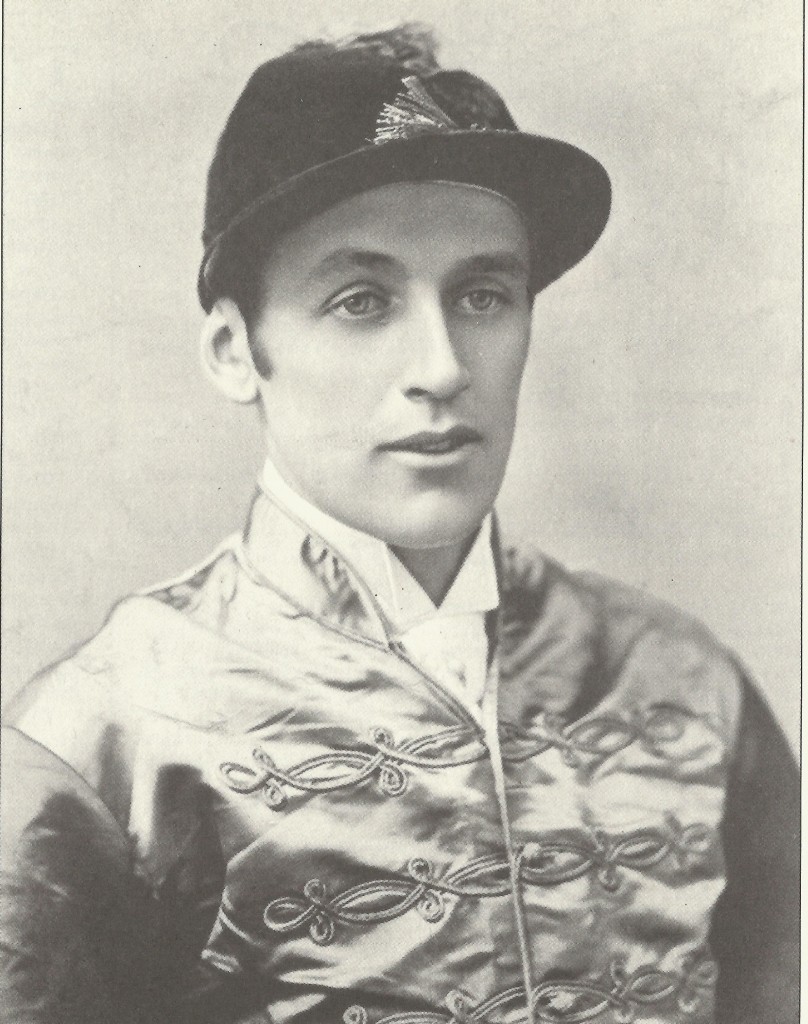
Known as ‘The Tinman’, due to his fondness for cash, Frederick James Archer was the greatest jockey of his generation.
Such was his popular acclaim, that London cab drivers would hail each other with “Archers up,” to show all was well.
Fred was born at St Georges Cottage, Cheltenham on 11th January, 1857. His father, William Archer, was a successful N.H. jockey, and the year after Fred was born he won the Grand National on Little Charlie.
At the age of 11, Fred signed apprentice indentures to Mathew Dawson at Heath House, in Newmarket. It was there he learned his trade, and weighing only 4st. 1lb, he partnered all the stable’s lightweights in handicaps.
Eventually, when he grew tall, he would rap his legs around the horse, squeezing him for the final drive. Powerful in a finish, he was rarely beaten and used the whip unsparingly.
Between 1874 and his death he notched 21 British Classics, including four in the Oaks: Spinaway (1875), Jannette (1878), Lonely (1885), and Wheel of Fortune (1879), who he swore was the best filly he ever rode. He also rode five winners of the Derby: Silvio (1877), Bend Or (1880), Iroquois (1881), Melton (1885) and Ormonde (1886), the greatest horse of the 19th century.
Also, since Fred Archer holds the Royal Ascot record with 12 wins from 24 rides it is worth unearthing his brilliant achievement in 1878.
Ascot was then a four-day meeting. On the Tuesday, he rode one winner from seven rides – Garswood 4-9 fav in a Post Sweepstake.
On Wednesday, he rode five winners from six mounts: Lady Lumley 5-4 fav in the Fern Hill Stakes; Julius Caesar 10-1, top weight (5y-8st-6lb) in the Royal Hunt Cup; Redwing 8-1 in the Coronation Stakes; Muley Edris 9-4 in the Triennial Stakes and Sonsie Queen 9-2 in the Ascot Biennial Stakes.
On the Thursday, he rode three winners from six mounts: Lord Clive 1-3 fav in the New Biennial Stakes; Trappist 2-5 fav in the All-aged Stakes and Petrarch 5-4 fav in the Rous Memorial Stakes.
On Friday, the final day, he rode another three winners from five mounts: Out of Bounds 5-6 fav in the Maiden Plate; Trappist 7-1, top weight (6y-9st-10lb) in the Wokingham Stakes and Jannette 4-7 fav in a Triennial Stakes.
In contrast to today, Trappist‘s 9st 10lb in the Wokingham, gave 20lb to the next highest and 59lb to the bottom weights on 5st 7lb, in a field of 24. The distances were 3/4 length and a bad third.
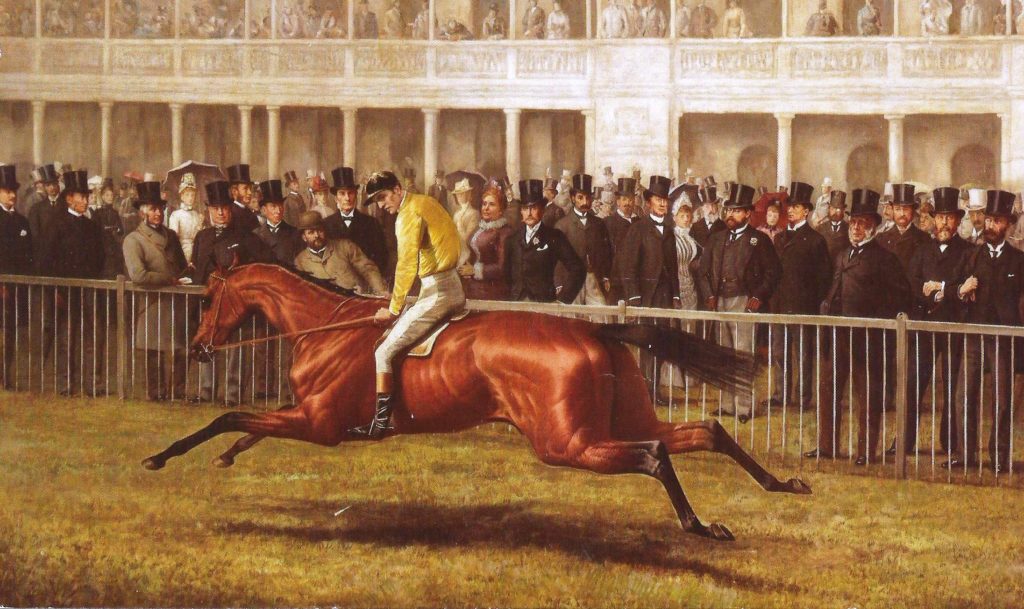
Fred Archer on Ormonde at Epsom 1886
During this time his weight rose from 6 st 2 lb to 9 st 1 lb, so causing him to endure lengthy periods of wasting with a vicious purgative known as “Archer’s Mixture”.
While still mourning the death of his wife, Helen Rose and wasting to make 8 st 7 lb on St. Mirin in the Cambridgeshire, he was beaten a head carrying 1lb overweight.
Tragically, on Monday, 8 November, 1886, while suffering from a typhoid fever, he shot himself in a fit of depression. He was 29 years of age.
Archer was Champion jockey for 13 consecutive years to 1886 and rode a total 2,748 winners, including 246 in 1885. His lifetime ratio of winners to mounts exceeded 34%, although in 1881 and 1884 it exceeded 41%
His obituary stated: “Backers have lost the best friend they ever had”.
For more Racing History see Michael’s Books for Sale.

On a sunny day, with a crowd of 125,000 and in the presence of the Queen and Prince Philip, the scene was set for a perfect Derby Day.
Of all the traditional trials, the Dante Stakes at York seemed to hold the key; Golden Horn finishing strongly to beat Jack Hobbs and Elm Park, with all three going to Epsom’s Breakfast with the Stars to breeze round and show all was well.
However, there were many who doubted Golden Horn’s ability to stay another 300 yards. His pedigree being full of mile-to-a mile and a quarter horses. While his owner, Anthony Oppenheimer, still uncertain, needed to be convinced by trainer, John Gosden, before paying the £75,000 supplement to enter. But none need have worried. Jig-jogging along the inside rail down to the start, Frankie Dettori settled him beautifully and when he arrived at the start, he was ready to go on Good to Firm ground.
Aidan O’Brien, having trained the last three winners of the Derby had three entries, Giovanni Canaletto, a full brother to Ruler Of The World, being the most fancied, with Hans Holbein (Chester Vase) and Kilimanjaro (Lingfield Derby Trial) making up the team.
The field of 12 on their way, Elm Park took them along from Hans Holbein, Storm The Stars and Jack Hobbs. After three furlongs, Hans Holbein (rails) and Elm Park took each other on and drew eight lengths clear of Storm The Stars, Epicuris and Jack Hobbs.
On reaching the highest point, Hans Holbein pressed on to a four-length lead from Elm Park and Epicuris, with Golden Horn tucked in at the back of the field in ninth.
The order remained unchanged around Tattenham Corner, but into the straight, Dettori brought Golden Horn up the outside to begin his challenge. A furlong later, with the leaders five-wide, across the course, Jack Hobbs shot to the front. Seconds later, Golden Horn swept past Jack Hobbs, who edging left with the camber, was followed over by Golden Horn, who stormed home to win by 3½ lengths. Storm The Stars kept on for third, a further 4½ lengths away. The time, 2 min 32.32 sec, was the third fastest in the history of the race, behind those of Workforce (2 min 31.33 sec in 2010) and Lammtarra (2 min 32.31 sec in 1995).
John Gosden, who trained the first two home, previously trained Benny The Dip to win the race in 1997. His wife, Rachel Hood, retained a 37.5 per cent share in Jack Hobbs, with two friends keeping 6.25 per cent each, after Sheikh Mohammed purchased a 50 per cent share after the Dante Stakes.
Frankie Dettori, who lit up the afternoon with hugs and kisses to all in the winners enclosure, had last won the race in 2007 on Authorized.
The sire of the winner, Cape Cross, had previously sired Sea The Stars to win the Derby in 2009 and Ouija Board, the Oaks in 2004. He currently stands at Kildangan Stud in Ireland at E20,000.
The result of the race in the style of my two histories of the Derby follows

To see a selection of Michael’s own books for sale
go to Books for Sale at the top of the page.
A few days ago, Racing Post wrote a review of the new Epsom Derby website www.epsomderby.co.uk/
To read my essays in the History section referred to below, click first on Derby Day and then on History.
A copy of the review, published on Sunday, 24 May, follows.


One hundred years ago and a year into the First World War, all the Classics were run at Newmarket.
In the Two Thousand Guineas, Pommern, a bay colt by Polymelus out of Merry Agnes, gave Steve Donoghue his first of 14 Classic winning rides.
Here follows the essay and Pommern’s race record taken from my book The Classic Pedigree 1776 – 1989.


The first Aintree steeplechase, run on 29 February 1836, under the title,
The Grand Liverpool Steeplechase, was won by The Duke (see below)
and ridden by the famous Captain Martin Becher.

The same year saw the inaugural hare coursing classic, the Waterloo Cup, run at Altcar, both events being organised by a local landlord, William Lynn of the Waterloo Hotel. Lynn having previously introduced Flat Racing to Aintree in 1829, on land leased from the 2nd Earl of Sefton.
The 1837 and 1838 renewals of The Grand Liverpool Steeplechase, were until recent years, thought to be run at the then nearby, Maghull racecourse. However, records taken from Chris Pitt’s authoritative book, A Long Time Gone, show that racecourse ran its final meeting on 16 May 1834. Further evidence found, suggest that the 1837 race, won again by The Duke, and the 1838 race, won by Sir William, were both run over the original Aintree course and as such were credited as Grand National’s well into the 1860s.
Latterly, however, due to the races supposedly run at Maghull, together with the 1839 renewal, renamed The Grand National, the authorities proclaimed the first race as 1839, with the aptly named winner, Lottery.

Recent requests from published historians (including the famous Aintree historian, John Pinfold), to restore the earlier races to the record books have so far been declined.
For my part, in parallel, may I remind both historians and the Aintree authorities, that the so called St Leger Stakes, was run at Cantley Common as
“a sweepstakes” from 1776-1777, before becoming the St Leger. And those two earlier races have long been accepted as St Leger’s, thus making it the oldest of our five Classic races.
Putting that aside, in a few days time, in every street, in every village and in every town, people will be looking at the runners for their annual each way bet on the greatest steeplechase in the world – a race watched on TV, around the world, by over 500 million people in 140 countries.
Let us enjoy this and play our part in continuing its wonderful history.
 Racing in Hong Kong & Australia
In order to visit family in Melbourne and see some of the world’s famous racecourses, Trish and I stopped off at Hong Kong to visit Happy Valley on the way out, and Sha Tin on the way back.
For those who have never been, Happy Valley race most Wednesday evenings.
As a visitor, by showing our passports and paying around £12 each we could go into the Members Enclosure. 
Happy Valley is a tight track in the middle of the city, surrounded by skyscrapers.
The tote deductions were lower than usual and encouraged a staggering turnover. With an attendance of 16,000, the tote turnover was HK$1,217,144,118, roughly £105,838,000.
There were eight races, the highlight being the January Cup, a Group 3 handicap for 90+ worth £240,000. Most races have a close finish, with usually two lengths covering the first four.
A few days after our arrival in Melbourne we visited Flemington, home of the Melbourne Cup.
Strangely, the experience was a complete contrast. A small attendance, the viewing 40 yards back from the track and, the winning post was a further hundred yards past the members enclosure!
There were, however, bookmakers, albeit at the back of the stands, while food, drink and getting a bet on were fine.
There was also a fine display of roses, a bed of which surrounded a handsome statute of Phar Lap.
Continuing on to Royal Randwick (NSW) for the Australia Day Cup, over 2400 metres, we had a day’s racing in glorious sunshine.
The racecourse had recently undergone a impressive rebuilding programme to emulate our own Ascot.
Whilst visiting the bookmakers, comfortably housed inside the ground floor, I saw the name of Rob Waterhouse. Wondering if this was the same man who had previously bought all my books, I enquired at the joint.
Suddenly, I heard, “Michael, how are you. Fancy meeting you in Australia.” His sister of course, Gai Waterhouse, was Champion Trainer and whose Danas Best, was favourite for the Australia Day Cup. Fortunately, I backed it and, leading from start to finish, it won easily.

Danas Best returns to the winners enclosure with Tommy Berry up.

If you are wondering if we saw any of the beaches – we did – see below,
Trish on a deserted beach in Byron Bay.

Finally, on returning to Hong Kong we visited Sha Tin – a fantastic racecourse with a gigantic screen.
Sha Tin is a very clean and modern racecourse, the attendance on this Sunday afternoon was 26,000 and the Tote turnover for a ten race card,
all handicaps, was £133,608,000.
The feature race – the Tin Shui Handicap, was over 1200 metres for horses
rated 85-100 and carried £192,000 in prizemoney.
Interestingly, there were very few Europeans in Hong Kong, either in the hotels or, at the races. Even so, it would be hard to find more enthusiastic and dedicated set of punters anywhere in the world!

Father Perry Green and his housekeeper, Emily, having spent the morning taking down the Christmas decorations, were carefully wrapping the crib figures in tissue paper and boxing them up for next year.
The tree had been a bit of a problem – an artificial, three-part, screw together, measuring eight feet high. Not Father Perry’s idea, but Emily had insisted, “I haven’t time to hoover up pine needles every day for the twelve days of Christmas.”
So now, having forcefully crammed the tree back into its original box, it joined the other packages on the landing, waiting for Father Perry to put them in the loft.
A few days later, not having visited the loft since moving into his new residence, Perry was keen to tell Emily what he had found up there.
“It’s terribly dusty, nothing has been disturbed for years – rolls of carpet, tatty curtains, old picture frames; no lights of course, but there is a skylight window and under it, there’s a card table, a wicker chair and a pile of old newspapers. It looks as if many years ago someone went up there to study. Oh, and I think we might have mice too. I may have to ask the council to send around the pest controller.”
 The following Saturday, there was jump racing at Ascot on TV. Father Green had come back with the Racing Post and was looking forward to studying the form. However, no sooner than he had summed up the first race, Emily’s brother, Donald, arrived to tidy the garden and rake up and burn the leaves.
Perry became restless and felt guilty reading the racing pages while Donald was working, so to ease his conscience, he went out to make himself useful. An hour or so later, with Donald gone and the leaves gently smouldering at the bottom of the garden, Perry thought he had just time to find a few winners.
“Have you seen my Racing Post, Emily?”
But no, she hadn’t, and after he had made a thorough search, his frustration became evident when, on turning on the TV, he learned that the only horse he had picked out – Mark Pitman’s Hitman – had won at 20-1.
That night, while lying in bed, Father Green was disturbed by a scampering in the loft, not much and not often, but just enough to add to his irritating day.
Monday morning, after mass, Father Perry went out to buy four mouse-traps and on returning, climbed up into the loft to prime them with Sainsbury’s mature cheddar.
The manoeuvre to set the first three traps entailed Perry crawling around on his knees with a torch for ten minutes. But then, with a touch of flair, he planned to set the final trap on the table under the skylight.
Approaching the dusty card table his eyes fell upon a half-opened Racing Post. He checked the date – it was Saturday’s!
“That’s impossible,” he uttered, then, instinctively, he turned the pages to the Ascot form, and instantly recognised the circle he had drawn around Hitman.
Trembling slightly and feeling angry, he tried to reason how the newspaper he couldn’t find on Saturday had now appeared in the loft.
After priming the fourth trap, Father Perry descended the ladder still in a state of bewilderment. Then, sitting down heavily on a kitchen chair he told Emily of the mystery.
His story, however, carried little credence with her.
“Are you sure you didn’t go up there before Donald came; you’ve been going on about those mice for days?”
Although still a little confused, Father Perry knew he hadn’t and didn’t bother to answer.
The next day, as soon as Emily went shopping, Perry decided to take another look in the loft. He had told himself it was to see if the traps had bagged a mouse or two, but in truth he was still mystified by the reappearance of his Racing Post.
Taking a torch, he checked the first two traps – one tiny mouse.
“Looks like they’ve started breeding up here,” he thought. Then, glancing across to where the light partially covered the table, he thought he could dimly make out a figure hunched in the wicker chair. He took a half step and leaned forward, to be sure. Suddenly, the chair creaked and a figure in a military uniform half turned his head to gaze in his direction. Perry recoiled in horror. Half of the man’s face had been shot away, there was no blood, but the face had a grey ghoulish look. Father Green, now transfixed four yards from the vision, spoke out – his faltering voice sounding distant and hollow.
“Who are you, and, and w-why are you here?”
The man then got to his feet and slowly raised his arms above his head, as in an act of surrender. Perry, mesmerised, focussed all his attention on the image in an attempt to remember every detail, but then, after six or seven seconds, the man whose uniform Perry now recognised as an army Lieutenant, slowly faded away.
“Father, are you in the loft, Father?”
Emily had returned laden from the shops and called up for some help to put the groceries away.
When Perry came down, he said nothing, putting away the shopping as if in a trance. Meanwhile, Emily, sensing that he was preoccupied waited, until eventually asking, “How are the mice up there – still running around?”
Perry remained pale and preoccupied.
Then putting his hand on her shoulder said, “Sit down a minute Emily.”
They both sat down.
“Look, I don’t want you to think I’m going mad, but, I have just seen what I think was a ghost in the loft – a military man, badly wounded.”
Perry held the corner of the kitchen table for support while he continued, “I believe he might have been a Lieutenant in the First World War.”
Emily listened, reserving her credence and watching poor Perry’s face while he tried to make sense of what he had just seen. And although they both made an effort to normalise the rest of the day, the thought of the ghostly Lieutenant returned in every quiet moment.
The next morning, soon after Perry had gone out for his Racing Post, Emily, courageously pulled down the loft ladder, “To see for myself,” she mused.
“Father Perry was right about one thing,” she thought, “it was terribly dusty.”
Then, flashing a torch about her, she saw the dead body of a mouse caught in a trap.
“Yuk!” she recoiled.
Seconds later, she heard a rustle of paper and instinctively thought it was another mouse, or worse still, a rat. But slowly, almost unwillingly, her eyes went to the far end of the loft. And there, under the murky skylight, she saw him. Dignified in appearance and in his mid-thirties, he took no notice of her and carried on reading his newspaper.
“It was true, he was wearing a military uniform,” but then, after remaining motionless for what seemed like a full minute, she nervously called out, “Can I help you, Sir?”
He neither moved, nor spoke.
Then, as he slowly faded before her eyes, she had the strangest feeling that he belonged there.
Carefully, she made her way back and down the ladder. Where feeling numb from the experience she flopped into a chair and gazed blankly out of the kitchen window.
“So it really was true,”she told herself, “Just as Father Perry had said.”
Slowly, her validation of the vision led her on, and Emily, being Emily she soon became troubled with the responsibility of it.
While waiting patiently in the kitchen her mind darted to and fro over her experience, honing it in order to add to Father Green’s first encounter. But where had he got to?
When eventually Father Green came through the door, he sensed from Emily’s expression she had been waiting for him. Apologising and explaining that he had dropped in on a sick parishioner, he put the kettle on, while Emily, anxiously at first, told him her story.
After a while, when she had run out of things to say and Father Green had nothing more to add, they agreed that a drive and a walk around Victoria Park would help them put things into perspective.
“Blow the cobwebs away,” said Emily, taking charge of the situation, “You’ve been too long worrying about St Joseph’s and that silly diocesan survey, and now this. A good long walk in the fresh air is what’s needed. I’ll put together a picnic.”
Vicky Park, as it is known locally, was bathed in a watery sunlight and sitting on one of the benches by the lake, Father Green and Emily ate their sandwiches and fed the ducks. Oddly, they took on the appearance of a married couple after a disagreement; however, there had been no disagreement, only disbelief.
They spoke very little, each in their minds revisiting the appearance of their ghostly lodger.
There were very few people in the park that day, but Father Perry commented on the two soldiers taking a stroll.
“You know, there can be very little peace in an active soldier’s life and those who fight in close combat must remember those violent images for the rest of their lives.”
Then as an afterthought, “And what of the loved ones left behind?”
Suddenly, he recalled the childhood memory of the framed blood stained photograph on the mantelpiece of his great aunt Maud. Once she had told him that her husband, Walter, when fatally wounded in the trenches at Mons, had held it up in front of him, before he died.
Father Perry, a very gentle and fearful man, told Emily, “I would surely have suffered nightmares if I had witnessed those bloody battles at close hand.”
Emily, touched by his sentiments, supported and sympathised with him, until finally, she diverted the topic to her idea that perhaps, the ghostly Lieutenant had lived in the house some years before.
“We could check on that, I suppose,” said Perry, thoughtfully, “I’ll go to the Council Offices tomorrow, and ask if they have a record of past occupants.”
“While you are there,” lightened Emily, “would you ask them to send a pest exterminator – who knows how many mice we’ve got up there now?”
Father Green’s enquiries were absorbing. In fact, he was soon spending more time at the Council Offices than at St Joseph’s. Nevertheless, with time put to good effect, he had made steady progress. Apparently, a Mr and Mrs Henderson-Bell had lived there with their son, Roland, until 1913. They then went to live in Canada, leaving Roland behind, until he joined the Army a year later. Further records showed the house as purchased by the Army in 1919.
Then, suddenly remembering the ever-growing patter of tiny feet in the loft, Perry made an appointment for the pest exterminator to call.
A week later, a ring at the front door brought in Mr Horatio Smallwood, the tall, thin, weasel-like, pest exterminator from the Council. His ID checked, Father Perry welcomed him in, introduced him to Emily then took him upstairs to the loft ladder. Neither Father Perry nor Emily made any mention of their ghostly lodger, and once Mr Smallwood was in the loft, Perry, rather than accompanying him, nervously hovered at the foot of the ladder, praying that the Lieutenant would not put in an appearance.
After what had seemed the slowest 20 minutes in Father Perry’s life, Smallwood, having replaced the traps with rat poison, descended. Whereupon, Perry, after scrutinising the weasel’s face for signs of a sighting, gave grateful thanks. Meanwhile, Mr Smallwood washed his hands, asked for a ‘job done’ signature and, before Perry’s heartbeat had returned to normal, was gone.
Having as he thought, his obsession with spectre under control, Father Green returned to the loft the following week. Sure enough, there was no sign of mice. Mr Smallwood had told Perry that when the mice ate the poison they would scuttle back to their holes to die.
However, the question that had troubled Perry’s mind was silently answered when, under the skylight all that was visible was an empty table and chair. Still requiring proof, he again looked hard, looked away and refocused – nothing.
For a moment, he stood there bathing in the relief. Then, torch in hand, he walked across to where the spectre had been. His old Racing Post was still there, but with it, he found a pile of very old newspapers, some racing. He looked at the dates – all were between August and November 1917. The front pages gave reports of the Battle of Passchendaele in Belgium, one newspaper, however, was folded to the racing news. Perry scanned the page – it gave the result of that year’s St Leger and on seeing the name Gay Crusader, he was reminded of that great horse’s Triple Crown victories.
When later, he tossed the paper back onto the table, he caught sight at the foot of the wicker chair, what looked like a ladies prayer book.
It was, and inside the front cover, he read the inscription – “To Rosemary, with fondest love, Roland.”
“Strange,” he thought, “Perhaps he never gave it to her? Unless, that is, she sent it back!”
Finally, carefully folded into the back of the prayer book, he found a cutting from the local paper, telling of the bravery at Passchendaele of Lieutenant Roland Henderson-Bell.
When Father Green and Emily did their big loft clear-out, they vacuumed up all the cobwebs and dead insects, took down the tatty curtains and rolls of carpet, until, lastly, it came to throwing out the Lieutenant’s card table and wicker chair. Still haunted by his memory, Perry deliberated with mixed feelings. Nevertheless, it was Emily who insisted, “The past is past Father, let’s now have a nice clean loft.”
So, as usual, in household matters, Emily had her way and everything was taken to the local waste disposal.
Returning from the tip, Father Perry was forestalled outside his house by a very old man.
“I saw you throwing out the last of Roland’s furniture,” he said inquisitively.
“You knew him?” replied Perry, stunned.
“Oh yeah, we all knew him round here, and everybody gave him money; you see, he was so horribly wounded. Mind you, that was before we realised he was gambling everything away on the horses. I was only a small boy at the time,” he said reminiscing, “but my Mum and Dad were very angry when they found out.”
“That said,” he continued, “I always had a soft spot for him – he used to call me little Tommy Atkins and sometimes, if I asked him, he would show me his medals and his officer’s revolver.”
“Sadly, what finished him was when his lady friend broke up with him. Soon after that, he died, suddenly like.”
“I shouldn’t be telling this to you Father,” he said, lowering his voice, “but I heard say she lost a child – whose, I couldn’t say. But you shouldn’t listen to rumours, should you?”
Father Green, however, felt compelled to keep the ladies prayer book and later that month, invited little Tommy Atkins to attend a belated Mass at St Joseph’s for Lieutenant Roland Henderson-Bell and his fiancé, Rosemary.
Very few attended, but Emily and the old man went along and sat near the front, where they saw Father Green put Rosemary’s prayer book on a corner of the altar. The Mass progressed through the usual rituals and concluded with the final blessing.
Afterwards, outside the church, while Father Green was conversing with his parishioners, he suddenly remembered he had left Rosemary’s prayer book on the altar. Excusing himself he hurried back through the empty church – it had gone.
For a moment or two, he felt confused, until believing that Emily must have picked it up. Then, while still a little unsure, he heard the scraping of a chair in the darkened Lady Chapel. Peering through the shadows, he could just make out the veiled outline of a young woman holding the hand of a child in school uniform. With caution, he slowly moved towards the figures, already knowing it was useless, as they became fainter and fainter until, on setting foot inside the Lady Chapel, he was just in time to catch a glimpse of the little girl turning and waving goodbye.
Father Green never told anyone of his experience and despite all his efforts, he was unable to recover Rosemary’s prayer book.
This story first appeared as The Ghostly Lieutenant in Michael’s book,
The Gambling Adventures of Father Green,
of which he has a few signed copies for sale.

Queen of Trumps was a high class filly that has almost been forgotten. Thirty-four years after Eleanor won the Derby and Oaks, Queen of Trumps was the first filly to win both the Oaks and St Leger.
A brown filly born in 1832, she took her name from her dam, Princess Royal, and her granddam Queen of Diamonds.
In a career of great resilience she won 10 of her 11 races, her one defeat coming from unpredictable circumstances.
I hope that the short essay that follows will bring back a little of her fame.


